
Independent review · 2026
WriterZen Review
WriterZen on writerzen.net merges keyword research, topic clustering, and AI drafting — an SEO operator’s workstation repurposed by students who want ‘research plus writing’ in one tab. Essay fit 6.8 at rank #23 for $23/month delivers topic maps that resemble mind-map assignments and drafts that still need academic sourcing. It beats pure generators on discovery, loses to LongShot on fact-check branding and to Moonbeam on outline control.
writerzen.net · #39 in TOP 50
Essay generator
Topic research + AI writing suite
Our verdict
WriterZen on writerzen.net merges keyword research, topic clustering, and AI drafting — an SEO operator’s workstation repurposed by students who want ‘research plus writing’ in one tab. Essay fit 6.8 at rank #23 for $23/month delivers topic maps that resemble mind-map assignments and drafts that still need academic sourcing. It beats pure generators on discovery, loses to LongShot on fact-check branding and to Moonbeam on outline control.
Overview
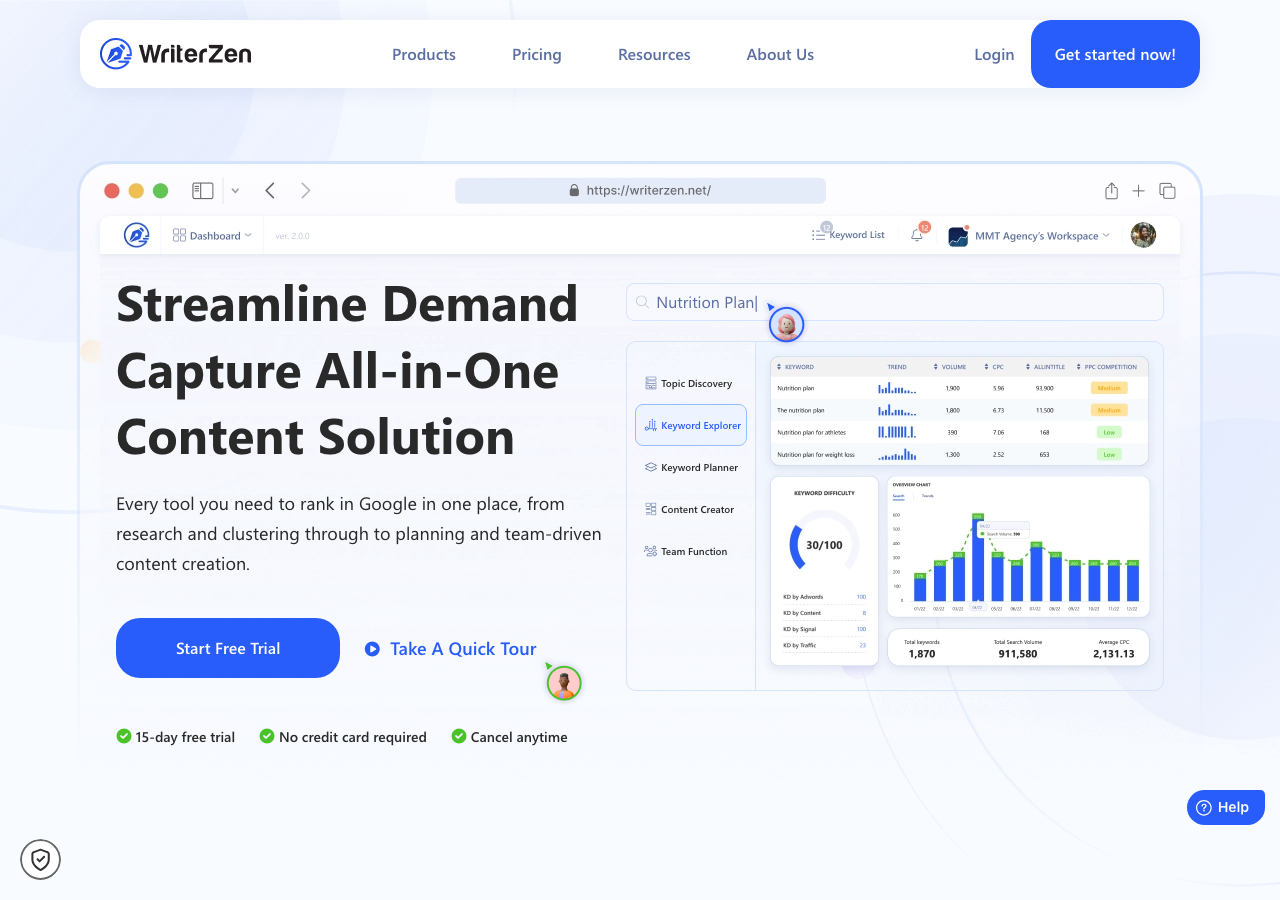
WriterZen’s roots show in every screen: search volume, keyword difficulty, cluster diagrams. Strip the marketing metrics mentally and the clusters become ‘related concepts I should address in my sociology paper on housing policy.’ That reframing unlocks student value.
At $23/month it sits mid-pack — above Texta.ai and Copymatic in price, below WordHero. Rank #23 aligns with essay fit 6.8: helpful for planning-heavy expository work, awkward for close-reading essays with assigned texts.
WriterZen workflow classically runs Keyword Explorer → Topic Cluster → AI Writer. Students swap ‘keyword’ for ‘assignment theme’ and ‘cluster’ for ‘required subtopics.’ The AI Writer then produces blog-shaped sections per cluster node — rename nodes to rubric headers before expanding.
Essay fit 6.8 rewards the research front half: seeing gaps in your coverage before drafting reduces off-prompt papers. Generated prose quality is average among $20 tools — edit heavily.
Rank #23 reflects neither top nor bottom — WriterZen is easy to overlook between louder brands. Integration with Google Docs and Word helps export; LMS footnote formatting still manual.
International students may find keyword tools English-centric — topic suggestions miss region-specific policy names unless you seed local terms manually.
WriterZen’s content calendar and publishing queue features clutter the UI for pure essay use — hide panels you do not need to reduce mis-clicks into SEO workflows.
AI model selection, when exposed, defaults to fast drafts — slower modes may produce slightly tighter argument chains worth the wait on capstone sections.
WriterZen’s strength is making invisible research gaps visible before you write — a cluster map showing you forgot ‘housing policy enforcement’ or ‘tenant organizing’ is worth more than five hundred words of AI prose about ‘urban challenges’ in the abstract. Students who skip the cluster step and jump straight to AI Writer inherit the tool’s SEO instincts without its planning payoff.
The product assumes you are comfortable translating marketing vocabulary into academic vocabulary — ‘content brief,’ ‘pillar page,’ and ‘keyword intent’ appear throughout. Reframing those labels as ‘thesis spine,’ ‘major section,’ and ‘what the rubric asks’ is a mental habit WriterZen does not teach; you must supply it.
WriterZen competes for attention with free mind-mapping apps and library research guides. Its advantage is tight coupling between map nodes and draft expansion; its disadvantage is monthly cost for features you might replicate with a whiteboard plus ChatGPT if you already pay for that elsewhere.
Policy analysis and comparative politics papers benefit disproportionately from cluster planning — seeing that you omitted enforcement mechanisms or regional case studies before drafting saves revision hours. Literary close-reading assignments gain little from keyword clustering unless you reframe nodes as thematic lenses tied to assigned passages.
WriterZen's export to Google Docs sometimes strips heading hierarchy your LMS expects — rebuild section titles manually after paste and match your handbook's capitalization rules before submission.
Drafting workflows that work
Before AI Writer, build a cluster from three seed terms taken from your syllabus learning objectives — not from Google search popularity.
Assign one peer-reviewed source per cluster node before expansion — blank nodes produce hollow paragraphs.
Use the plagiarism checker bundled in some plans on your final human-edited doc, not on raw AI output you plan to rewrite anyway.
Disable SEO suggestions like ‘add FAQ section’ unless your assignment is literally Q&A format.
Export cluster maps as PDF for process portfolios some capstone courses require — shows planning even when prose is human-final.
When WriterZen suggests competitor keywords, translate to ‘concepts my professor mentioned’ — discard pure search-volume noise.
Export your cluster diagram as PDF before expanding nodes — professors who allow AI for planning may ask to see outline evolution. The diagram proves you chose subtopics; it does not prove expanded paragraphs are policy-compliant without separate disclosure.
When a cluster node generates thin prose, delete the node and split it into two narrower nodes rather than regenerating the same vague header — WriterZen rewards specificity at the map layer more than at the regeneration button.
Capstone students writing literature reviews should map authors and debates as cluster nodes, not themes alone — theme-only clusters produce theme-level AI paragraphs without the citation density graduate rubrics require.
Turnitin, detectors, and campus policy
Cluster-driven AI text still patterns as generated — planning human, prose machine. Disclosure policies apply to expanded sections regardless of your mind-map authorship.
WriterZen’s plagiarism tool uses different indexes than Turnitin — clean here, flagged there remains possible.
Topic research logs do not prove you read sources — oral defense or reflection prompts expose shallow use.
Shared keyword projects in class Discords duplicate cluster structures — collusion risk.
WriterZen plagiarism matches may highlight common phrases from textbook glossaries — human judgment distinguishes legitimate shared terminology from copying.
WriterZen's bundled plagiarism checker gives false comfort — a clean scan there does not predict Turnitin outcomes on the same file. Treat bundled checks as rough self-audit, not as permission to submit lightly edited AI expansions.
Humanities instructors assign close reading precisely because cluster-and-expand workflows produce competent summaries without textual engagement. WriterZen cannot substitute for quoting the passage your prompt names; skipping quotes is an integrity and grading problem separate from AI scores.
Oral defense and conference-style Q&A expose WriterZen users who can explain their cluster map beautifully but cannot defend a claim in paragraph four — planning authorship does not transfer to analysis authorship under most honor codes.
Pricing and tiers
$23/month from writerzen.net — tiered limits on keywords and AI words. Capstone students should confirm cluster and export limits on the plan they choose.
Annual discount vs monthly — calculate against one semester of use.
Cheaper path: library research session free, Moonbeam $15 for outline expansion only — WriterZen wins when you want both in one subscription.
Trial periods may limit cluster exports — confirm you can download your mind-map before paying for a single assignment.
WriterZen’s learning curve exceeds Texta or Copymatic — budget an hour onboarding before deadline week adoption.
Bottom line
WriterZen at 6.8 essay fit helps planners who translate SEO clusters into rubric coverage, then rewrite AI sections with real citations.
Choose LongShot if fact-check marketing matters; Moonbeam if bullets already exist.
Student reviews note strong mind-maps, mediocre paragraphs — expect to write, not just export.
WriterZen rewards majors with research-heavy survey courses — less payoff in creative writing workshops grading voice over coverage.
Rank #23 with 6.8 essay fit: solid planner, average generator — buy for clusters, not for prose magic.
Pros
- topic clustering mirrors assignment planning for expository papers.
- combines research visualization with drafting — fewer tab switches.
- bundled plagiarism scan useful on final drafts.
Cons
- SEO UI noise distracts from academic framing.
- generated prose middling — heavy edit required.
- $23/month without top-tier essay fit vs Moonbeam value.
- weak for assigned-text literary analysis tasks.
Pricing
- Listed from $23/mo for WriterZen — annual billing and student promos change the total.
- Category: Essay generator. Features and pricing change; verify before you subscribe.
What this tool does
Essay generator — Topic research + AI writing suite. Feature sets and export limits change; confirm on writerzen.net before subscribing. For raw chat drafting, see our AI engines list instead.
Compare alternatives
Who it's for
- topic clustering mirrors assignment planning for expository papers.
- combines research visualization with drafting — fewer tab switches.
- bundled plagiarism scan useful on final drafts.
Who should compare alternatives
- SEO UI noise distracts from academic framing.
- generated prose middling — heavy edit required.
- $23/month without top-tier essay fit vs Moonbeam value.
- weak for assigned-text literary analysis tasks.
Student experiences
Ratings from students who used WriterZen on real assignments — includes critical reviews.
Loading student reviews…
1,180 words · Updated 2026