
Independent review · 2026
JotBot Review
Jotbot lands at rank #2 with an essay fit score of 8.2/10 and a $20 monthly price tag in our essay-generator category — marketed as an AI essay writer with source finding for students. That combination sounds like a deadline lifesaver, and for brainstorming plus rough structure it often delivers. The honest 2026 caveat: generated citations and ‘found’ sources still need manual verification, and Turnitin’s AI indicator does not care that Jotbot labeled a paragraph original. Use it to accelerate research organization, not to submit untouched machine prose.
myjotbot.com · #2 in TOP 50
Essay generator
AI essay writer + source finder for students
Our verdict
Jotbot lands at rank #2 with an essay fit score of 8.2/10 and a $20 monthly price tag in our essay-generator category — marketed as an AI essay writer with source finding for students. That combination sounds like a deadline lifesaver, and for brainstorming plus rough structure it often delivers. The honest 2026 caveat: generated citations and ‘found’ sources still need manual verification, and Turnitin’s AI indicator does not care that Jotbot labeled a paragraph original. Use it to accelerate research organization, not to submit untouched machine prose.
Overview
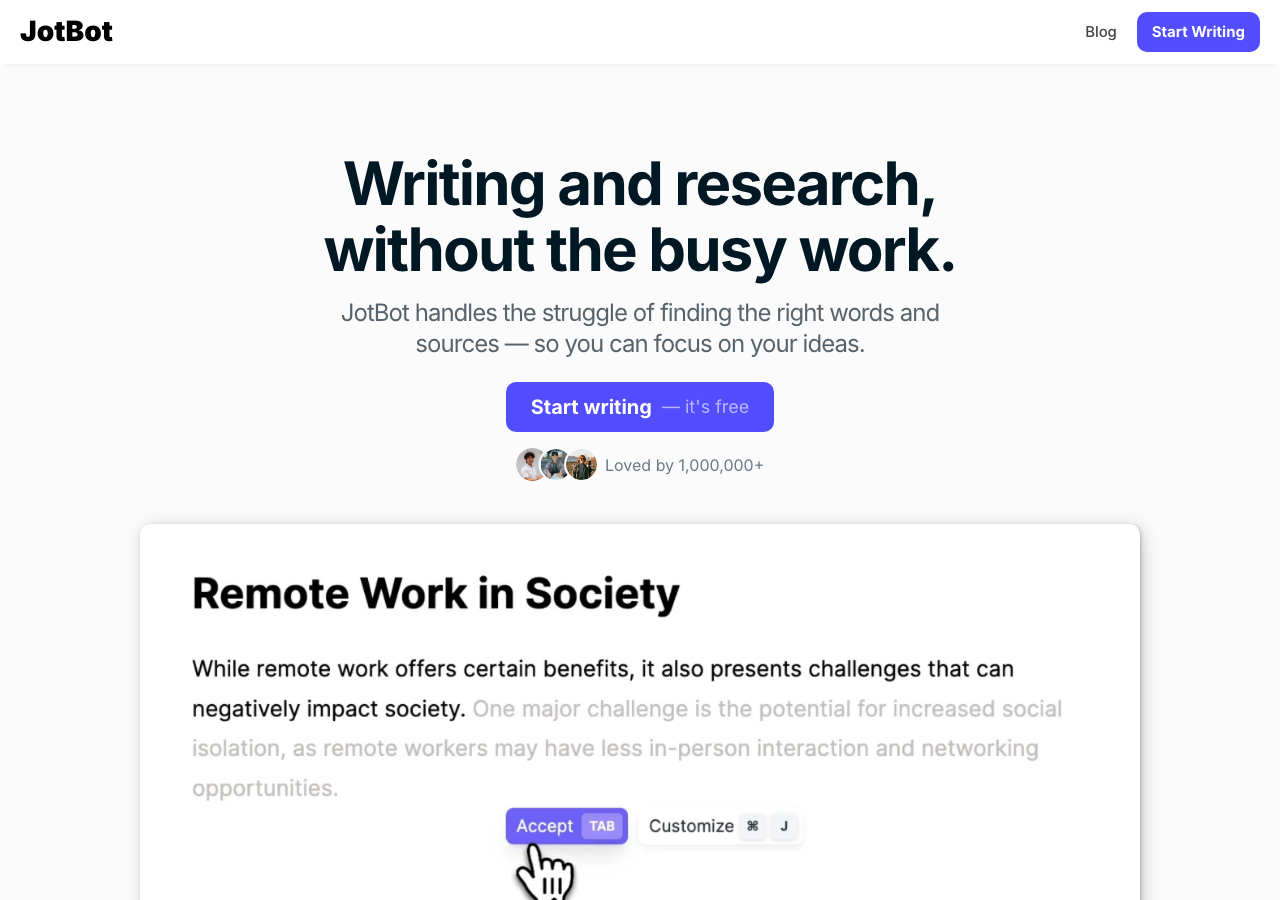
Jotbot targets undergraduates who want a single interface that moves from prompt to outline to draft while surfacing references — closer to a specialized homework assistant than a general chatbot. The product’s pitch — AI essay writer plus source finder — differentiates it from Grammarly-style polish tools and from marketing copy platforms like Jasper. Students report fastest value on compare-contrast prompts and survey-style papers where section headers matter more than archival primary sources.
At $20 per month, Jotbot sits in the same band as ChatGPT Plus, which makes the choice practical: pay for a student-skinned workflow or pay for a frontier model you prompt yourself. Jotbot wins on guided steps; ChatGPT wins on flexibility and community prompt lore. Neither removes campus integrity risk.
Jotbot’s placement in the essay_generator category reflects a product built around long-form student output rather than sentence fixes. The interface typically walks you through topic, length, tone, and citation preferences before producing structured sections — introduction, body blocks, conclusion — with bibliographic lines attached. Essay fit 8.2 acknowledges solid drafting speed and reasonable academic tone when prompts include rubric detail, while penalizing the same hallucination and verification gaps that plague every generator in 2026.
Rank #2 in our list signals strong niche adoption among students who dislike blank-page prompting in general chat UIs. Source finder features aggregate links and reference strings that look citation-ready in preview; experienced researchers know the failure mode — dead URLs, mismatched authors, and journal titles that sound plausible but do not exist. Treat every Jotbot bibliography line as a todo item, not a finished Works Cited entry.
Compared with Writesonic or Aithor, Jotbot leans more explicitly toward homework framing — fewer SEO blog templates, more essay-shaped defaults. Compared with Samwell or Paperpal in the academic category, it is less specialized for journal formatting and discipline-specific phrasing, but often faster for a first full draft from a one-line assignment question.
International and ESL students should watch tone uniformity: Jotbot’s default academic voice can read polished in ways that overlap with detector training data. That does not prove cheating, but it raises the same false-positive concerns documented at multiple universities that revised AI detection policies after 2024. Your defense is process transparency, not tool branding.
Essay drafting workflows
Start by pasting the full assignment prompt and rubric criteria into Jotbot before generating anything — section weighting for ‘analysis’ versus ‘summary’ changes output quality dramatically. Ask for an outline only on the first pass; read it against the rubric and fix missing requirements manually. Second pass: generate one body section at a time so you can insert your own examples, course readings, and lecture concepts between machine paragraphs.
When source finder returns references, open each in a new tab before merging text. Replace any source you cannot access with one you found in your library database. Paraphrase key quotes yourself after reading the PDF — Jotbot summaries of abstracts are starting points, not substitutes for engagement with the paper. For STEM lab reports, specify data you collected; otherwise the model invents plausible but fictional numbers.
Rewrite introductions and conclusions in your voice after the body stabilizes — detectors and instructors both overweight those sections for generic AI phrasing. Strip transition phrases that repeat across every Jotbot essay (‘In today’s world,’ ‘It is important to note’). Add one imperfect sentence or course-specific aside professors expect from someone who attended class.
Export to Google Docs early and edit there for a week if possible — sudden overnight word-count jumps trigger integrity questions even when detectors stay quiet. Version history showing incremental human edits supports appeals if Turnitin flags AI probability later.
Turnitin, detectors, and campus policy
Submitting a Jotbot draft without substantial revision is high risk in 2026. Turnitin’s AI writing score is explicitly probabilistic; institutions from Michigan State to various Australian universities warn against treating it as sole evidence — yet students still face meetings when scores spike. Jotbot does not grant immunity, and ‘undetectable’ claims elsewhere in the market are not credible guarantees.
Source finder output can create a second integrity problem: citations that look real but are wrong. Misattributed quotes are misconduct independent of AI detection. Professors who spot-check one reference and find a mismatch may escalate beyond a rewrite request. Verify authors, years, and page numbers manually — same rule as ChatGPT bibliographies.
If your syllabus bans generative AI entirely, Jotbot is out of bounds for compositional use — full stop. If policy allows AI for brainstorming only, keep Jotbot output in a separate notes file and retype arguments in your own words. Screenshots of that separation help in appeals, though policies vary by department even within one university.
Group work: sharing Jotbot prompts can produce structurally identical essays across classmates — a plagiarism pattern detectors may miss but instructors recognize. Edit independently; do not merge the same exported file with find-replace names.
Pricing and tiers
At roughly $20 per month, Jotbot competes directly with ChatGPT Plus and Claude Pro — budget one subscription at a time unless you have a specific workflow reason for two. Trial windows and annual discounts appear periodically; students finishing one term paper may subscribe for thirty days and cancel if billing reminders are set.
Hidden costs include verification hours: plan ninety minutes per paper to validate sources and rewrite voice, not just generation minutes. Free tiers, if offered, usually cap word count or source depth during finals week when you need them most — read limits before relying on Jotbot for a capstone.
Against Writesonic near $16, Jotbot’s student positioning and source finder may justify the premium if those features save you tab-switching. Against Aithor near $14, Jotbot typically trades lower ‘stealth’ marketing for more mainstream academic templates — Aithor’s undetectable angle is a red flag under honor codes, not a feature.
Institutional payment methods vary; confirm whether subscription charges appear as recurring on cards with low limits — a practical issue for international students using prepaid debit.
Bottom line
Jotbot at rank #2 and essay fit 8.2 is a strong essay generator for students who will rewrite, verify, and own the argument — not for one-click submission.
Treat source finder as a discovery hint, not a bibliography. Compare ChatGPT Plus if you want one tool for non-essay tasks too; compare Paperpal if journal-grade academic phrasing matters more than speed.
Student ratings below reflect real friction: fast drafts, slow integrity anxiety, and the occasional citation that falls apart under professor spot-checks.
Pros
- guided essay structure plus source suggestions reduce blank-page time for standard undergrad prompts.
- essay fit 8.2 reflects usable academic tone when rubrics are pasted into prompts.
- all-in-one flow beats juggling a chatbot plus separate citation tabs for survey papers.
Cons
- citations and links require manual verification — hallucinations still happen.
- default prose can read generic; Turnitin AI scores may rise on unedited exports.
- $20/month overlaps with general-purpose engines that offer broader non-essay tools.
Pricing
- Listed from $20/mo for JotBot — annual billing and student promos change the total.
- Category: Essay generator. Features and pricing change; verify before you subscribe.
What this tool does
Essay generator — AI essay writer + source finder for students. Feature sets and export limits change; confirm on myjotbot.com before subscribing. For raw chat drafting, see our AI engines list instead.
Compare alternatives
Who it's for
- guided essay structure plus source suggestions reduce blank-page time for standard undergrad prompts.
- essay fit 8.2 reflects usable academic tone when rubrics are pasted into prompts.
- all-in-one flow beats juggling a chatbot plus separate citation tabs for survey papers.
Who should compare alternatives
- citations and links require manual verification — hallucinations still happen.
- default prose can read generic; Turnitin AI scores may rise on unedited exports.
- $20/month overlaps with general-purpose engines that offer broader non-essay tools.
Student experiences
Ratings from students who used JotBot on real assignments — includes critical reviews.
Loading student reviews…
1,227 words · Updated 2026