
Independent review · 2026
The Good AI Review
The Good AI holds rank #43 at essay fit 6.8/10 with a $6 entry tier — one of the cheapest structured essay generators in our TOP 50. the-good-ai.com promises free-tier drafts with fill-in-the-blank essay shapes: intro, body, conclusion boxes that beginners find less intimidating than a blank chat prompt. Quality matches the price band: workable for brainstorming and panic outlines, thin for upper-division courses expecting sourced argumentation. It is not invisible to Turnitin, and the name’s optimism does not upgrade campus policy.
the-good-ai.com · #43 in TOP 50
Essay generator
Free-tier structured essay generator
Our verdict
The Good AI holds rank #43 at essay fit 6.8/10 with a $6 entry tier — one of the cheapest structured essay generators in our TOP 50. the-good-ai.com promises free-tier drafts with fill-in-the-blank essay shapes: intro, body, conclusion boxes that beginners find less intimidating than a blank chat prompt. Quality matches the price band: workable for brainstorming and panic outlines, thin for upper-division courses expecting sourced argumentation. It is not invisible to Turnitin, and the name’s optimism does not upgrade campus policy.
Overview
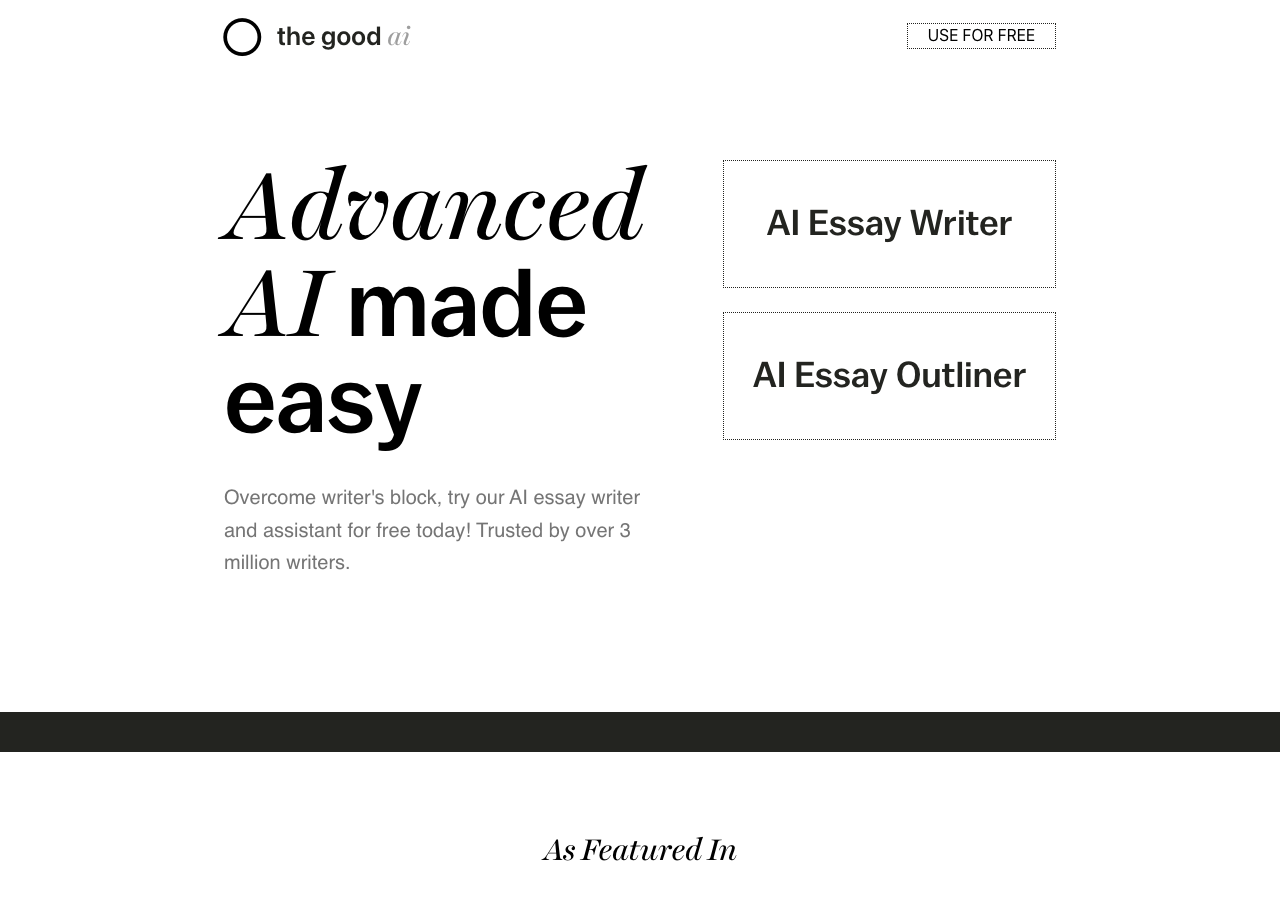
The Good AI competes with PaperTyper, EssayGenius, and Cramly’s generator modes for students who want instant structure without learning prompt engineering. The UI emphasizes essay type selectors — argumentative, descriptive, narrative — that map to school assignment genres more cleanly than raw ChatGPT.
Reddit and TikTok discovery drive traffic; retention depends on whether users realize exported essays need heavy revision, manual citations, and voice editing. Free-tier caps mean many students hit paywalls mid-deadline unless they upgrade to the roughly six-dollar monthly plan.
The Good AI’s product identity is accessibility over depth. You choose essay type, paste a topic sentence or prompt, set approximate length, and receive block paragraphs with predictable transitions (‘Furthermore,’ ‘In conclusion’). That predictability helps anxious writers see shape; it also produces professor-deja-vu intros across a lecture hall using the same tool.
Essay fit 6.8 reflects honest middle-tier generator performance — better organized than zero-cost spammy essay mills, less capable than PaperGen on research papers or Outwrite on clarity editing. Upper-level seminars expecting historiography or primary source engagement will find outputs generic within two paragraphs.
The structured generator lane assumes you will edit. Students who treat output as final copy inherit factual vagueness — essays about climate policy that name no treaty, literary analysis that quotes no passage. The tool accelerates zero-to-something; it does not accelerate zero-to-A without your labor.
Mobile-friendly layouts matter for commuters drafting between classes; however, serious citation work still belongs on a laptop with library tabs open.
Seasonal traffic spikes around November and April finals — when servers slow, students re-run the same prompt and get eerily similar paragraphs to classmates who panicked on the same night. Planning a drafting day before export caps hit beats refreshing the generator at 3 a.m.
Generator workflows that do not backfire
Start with outline-only generation if the UI offers section toggles; otherwise prompt for bullet thesis and three supporting claims before asking for prose. Feed course-specific keywords from your syllabus — theorist names, case study regions, lab concepts — so paragraphs anchor to class content instead of Wikipedia-generalities.
Use The Good AI for narrative or descriptive assignments where rubrics reward clear organization over citation density. Argumentative essays still need you to insert real sources manually; the generator will not reliably produce verifiable references.
After export, run a reverse outline: highlight each paragraph’s claim in the margin. If two body paragraphs make the same point with different adjectives, merge them and add evidence you find yourself. That step converts template output into arguable writing.
Pair with your own voice pass: shorten sentences, inject idioms you actually use in discussion posts, and break perfect parallel structure. Stylistic uniformity triggers AI heuristics and TA suspicion alike.
For compare-and-contrast assignments, generate side A and side B outlines separately with different seed details from your notes — single-prompt compare essays often fake balance by repeating symmetric platitudes. Professors want asymmetry: one side argued harder because your thesis leans.
Turnitin, free tiers, and academic honesty
Free-tier generators carry the same integrity weight as paid ones. Submitting unedited Good AI prose violates most AI disclosure rules and many outright bans. Turnitin’s AI indicator may or may not trigger; policy violations do not require a score — submitting work you did not meaningfully craft is enough.
Budget tools attract students in financial stress; integrity offices report that desperation does not mitigate plagiarism findings, though some instructors offer revision paths for first offenses. The ethical path is using generated text as private brainstorming, not printable final copy.
Group chats sharing Good AI prompts create duplicate essay skeletons. Change outline order and swap examples even when you used the same generator legitimately for ideation.
If your campus permits AI brainstorming, save screenshots or notes of your edits showing transformation — not because detectors demand it, but because process questions happen.
High school AP and first-year college instructors increasingly run in-class drafting checkpoints — thesis due week two, outline week three — specifically to prevent single-session generator submissions. The Good AI cannot bypass a pedagogy that grades milestones, only the final doc.
Pricing and tiers
From $6/month with a limited free tier, The Good AI undercuts most paid competitors except PaperTyper’s ad-supported model. Export limits, word caps, and slower generation on free plans push deadline users toward micro-subscriptions — viable for one essay, wasteful if you forget to cancel.
Annual plans may exist at modest discounts; verify current pricing on the-good-ai.com — student promos change seasonally.
Compare PaperTyper when you need zero-dollar grammar extras; compare Cramly when homework Q&A matters as much as essays; compare PaperGen when citations and section logic dominate the rubric.
Export formats vary — confirm your LMS accepts pasted rich text without breaking MLA headers you add later.
Bottom line
The Good AI at essay fit 6.8 is a budget brainstorming generator — rank #43, not a cheat code. It helps you see essay shape cheaply; it does not replace reading, sources, or your voice.
Skip for thesis-heavy research papers; consider for low-stakes practice drafts you will rewrite entirely.
Student experiences below reflect that split — relief at structure, frustration at depth and detector anxiety after paste-submit mistakes.
If you graduate from The Good AI to heavier research courses, plan to outgrow it — the tool is a training wheel, not a four-year writing stack.
Pros
- low cost and simple essay-type UI for beginners.
- structured outputs beat blank-page paralysis for short assignments.
- fast enough for outline rescue the night before drafting day.
Cons
- generic arguments and missing real citations on research tasks.
- recognizable template transitions under instructor scrutiny.
- free tier limits can block mid-assignment exports.
Pricing
- Listed from $6/mo for The Good AI — annual billing and student promos change the total.
- Category: Essay generator. Features and pricing change; verify before you subscribe.
What this tool does
Essay generator — Free-tier structured essay generator. Feature sets and export limits change; confirm on the-good-ai.com before subscribing. For raw chat drafting, see our AI engines list instead.
Compare alternatives
Who it's for
- low cost and simple essay-type UI for beginners.
- structured outputs beat blank-page paralysis for short assignments.
- fast enough for outline rescue the night before drafting day.
Who should compare alternatives
- generic arguments and missing real citations on research tasks.
- recognizable template transitions under instructor scrutiny.
- free tier limits can block mid-assignment exports.
Student experiences
Ratings from students who used The Good AI on real assignments — includes critical reviews.
Loading student reviews…
1,000 words · Updated 2026