
Independent review · 2026
Textero.ai Review
Textero.ai lands at #11 with an essay fit of 8.1/10 because it targets the student workflow end to end — topic prompts, sourced paragraphs, and summary helpers — at roughly $20/month. It is stronger than generic one-click generators when you need a literature-style scaffold, but weaker than dedicated research assistants when citations must survive a librarian’s spot check. Reddit threads from 2025–2026 describe usable first drafts for compare-and-contrast papers; they also describe bibliography lines that look real until you search the journal title. Treat Textero as accelerated outlining with optional references, not as proof that a source exists.
textero.io · #11 in TOP 50
Essay generator
Student essays with sources & summaries
Our verdict
Textero.ai lands at #11 with an essay fit of 8.1/10 because it targets the student workflow end to end — topic prompts, sourced paragraphs, and summary helpers — at roughly $20/month. It is stronger than generic one-click generators when you need a literature-style scaffold, but weaker than dedicated research assistants when citations must survive a librarian’s spot check. Reddit threads from 2025–2026 describe usable first drafts for compare-and-contrast papers; they also describe bibliography lines that look real until you search the journal title. Treat Textero as accelerated outlining with optional references, not as proof that a source exists.
Overview
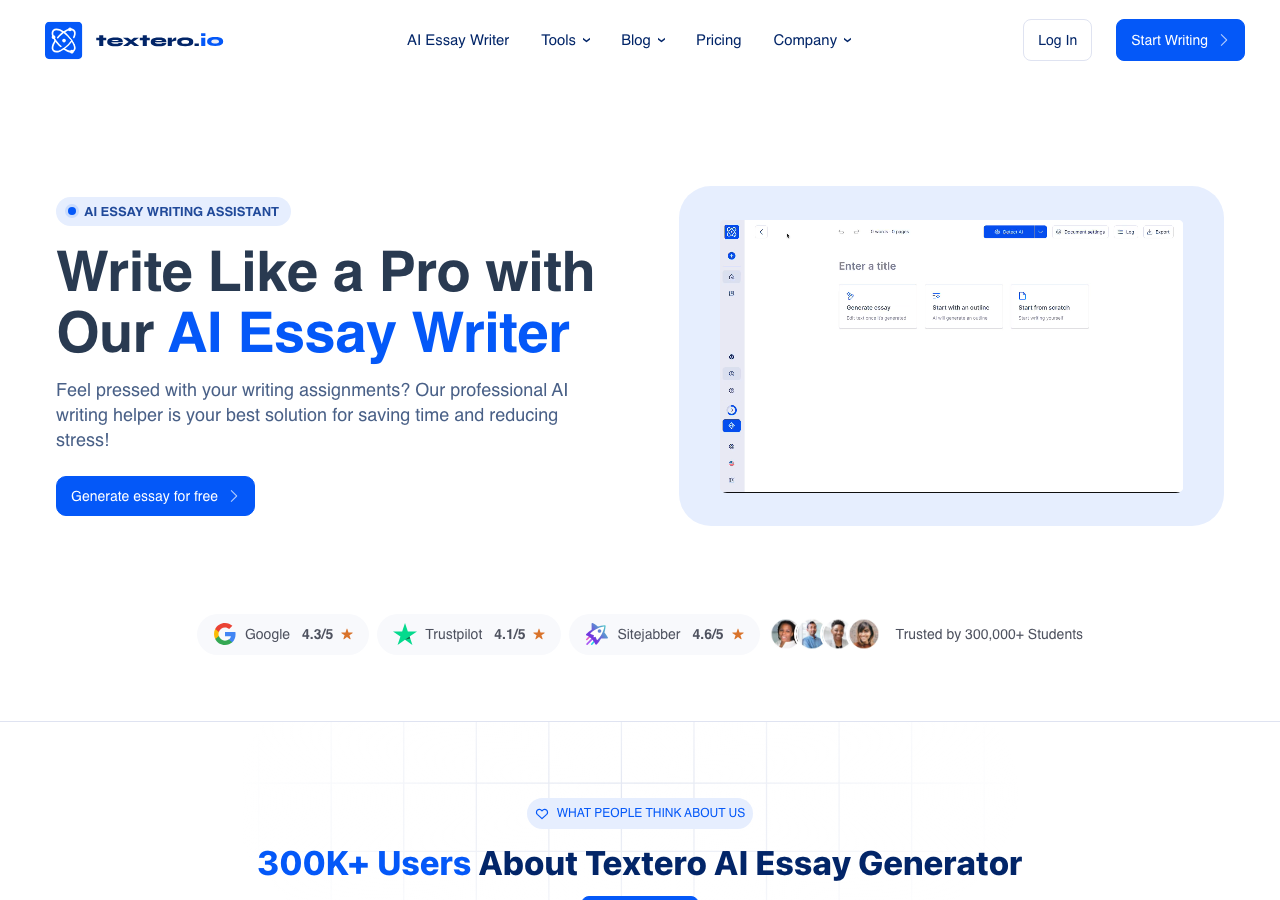
Textero markets itself squarely at coursework: enter a topic, pick length and tone, and receive structured sections with suggested readings. That positioning matters because many budget generators still optimize for blog posts. For undergraduates facing a Tuesday deadline, the appeal is speed plus the illusion of research — headings, intro hooks, and a references block that mirrors APA shape even when the underlying retrieval is thin.
The honest student use case is hybrid drafting. Start from lecture notes or a professor’s prompt list, let Textero expand bullet claims into paragraphs, then spend an hour replacing weak sources and rewriting transitions. Skipping that hour is how polished AI prose meets Turnitin scrutiny without earning the grade you assumed the tool guaranteed.
Textero occupies a crowded middle tier of AI essay tools — more specialized than Rytr, less citation-native than Jenni or Samwell, priced similarly to JotBot. Its interface emphasizes student essay types: argumentative, analytical, summary-and-response. Marketing screenshots show source lists beside generated text, which sets expectations higher than a blank ChatGPT window. Delivery often matches for surface structure; depth varies by discipline.
STEM and business topics tend to produce coherent section flow because training data is dense. Niche humanities prompts — local history, non-English primary texts — can yield confident generalities without usable footnotes. International students report Textero helps bridge vocabulary gaps when rewriting their own notes, but formal tone can read uniformly ‘tool polished’ if they accept defaults without voice edits.
Compared with QuillBot or Wordtune, Textero generates rather than rewrites; compared with StudyTexter’s fixed-price full paper model, it stays subscription-based and leaves assembly to you. Compared with free ChatGPT, Textero packages templates and export formatting that save ten minutes per assignment — worthwhile only if you actually verify sources during those minutes.
Essay fit 8.1 reflects real utility for structured short and medium papers, not automatic A-range quality. Rank #11 in our list tracks affiliate-adjacent traffic and student search volume, not a claim that Textero outwrites Paperpal on grammar or EssayGrader on feedback loops.
Sourced drafting workflows
Students who report good outcomes treat Textero’s source panel as a reading list draft, not a bibliography. Generate an outline first, scan suggested titles in Google Scholar, keep two sources you can quote directly, and discard the rest before expanding paragraphs. Prompt with course vocabulary — names from slides, textbook chapter titles — to reduce generic filler.
Summary mode fits weekly reading responses better than capstone chapters. Paste your annotated PDF notes, ask for a thematic summary under a word cap, then manually insert page citations from the physical text. Textero’s strength is compressing ideas you already possess; weakness is inventing page numbers for books it never opened.
For group projects, one teammate generating a Textero skeleton while others split verified research reduces identical phrasing risk. Everyone should rewrite their section independently — shared AI intros are easy for instructors to spot even when detectors stay quiet.
Export to Word or Google Docs early and track changes as you edit. When appeals require process evidence, a messy revision history outweighs a pristine AI first pass.
Turnitin, detectors, and campus policy
Turnitin’s AI writing indicator remains probabilistic in 2026; Vanderbilt-style guidance still warns against treating percentages as sole misconduct proof. Textero output triggers the same category risks as other generators: uniform paragraph length, stock transitions (‘Furthermore,’ ‘In conclusion’), and citation blocks disconnected from in-text use.
Australian and UK universities that limited detector reliance after false-positive waves illustrate the dual risk — you might face scrutiny whether or not you used AI, but pasted Textero paragraphs without revision increase stylistic tells professors recognize from office hours.
Detector evasion is not a product feature worth trusting. Humanize toggles do not convert unverified claims into ethical submissions. If your syllabus bans generative AI except for grammar, Textero’s full-essay mode is out of scope even when the text ‘passes’ GPTZero on a good day.
Document your workflow: dated outlines in your own words, library database timestamps, and tutoring receipts. That defense helps ESL students flagged for ‘too clean’ prose whether the cleanliness came from Textero or from years of IELTS prep.
Pricing and tiers
Textero’s listed entry near $20/month sits beside JotBot, HyperWrite Premium, and a month of ChatGPT Plus. Free trials and word caps rotate — confirm current limits on textero.io before budgeting a semester. Annual plans may discount monthly cost; cancel reminders matter for four-week crunch subscriptions.
Hidden cost is verification time: budget forty-five to ninety minutes per research-heavy paper to validate sources and align citation style with your handbook. A tool that saves two hours drafting but costs three hours on bibliography repair is negative value.
Students comparing budget options should weigh Rytr at $9 for shorter pieces or Samwell at $15 when citations are central. Textero wins when you want student-essay templates plus source suggestions in one UI, not when you need journal-grade reference accuracy.
Word-count targets in Textero forms sometimes overshoot assignment caps — set internal limits below the syllabus maximum to avoid trim marathons.
Bottom line
Textero earns essay fit 8.1 and list rank #11 by packaging student drafting and light sourcing at a familiar price point. It is a workable co-pilot for outlines and expansion when you supply judgment and real references.
Skip treating it as submit-ready research writing. Pair with manual Scholar searches, course office hours, and revision passes that leave visible human fingerprints on the argument.
Read student experiences below — averages reflect mixed citation wins and integrity scares, not marketing-perfect demos.
Pros
- student-essay templates with section scaffolding beat blank chat prompts for timed assignments.
- source and summary features orient workflows toward research-shaped output, not pure fluff.
- mid-tier pricing without per-paper surge fees unlike some fixed-quote academic shops.
Cons
- suggested sources demand manual verification — hallucinated metadata still appears in 2026 tests.
- default prose can feel homogeneous across users in the same course.
- not a grammar-first editor; pair with Grammarly or Paperpal for final polish.
Pricing
- Listed from $20/mo for Textero.ai — annual billing and student promos change the total.
- Category: Essay generator. Features and pricing change; verify before you subscribe.
What this tool does
Essay generator — Student essays with sources & summaries. Feature sets and export limits change; confirm on textero.io before subscribing. For raw chat drafting, see our AI engines list instead.
Compare alternatives
Who it's for
- student-essay templates with section scaffolding beat blank chat prompts for timed assignments.
- source and summary features orient workflows toward research-shaped output, not pure fluff.
- mid-tier pricing without per-paper surge fees unlike some fixed-quote academic shops.
Who should compare alternatives
- suggested sources demand manual verification — hallucinated metadata still appears in 2026 tests.
- default prose can feel homogeneous across users in the same course.
- not a grammar-first editor; pair with Grammarly or Paperpal for final polish.
Student experiences
Ratings from students who used Textero.ai on real assignments — includes critical reviews.
Loading student reviews…
1,076 words · Updated 2026