
Independent review · 2026
Rytr Review
Rytr holds #13 with essay fit 7.2/10 as the budget aisle’s dependable short-form generator — roughly $9/month for templated paragraphs when you are not asking for fifteen pages of sourced analysis. It shines on discussion posts, 500-word reflections, and email-to-professor drafts; it strains on upper-division research papers where section depth and citation integrity matter more than word count velocity. Student forums in 2025–2026 praise predictable UI and complain about repetitive phrasing when an entire cohort discovers the same ‘essay paragraph’ use case.
rytr.me · #13 in TOP 50
Essay generator
Budget AI writing for short essays
Our verdict
Rytr holds #13 with essay fit 7.2/10 as the budget aisle’s dependable short-form generator — roughly $9/month for templated paragraphs when you are not asking for fifteen pages of sourced analysis. It shines on discussion posts, 500-word reflections, and email-to-professor drafts; it strains on upper-division research papers where section depth and citation integrity matter more than word count velocity. Student forums in 2025–2026 praise predictable UI and complain about repetitive phrasing when an entire cohort discovers the same ‘essay paragraph’ use case.
Overview
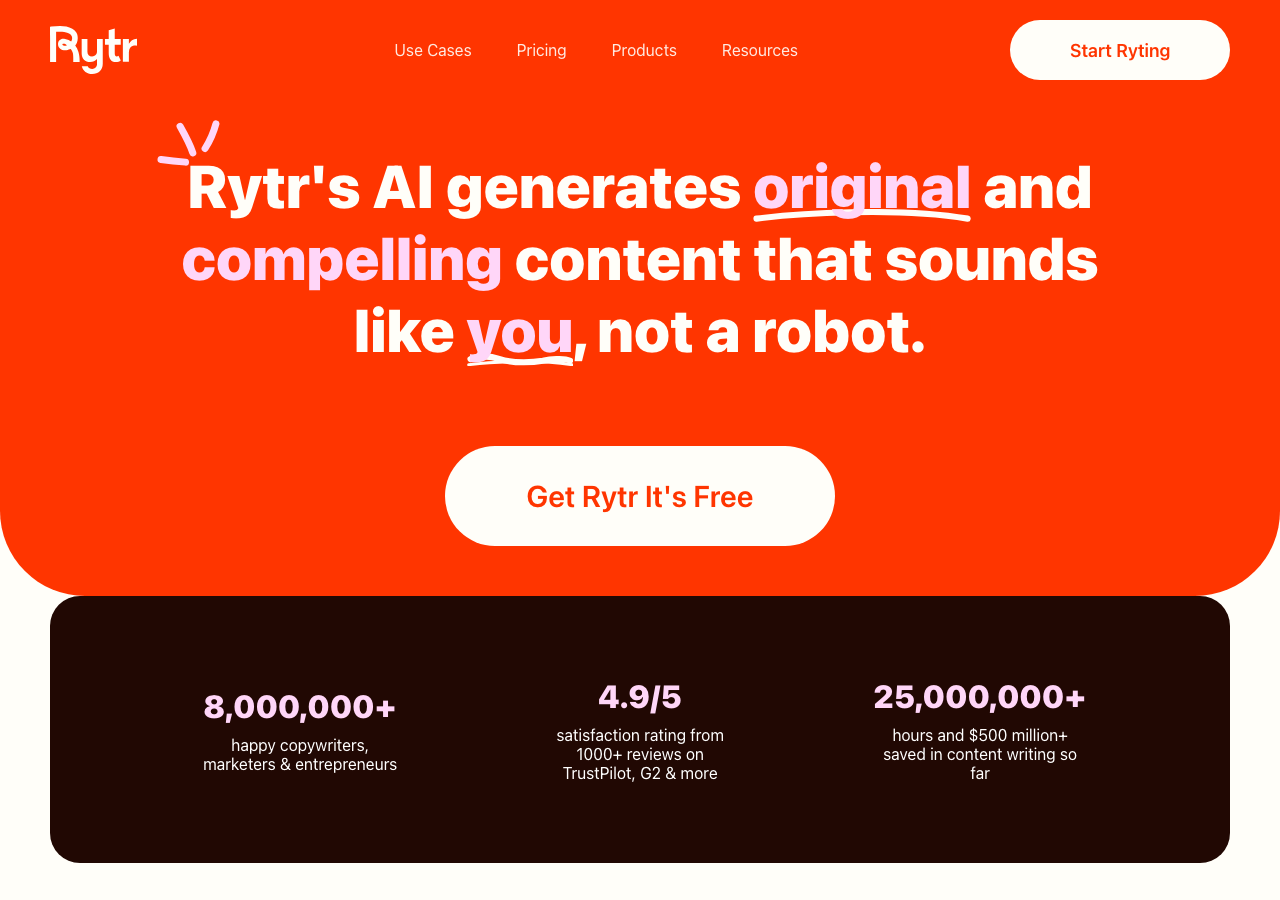
Rytr.me built its audience on marketers and solo creators before student ‘essay’ templates appeared in sidebar lists. That heritage shows: outputs skew crisp and promotional unless you dial tone toward ‘informative’ and cap length aggressively. For cash-tight undergraduates, the price undercuts Jasper, Copy.ai, and most academic specialists while delivering faster stubs than throttled free ChatGPT during finals week.
The trade is ceiling, not floor. Rytr will not crawl your university library proxy or format Chicago footnotes reliably. Success means feeding bullet ideas, accepting a rough paragraph, and rewriting voice before submission — the same integrity discipline costlier tools demand, just with thinner sourcing pretense.
Community college and dual-credit students often face tighter word caps and simpler rubrics — Rytr aligns with that workload until you transfer to research universities expecting sourced argumentation every week.
Rytr’s interface stacks use cases vertically — blog intro, email, social caption, essay outline — with tone and language selectors. Generation is fast, credits generous on paid tiers, and the learning curve shallow enough for mobile sessions between classes. Long-form mode exists but chunks output; stitching sections without redundant intros takes manual effort.
Quality for general education courses often passes the ‘readable first draft’ bar. Philosophy, legal writing, and data-heavy labs expose shallow reasoning quickly. Rytr rarely fabricates elaborate fake journals, but it will state common-knowledge claims as if they were argued — dangerous when your rubric demands named theorists.
Against Wordtune and QuillBot, Rytr creates text rather than refining yours. Against Textero and Samwell, it lacks student-source packaging. Against Notion AI inside your notes, Rytr is a standalone generator without workspace context unless you paste notes manually.
Essay fit 7.2 rewards honest short-assignment utility; rank #13 tracks enduring subscription value at $9, not parity with Paperpal’s academic grammar depth.
Marketing use cases still dominate template labels — scroll past ‘Facebook ad’ presets to find essay-adjacent options and customize tone away from sales voice.
History and philosophy majors report Rytr oversimplifies historiography — acceptable for survey courses, thin for seminars expecting primary source engagement.
Short-essay generation habits
Open with the assignment question copied verbatim in the prompt, add three bullet claims you believe, and request half the target word count first. Rytr’s first pass overshoots adjectives; expanding from a tight core preserves your ideas and cuts cleanup time.
Rotate tone presets between paragraphs — ‘informative’ for body, ‘convincing’ only for conclusion — to reduce template rhythm. Manually vary sentence openers afterward; detectors and instructors both notice identical cadence across three hundred words.
For weekly discussion boards, draft individually then cross-read for duplicate Rytr stock phrases (‘In today’s fast-paced world’). Even when Turnitin stays quiet, TAs recognize synchronized filler across thirty posts.
Pair Rytr with free library databases for any claim needing a citation; the tool will not insert DOIs you can trust without opening the link yourself.
Business majors use Rytr for case summaries when professors allow AI scaffolding — still attach your own exhibit citations from the case PDF, not Rytr’s memory.
Rotate output language settings only when courses permit non-English drafts — misclicking Spanish output on an English rubric wastes regeneration credits.
Turnitin, detectors, and campus policy
Rytr prose triggers the same AI indicator debates as larger models — probabilistic scores, campus policies diversifying after false positives on ESL writers. Budget tools do not mean invisible tools; repetitive template DNA can be easier to spot heuristically than polished GPT-4 paragraphs.
Using Rytr where syllabi ban ‘generative text except grammar’ is a policy violation regardless of detector outcomes. Some honor codes treat paraphrase bots and generators identically; read definitions carefully.
Humanize features marketed on social media do not constitute ethical disclosure to instructors. Revision with your own examples and messy transitions remains the credible defense in 2026 appeals.
Group assignments amplify risk: Rytr’s limited randomness makes near-duplicate paragraphs likely when prompts match.
Mobile drafting on Rytr tempts tap-accept habits — phone screens hide how generic a paragraph reads until you preview on desktop before submit.
Cross-language features help bilingual students draft English discussion posts from native-language bullets; still manually verify discipline terms Rytr transliterates incorrectly.
Pricing and tiers
Unlimited-style plans near $9/month undercut most competitors; annual billing drops effective cost further. Free tiers exist with character caps — enough for micro-tasks, frustrating for end-of-term portfolio weeks.
Compare $9 Rytr plus manual research against $20 Textero with source suggestions: if citations matter, the $11 delta may save more time than Rytr’s sticker price suggests.
Cancel after crunch periods; monthly flexibility is Rytr’s strongest budget argument for students who refuse year-long SaaS lock-in.
Lifetime deal chatter appears on deal forums — read renewal terms; student workloads rarely justify exotic pricing schemes over straightforward monthly cancel.
Bottom line
Rytr’s 7.2 essay fit and #13 rank mark it as a budget short-form tool — credible for small weekly writing, insufficient as a thesis engine.
Invest savings into verification time and voice edits; skip it when the rubric demands peer-reviewed evidence chains.
Student ratings below often mention saved discussion deadlines alongside professor callouts for generic intros — plan for both outcomes.
Upgrade path when Rytr ceilings hit: move long papers to Yomu or Notion AI with your notes, keep Rytr for weekly micro writing only.
Finals week tip: pre-write discussion templates in your own voice, use Rytr only to vary sentence openers — preserves authorship while saving minutes.
Pros
- among the cheapest paid generators that still handles coursework-length paragraphs.
- fast templates for discussion posts, outlines, and short reflections.
- simple UI with low learning overhead during deadline weeks.
Cons
- weak on long research papers and discipline-specific depth.
- repetitive phrasing across users and assignments.
- no trustworthy automated citation pipeline for academic work.
Pricing
- Listed from $9/mo for Rytr — annual billing and student promos change the total.
- Category: Essay generator. Features and pricing change; verify before you subscribe.
What this tool does
Essay generator — Budget AI writing for short essays. Feature sets and export limits change; confirm on rytr.me before subscribing. For raw chat drafting, see our AI engines list instead.
Compare alternatives
Who it's for
- among the cheapest paid generators that still handles coursework-length paragraphs.
- fast templates for discussion posts, outlines, and short reflections.
- simple UI with low learning overhead during deadline weeks.
Who should compare alternatives
- weak on long research papers and discipline-specific depth.
- repetitive phrasing across users and assignments.
- no trustworthy automated citation pipeline for academic work.
Student experiences
Ratings from students who used Rytr on real assignments — includes critical reviews.
Loading student reviews…
1,013 words · Updated 2026