
Independent review · 2026
Jenni AI Review
Jenni AI lands at rank #21 in our 2026 list with an essay fit score of 8.5/10 — one of the stronger academic-focused generators because it tries to anchor sentences to real papers instead of inventing bibliography entries from thin air. At roughly $12 per month, it targets students who want inline citations, autocomplete-style drafting, and a workspace that feels closer to Google Docs than a marketing copy dashboard. That positioning is genuinely useful for literature reviews and argumentative essays where professors expect named sources. It is not a magic submit button: citations still need manual verification, Turnitin still flags pasted AI prose, and the autocomplete habit can produce overconfident claims you did not read.
jenni.ai · #21 in TOP 50
Academic writing
AI essay writer with citations for students
Our verdict
Jenni AI lands at rank #21 in our 2026 list with an essay fit score of 8.5/10 — one of the stronger academic-focused generators because it tries to anchor sentences to real papers instead of inventing bibliography entries from thin air. At roughly $12 per month, it targets students who want inline citations, autocomplete-style drafting, and a workspace that feels closer to Google Docs than a marketing copy dashboard. That positioning is genuinely useful for literature reviews and argumentative essays where professors expect named sources. It is not a magic submit button: citations still need manual verification, Turnitin still flags pasted AI prose, and the autocomplete habit can produce overconfident claims you did not read.
Overview
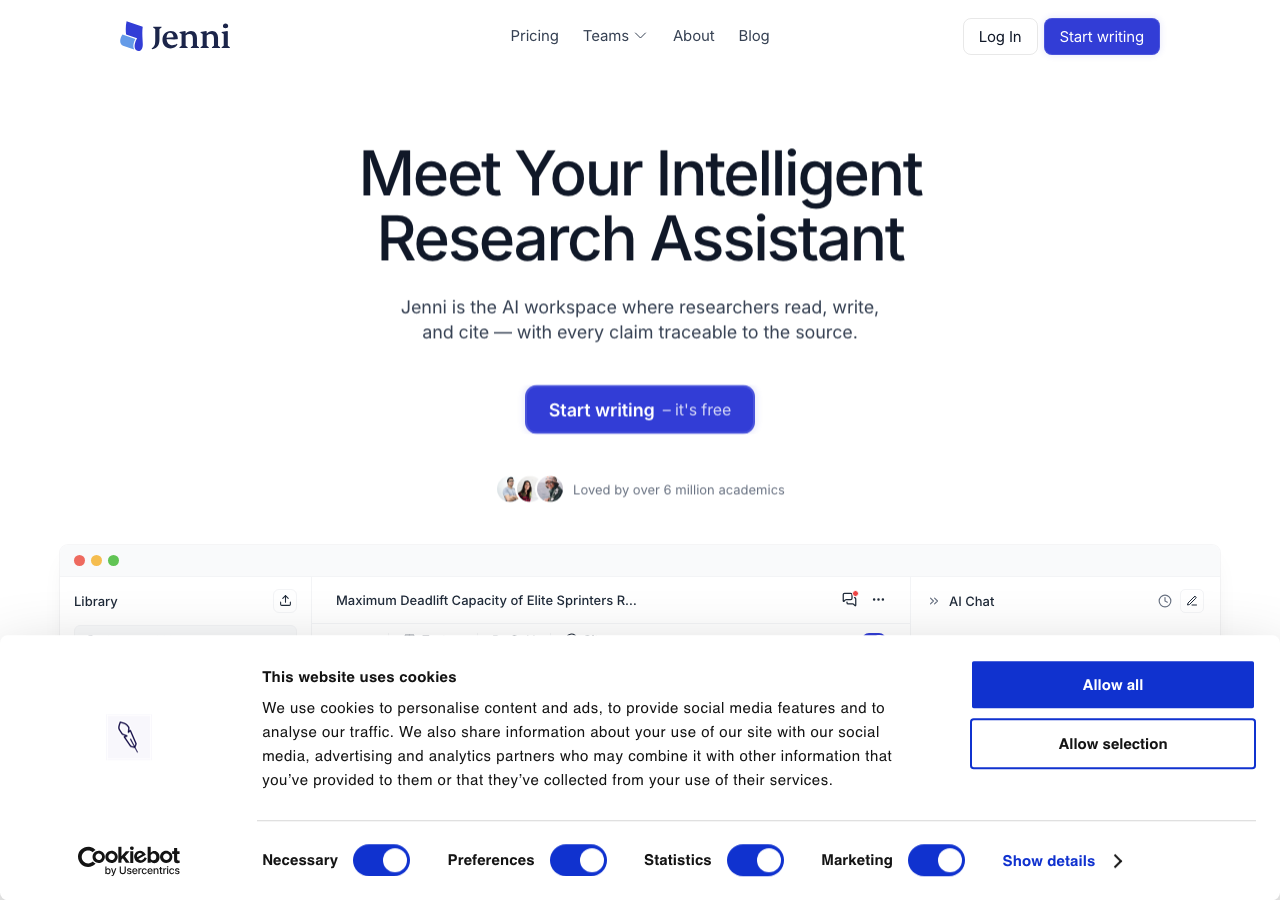
Jenni’s core pitch is writing with citations — you type a claim, the tool suggests continuations and attaches reference-style links drawn from its search layer. For undergraduates drowning in ten-source minimum requirements, that workflow beats blank-page panic. The editor supports PDF uploads, outline modes, and paraphrase helpers that keep tone somewhat academic rather than blog-fluffy. Compared with general chatbots, Jenni reduces the ‘fabricated DOI’ problem but does not eliminate it; always open the linked paper abstract before you cite it in APA.
The honest student read: Jenni shines when you already know your thesis and need help filling gaps with sourced sentences. It struggles when you ask it to write entire papers from a one-line prompt — output reads competent but generic, and integrity offices have seen enough Jenni-shaped intros to recognize the cadence. Treat it as a research-assisted drafting environment, not outsourced authorship.
Jenni AI occupies the academic category in our catalog because its feature set orbits scholarly writing rather than SEO blog posts. The product grew out of student demand for citation-aware autocomplete — a middle ground between ChatGPT’s free-form paragraphs and Zotero’s reference management without generative text. Essay fit 8.5 reflects that specialization: for coursework requiring named authors and publication years, Jenni’s inline suggestions save time finding ‘someone credible who said X’ compared with pure generators that hallucinate sources.
Rank #21 sits below the grammar and polish giants but above bulk content spinners because citation integrity matters more on campus than word count velocity. The interface feels familiar: left-side document, right-side AI controls, autocomplete triggered as you pause typing. Upload a reading PDF and Jenni can summarize sections — useful for weekly reading responses if you still write the analysis yourself afterward. Weak spots include occasional mismatched citations where the suggested paper discusses a adjacent topic, not your exact claim, and limited control over citation style compared with dedicated reference managers.
International students report mixed value: autocomplete helps ESL writers construct formal sentences, but the default prose can read uniformly polished — a pattern detectors and TAs associate with AI assistance. STEM students use Jenni for introduction and discussion sections while keeping methods and results self-written; humanities majors lean on it for finding secondary sources during outline expansion. Neither workflow is automatically policy-safe; check whether your syllabus permits AI-assisted drafting versus AI-generated text.
Against Paperguide at a similar price point, Jenni emphasizes in-document autocomplete while Paperguide pushes literature review mapping. Against QuillBot, Jenni generates more than it rewrites. Against raw ChatGPT Plus, Jenni wins on citation surfacing but loses on versatility for non-essay tasks like coding help or slide decks.
Citation-aware drafting workflows
A workflow that survives rubrics and integrity conversations starts with your thesis statement typed manually — no autocomplete until the argument is yours. Next, outline section headers yourself, then enable Jenni suggestions paragraph by paragraph, accepting only sentences whose attached sources you open and skim. When a citation looks plausible but wrong, reject it immediately; bad references fail faster than bad grammar during office hours.
For literature reviews, paste your professor’s source minimum into the sidebar notes and ask Jenni to suggest papers per theme — then read abstracts before adding anything to the draft. Do not bulk-accept autocomplete chains; they produce smooth transitions that hide weak logic. For argumentative essays, draft your counterargument section without AI first — Jenni defaults toward confident agreement that can flatten nuance.
PDF upload works best on open-access papers with clean text layers; scanned book chapters OCR unevenly and confuse summaries. Export to Word or Docs and run your own reference formatter — Jenni’s APA and MLA outputs need spot-checking on italics, capitalization, and DOI fields. Pair with Zotero or your library database for final bibliography assembly rather than trusting export alone.
Paraphrase mode inside Jenni helps when you have a quoted passage and need your own words — still compare against the original for meaning drift. If the paraphrase is too close, rewrite manually; plagiarism tools catch lazy paraphrase regardless of which AI produced it.
Turnitin, detectors, and campus policy
Jenni does not market itself as undetectable, which is more honest than humanizer tools promising invisible AI text. That said, autocomplete-heavy drafts can still trigger Turnitin’s AI indicator when students accept long unbroken chains of suggested prose. The 2025–2026 campus landscape treats detector scores as probabilistic — Vanderbilt and Michigan State guidance emphasizes corroborating evidence, while some Australian universities scaled back sole reliance on AI flags after false-positive waves affecting ESL writers.
Citation presence does not equal integrity compliance. A paper with real references but AI-composed analysis still violates many honor codes if you did not author the sentences. Professors who know Jenni’s stylistic tells — balanced intro paragraphs, slightly generic transitions, over-neat topic sentences — may scrutinize drafts even without a high detector score. Document process: keep your outline file, reading notes, and a version history showing which paragraphs you wrote before enabling autocomplete.
Group projects risk convergence when partners use Jenni on the same prompt set — section headers and citation patterns can look suspiciously similar. Edit independently before merging. If flagged, appeals in 2026 lean on dated incremental edits in Google Docs rather than screenshots of Jenni’s interface alone.
Do not assume ‘academic AI’ is exempt from reporting requirements. Many 2026 syllabi require disclosure of any generative assistance beyond spell-check. Ask your writing center where Jenni sits on the allowed spectrum before subscribing for a full semester.
Pricing and tiers
At about $12 per month, Jenni matches Paperguide and undercuts Jasper or Copy.ai plans aimed at marketing teams. Free tier exists with word limits that run out quickly during midterm week — expect upgrade pressure when autocomplete cuts off mid-paragraph. Annual billing may discount the monthly equivalent; calculate whether you need continuous access or a four-week finals sprint.
Student budgets should include a verification hour per paper: opening cited sources, fixing reference formatting, and rewriting generic transitions. That hidden cost applies to any citation-aware tool, not just Jenni. Compare $12 against ChatGPT Plus at $20 — Plus is broader but worse on inline scholarly references without manual prompting.
Cancel before renewal if you only needed one research paper cycle; check whether subscription management lives on jenni.ai or an app store portal. Institutional access is uncommon; do not assume .edu email unlocks a campus license.
Teams or study groups splitting accounts blur authorship and may violate terms of service — know your honor code on collaborative AI before sharing logins.
Bottom line
Jenni AI earns essay fit 8.5 and rank #21 because it addresses a real student pain point — writing with sources — without pretending citations replace thinking. It works best as a supervised drafting aid on arguments you own.
Verify every reference, reject long autocomplete chains, and compare Paperguide for lit-review mapping or Grammarly for final polish if budget allows only one extra tool.
Student experiences below reflect mixed outcomes: strong when paired with careful reading, risky when treated as a one-click paper factory.
Pros
- citation-aware autocomplete reduces fabricated reference risk compared with generic chatbots.
- essay fit 8.5 for sourced argumentative and review-style coursework when you verify every link.
- document workspace and PDF upload fit research-heavy weekly assignments.
Cons
- autocomplete encourages accepting prose you did not fully author — integrity gray zone.
- citation styles and metadata need manual cleanup before submission.
- generic academic cadence can invite stylistic scrutiny from experienced TAs.
Pricing
- Listed from $12/mo for Jenni AI — annual billing and student promos change the total.
- Category: Academic writing. Features and pricing change; verify before you subscribe.
What this tool does
Academic writing — AI essay writer with citations for students. Feature sets and export limits change; confirm on jenni.ai before subscribing. For raw chat drafting, see our AI engines list instead.
Compare alternatives
Who it's for
- citation-aware autocomplete reduces fabricated reference risk compared with generic chatbots.
- essay fit 8.5 for sourced argumentative and review-style coursework when you verify every link.
- document workspace and PDF upload fit research-heavy weekly assignments.
Who should compare alternatives
- autocomplete encourages accepting prose you did not fully author — integrity gray zone.
- citation styles and metadata need manual cleanup before submission.
- generic academic cadence can invite stylistic scrutiny from experienced TAs.
Student experiences
Ratings from students who used Jenni AI on real assignments — includes critical reviews.
Loading student reviews…
1,334 words · Updated 2026