
Independent review · 2026
Frase Review
Frase sits at rank #22 with an essay fit score of 7.8/10 — a long-form content platform built for SEO teams that undergraduates repurpose for research outlines, draft expansion, and keyword-aware structuring. At roughly $15 per month, it bundles SERP research, brief builders, and AI drafting in one dashboard. For students, the honest story is split: Frase excels at turning a topic into a detailed outline with subheadings and talking points, which maps well to essay planning, but the default output skews toward web articles — listicle rhythm, H2 headers, and marketing transitions that professors recognize when pasted unchanged. It is a planning and restructuring tool more than a citation-safe research assistant.
frase.io · #22 in TOP 50
Essay generator
Research, outline, write, optimize long-form
Our verdict
Frase sits at rank #22 with an essay fit score of 7.8/10 — a long-form content platform built for SEO teams that undergraduates repurpose for research outlines, draft expansion, and keyword-aware structuring. At roughly $15 per month, it bundles SERP research, brief builders, and AI drafting in one dashboard. For students, the honest story is split: Frase excels at turning a topic into a detailed outline with subheadings and talking points, which maps well to essay planning, but the default output skews toward web articles — listicle rhythm, H2 headers, and marketing transitions that professors recognize when pasted unchanged. It is a planning and restructuring tool more than a citation-safe research assistant.
Overview
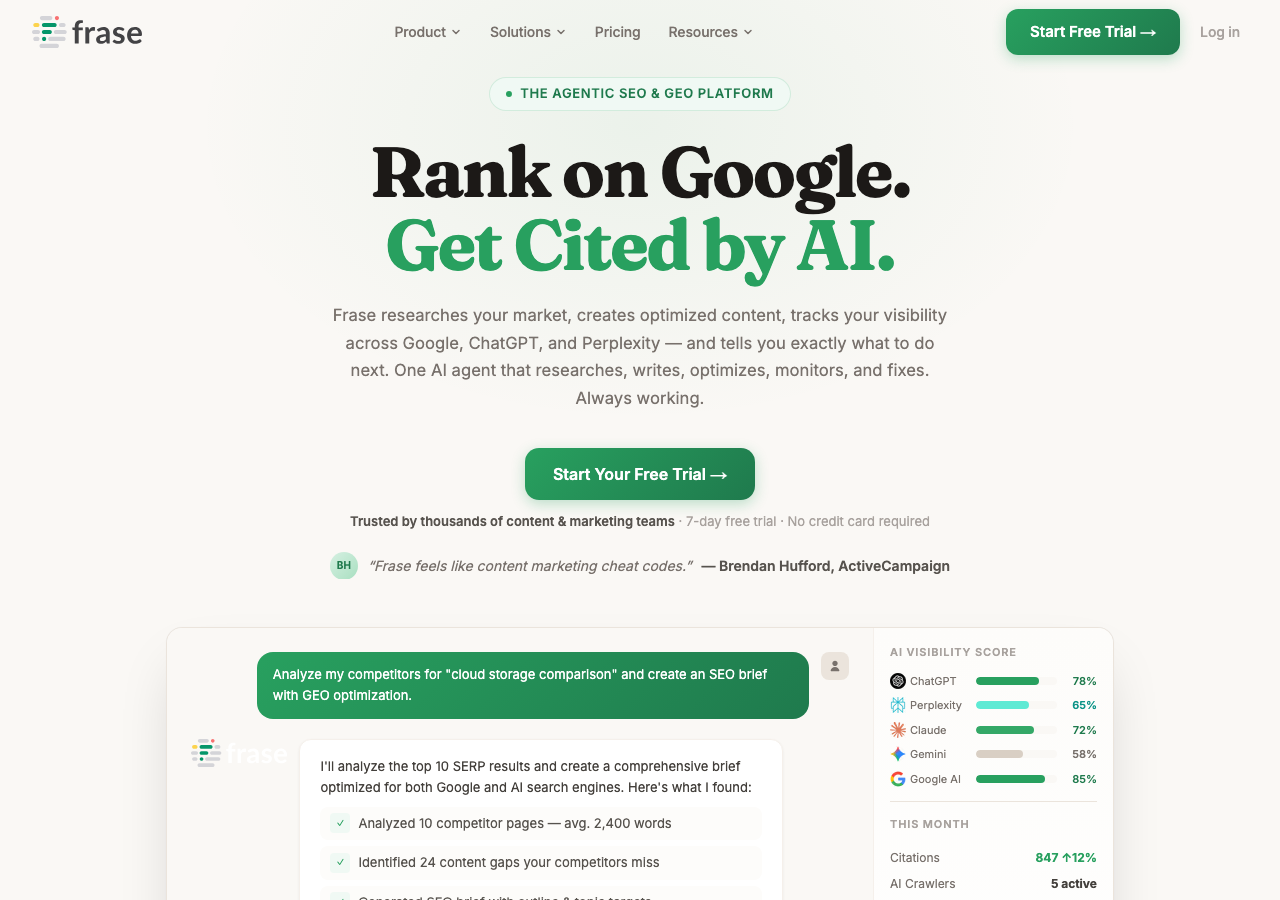
Frase’s workflow starts with a query — your essay topic phrased like a search term — then analyzes top-ranking pages to suggest headings, questions to answer, and word-count targets. That mirrors how some students already research by reading Wikipedia and the first page of Google, but packages it faster. The AI writer fills sections from those briefs; quality is coherent for explanatory essays and weak for thesis-driven arguments requiring primary sources.
Compared with dedicated academic tools like Jenni or Paperguide, Frase does not prioritize scholarly databases or DOI-backed citations. Compared with ChatGPT, it offers more structure out of the box — you get an outline before paragraphs. Essay fit 7.8 reflects solid organizational help with a penalty for SEO-native prose and limited integrity safety when students submit brief-generated drafts verbatim.
Frase belongs to the essay_generator category in our catalog because its primary output is long-form text assembled from research briefs, even though the product’s commercial heart is content marketing. Students discover it through YouTube workflows promising ‘write a 2000-word paper in an hour’ — technically possible, academically risky. Rank #22 places it above pure spinners because the research brief step forces some engagement with what already exists on a topic, which can surface counterarguments and definitional questions worth addressing in intro sections.
The interface separates research, outline, and write panes — useful when your professor wants a proposal before the full draft. You can export briefs as bullet plans and write manually in Google Docs, treating Frase as ideation only; that restrained use aligns better with honor codes than full auto-generation. Essay fit drops when you rely on AI paragraphs without rewriting: Frase favors informational density over nuanced claim-and-evidence architecture expected in upper-division courses.
Humanities students writing explanatory topics — ‘how photosynthesis works,’ ‘overview of Keynesian policy’ — get more mileage than philosophy majors crafting original theses. STEM lab reports still need your data; Frase cannot interpret results tables. Business case write-ups sometimes fit the tool’s strengths if the assignment mimics market analysis memos rather than academic argument.
Against Scalenut at a higher price, Frase competes closely on SEO-style long-form; Scalenut adds cruise-mode automation Frase partially matches. Against Koala at $9, Frase is pricier but stronger on research briefs. Against Notion AI or free ChatGPT with manual outlining, Frase saves time if you value SERP-driven structure — otherwise redundant.
Research and outline workflows
The workflow most likely to survive grading starts in Frase’s research tab: enter your topic, review suggested questions, and export an outline without generating full prose. Manually mark which bullets require peer-reviewed sources versus textbook explanations. Assign yourself readings from the library before returning to Frase to draft only sections where you already have notes — treat AI paragraphs as scaffolding to rewrite, not submission-ready text.
Brief builder mode helps compare how commercial websites frame a topic — useful for rhetorical analysis assignments where you critique public discourse. For standard argumentative essays, flip the brief: ensure your thesis appears in the intro bullet you write yourself, not the AI-suggested H1. Disable or ignore word-count optimization that pads sections with filler — professors notice inflated background paragraphs with no citation.
Optimization features meant for Google rankings — keyword density, entity coverage — have no grade benefit and can distort academic tone. Strip SEO metadata before pasting into LMS text boxes. If your instructor allows AI for brainstorming only, screenshot or PDF the brief as evidence of permitted use scope.
Team accounts tempt group projects to share one brief — risk is homogenous structure across submissions in the same section. Differentiate outlines before any AI drafting; professors compare section headers across classmates more often than students expect.
Turnitin, detectors, and campus policy
Frase output triggers the same detector categories as other GPT-class text when submitted wholesale. The tool does not include humanizer layers or detector scores — honesty by omission. Turnitin’s AI indicator remains contested on campuses; false positives hit clean human writing too, but Frase’s generic long-form cadence — predictable H2 openings, summary sentences starting with ‘In conclusion’ — adds heuristic risk even when scores stay low.
Because Frase pulls from public web content patterns, two students on the same topic can produce structurally similar essays without copying each other — parallel generation, not plagiarism, but still suspicious in small seminars. Cite real sources manually; Frase will not build a bibliography you can trust. Many briefs suggest facts without links to primary research — verify every statistic.
2026 syllabus trends increasingly require AI disclosure. Frase used for outlines only is easier to defend than full-document generation. Keep version history showing manual rewrites after any Frase export. Writing centers report students flagged after using SEO tools for ‘school essay’ prompts marketed on social media — policy literacy matters as much as detector evasion.
Do not confuse organizational help with authorship. An outline assistant can still violate ‘all work must be your own’ clauses if paragraphs are machine-written. Ask before paying $15 monthly if your department publishes AI guidance.
Pricing and tiers
Frase at about $15 per month sits mid-pack — more than Koala or HIX, less than Anyword’s marketing-focused tiers. Plans tier by document limits and seat count; solo students rarely need team features but may hit project caps during concurrent finals. Trial periods help test whether brief quality matches your major — cancel if outlines feel too blog-like for upper-level seminars.
Annual prepay discounts change effective monthly cost; compare against four months of ChatGPT Plus if you already subscribe elsewhere — overlap reduces value. Hidden cost is rewrite time: SEO-native drafts need heavy editing for academic voice, eating hours Frase supposedly saved.
No robust student discount program is guaranteed globally; check frase.io pricing before assuming .edu rates. Free alternatives — manual SERP skimming plus free ChatGPT outlining — replicate much of the workflow with more labor.
Affiliate-heavy YouTube reviews oversell essay use cases; budget for editing, not just subscription sticker price.
Bottom line
Frase earns rank #22 and essay fit 7.8 as a structured brainstorming and outlining aid repackaged from SEO workflows — valuable with discipline, risky as a one-click essay button.
Export briefs, write and cite manually, or compare Scalenut for similar long-form automation and Jenni for citation-aware drafting if sources dominate the rubric.
Student ratings below skew mixed: power users praise outlines; integrity-conscious users warn against submitting AI sections untouched.
Pros
- SERP-driven briefs accelerate outline and question discovery for explanatory topics.
- essay fit 7.8 when used for planning rather than verbatim submission.
- integrated research-to-write pipeline reduces context switching versus separate tools.
Cons
- default prose reads like web content, not seminar papers — heavy rewrite required.
- weak scholarly citation support compared with academic-specific tools.
- $15 monthly hard to justify if you only write two essays per term.
Pricing
- Listed from $15/mo for Frase — annual billing and student promos change the total.
- Category: Essay generator. Features and pricing change; verify before you subscribe.
What this tool does
Essay generator — Research, outline, write, optimize long-form. Feature sets and export limits change; confirm on frase.io before subscribing. For raw chat drafting, see our AI engines list instead.
Compare alternatives
Who it's for
- SERP-driven briefs accelerate outline and question discovery for explanatory topics.
- essay fit 7.8 when used for planning rather than verbatim submission.
- integrated research-to-write pipeline reduces context switching versus separate tools.
Who should compare alternatives
- default prose reads like web content, not seminar papers — heavy rewrite required.
- weak scholarly citation support compared with academic-specific tools.
- $15 monthly hard to justify if you only write two essays per term.
Student experiences
Ratings from students who used Frase on real assignments — includes critical reviews.
Loading student reviews…
1,222 words · Updated 2026