
Independent review · 2026
EssayGrader Review
EssayGrader ranks #12 with essay fit 6.5/10 — not because students write inside it, but because it increasingly sits on the other side of the desk: AI rubric scoring, bulk feedback, and comment banks aimed at educators from about $15/month. If your instructor pilots it, your drafts may be compared against machine-readable criteria before human eyes refine the grade. Students can repurpose the same tool for self-editing — paste a near-final essay, read criterion-level notes, fix thesis alignment — yet it will not generate arguments or hunt peer-reviewed PDFs for you.
essaygrader.ai · #12 in TOP 50
Academic writing
AI grading & feedback for educators
Our verdict
EssayGrader ranks #12 with essay fit 6.5/10 — not because students write inside it, but because it increasingly sits on the other side of the desk: AI rubric scoring, bulk feedback, and comment banks aimed at educators from about $15/month. If your instructor pilots it, your drafts may be compared against machine-readable criteria before human eyes refine the grade. Students can repurpose the same tool for self-editing — paste a near-final essay, read criterion-level notes, fix thesis alignment — yet it will not generate arguments or hunt peer-reviewed PDFs for you.
Overview
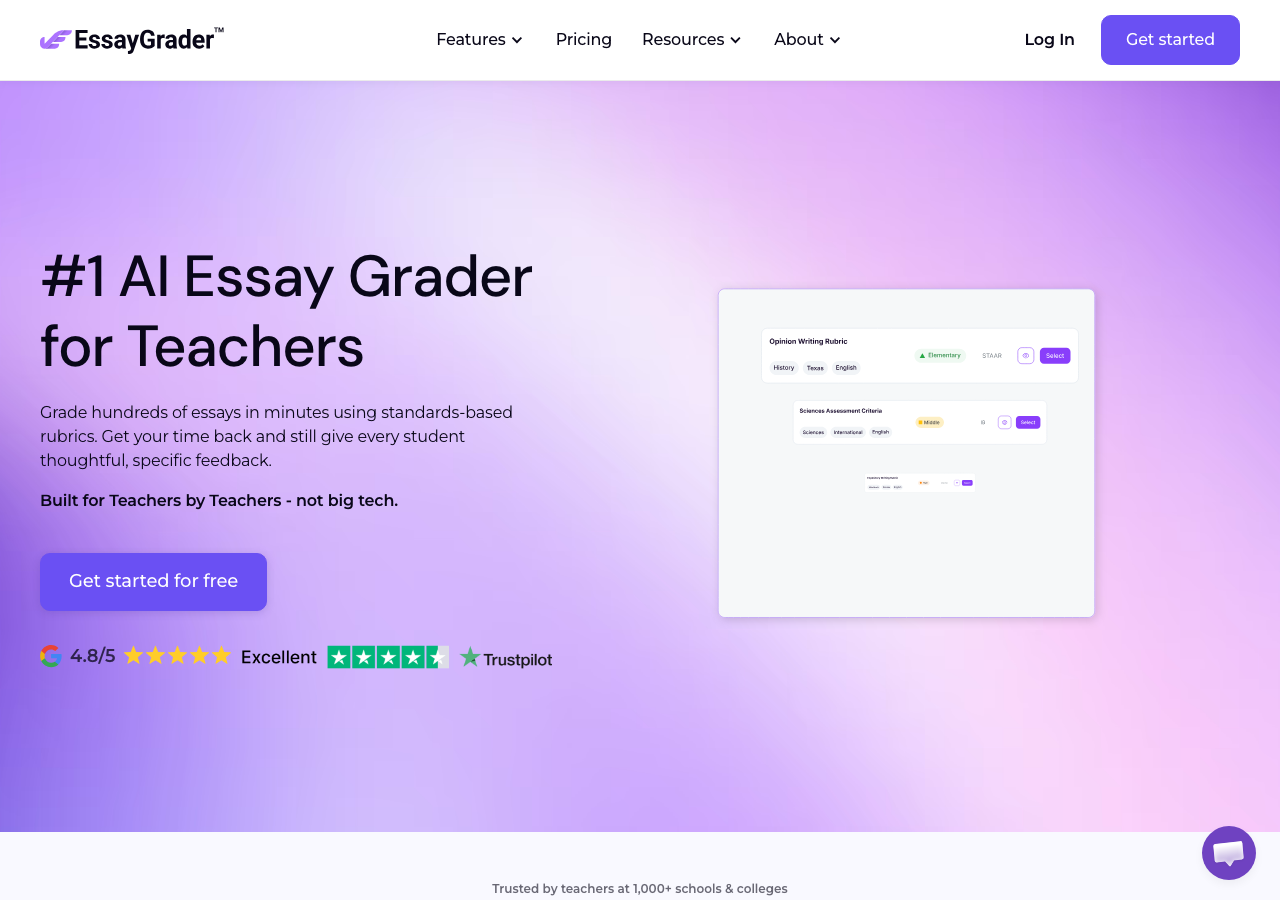
EssayGrader.ai belongs to the academic feedback category alongside platforms marketed to departments tired of repeating the same margin comments. For coursework, the student-relevant story is diagnostic: treat scores as a practice rubric, not as prophecy of your professor’s judgment. Models trained on generic rubrics miss discipline-specific nuance — a film studies paper penalized for ‘lack of data tables’ is a category error you must interpret.
Adoption grew in 2025–2026 as institutions experiment with AI-assisted grading under union and FERPA scrutiny. Whether your campus uses it officially or not, understanding how automated rubric parsers behave helps you pre-flight submissions: clear thesis sentences, labeled sections, explicit citations — the same signals that help human TAs grade faster also satisfy machine checklists.
EssayGrader packages essay scoring, feedback paragraphs, and class-level analytics for teachers. Product demos highlight time saved on 120-introductory-composition papers; student-facing marketing is thinner, which explains the lower essay fit score relative to generators like Textero. Capability centers on evaluation templates: argumentative, narrative, research summary, with adjustable weights for grammar, structure, evidence, and style.
When students access it — through a campus license, a free trial, or a shared TA account — the interface asks for pasted text or uploads, then returns rubric breakdowns and suggested revisions. It does not replace office hours; it compresses repetitive checklist feedback you might otherwise wait a week to receive.
Compared with Grammarly’s tone suggestions, EssayGrader speaks rubric language (‘thesis clarity 3/5’). Compared with Turnitin’s similarity report, it emphasizes qualitative criteria rather than overlap percentages. Compared with ChatGPT ‘grade my essay’ prompts, it offers more consistent structure but less conversational coaching unless you iterate manually.
Essay fit 6.5 acknowledges utility as a self-check mirror, not as a drafting engine. Rank #12 reflects educator-market momentum and student secondary use, not a recommendation to subscribe instead of Paperpal for sentence-level academic polish.
Self-grading and revision loops
Productive student workflows run EssayGrader after human first drafts, not on empty prompts. Write your introduction and thesis without AI, paste the section, read which rubric rows score lowest, then revise before generating body paragraphs. That order keeps authorship visible while using the tool as a structured checklist.
Upload the assignment rubric PDF when the product allows custom criteria — mirror your professor’s language (‘synthesizes at least two secondary sources’) so feedback aligns with actual grading sheets. Generic templates overweight five-paragraph essay tropes that advanced courses explicitly discourage.
Use batch feedback history to spot recurring weaknesses across a semester — weak transitions, summary without analysis — and target one skill per paper. Treat numeric subscores as directional, not precise; two runs on the same essay can differ slightly as models update.
If your instructor discloses AI-assisted grading, ask which criteria remain human-only. Ethical transparency cuts both ways: you should know whether a machine pre-scored your draft before appeal conversations.
Turnitin, detectors, and campus policy
EssayGrader does not immunize you from AI writing detectors — it evaluates text, it does not certify human origin. Pasting ChatGPT output into EssayGrader for cosmetic fixes before Turnitin submission is still an integrity risk if your syllabus bans generative drafting.
Some departments pair EssayGrader with plagiarism tools; others replace one with the other in budget cuts. Students report confusion when similarity scores and rubric scores arrive in different portals with conflicting narratives.
False comfort is the main hazard: a high EssayGrader score on AI-generated text means the generator satisfied a generic rubric, not that your instructor will agree or that citations are real. Appeals in 2026 still hinge on process documentation, not third-party app badges.
FERPA and data retention policies vary — pasted essays may be stored for model improvement depending on plan and jurisdiction. Avoid uploading peer work or proprietary lab data without permission.
Law and medical ethics courses with client narratives should never enter cloud graders — anonymization failures carry consequences beyond a letter grade.
Pricing and tiers
Educator plans starting near $15/month scale with class count and feature flags — bulk upload, LMS integrations, custom rubrics. Students rarely need institutional tiers; occasional free scans or short trials suffice for self-checks before final submission.
Compare cost with a writing center visit: one human session often delivers more disciplinary nuance than a month of rubric automation. EssayGrader wins on immediacy at 11 p.m., not on replacing expert readers for thesis-driven seminars.
If your university licenses the tool, use it; if not, free Grammarly critiques plus a rubric photocopy may duplicate eighty percent of the value for grammar-heavy assignments.
Department pilots sometimes sunset quickly when faculty realize rubric AI misses disciplinary reasoning — students should not purchase annual plans expecting campus-wide permanence.
Bottom line
EssayGrader’s 6.5 essay fit and #12 rank describe a feedback instrument, not a student writer. Use it to stress-test rubric alignment when you already own the argument.
Do not confuse a green dashboard with academic integrity clearance or citation accuracy. Pair human revision, verified sources, and campus writing support for anything high-stakes.
If you need drafting help, shift budget toward JotBot, Yomu, or ChatGPT Plus; keep EssayGrader in the self-edit lane.
Writing centers remain the gold standard for disciplinary feedback — EssayGrader complements appointments; it does not replace human readers who know your professor.
Pros
- rubric-aligned feedback helps pre-flight essays before human grading.
- useful for spotting missing thesis, weak evidence labels, or structural gaps.
- educator adoption means understanding it clarifies how automated pre-scoring may see your work.
Cons
- low essay fit for generation — not a research or drafting solution.
- generic templates misfire on discipline-specific assignments.
- scores can embolden overconfidence on AI-written or thinly sourced drafts.
Pricing
- Listed from $15/mo for EssayGrader — annual billing and student promos change the total.
- Category: Academic writing. Features and pricing change; verify before you subscribe.
What this tool does
Academic writing — AI grading & feedback for educators. Feature sets and export limits change; confirm on essaygrader.ai before subscribing. For raw chat drafting, see our AI engines list instead.
Compare alternatives
Who it's for
- rubric-aligned feedback helps pre-flight essays before human grading.
- useful for spotting missing thesis, weak evidence labels, or structural gaps.
- educator adoption means understanding it clarifies how automated pre-scoring may see your work.
Who should compare alternatives
- low essay fit for generation — not a research or drafting solution.
- generic templates misfire on discipline-specific assignments.
- scores can embolden overconfidence on AI-written or thinly sourced drafts.
Student experiences
Ratings from students who used EssayGrader on real assignments — includes critical reviews.
Loading student reviews…
1,004 words · Updated 2026