
Independent review · 2026
Anyword Review
Anyword sits at rank #26 with an essay fit score of 6.8/10 — the lowest essay fit among this batch because it is built for marketing teams optimizing ad copy, email subject lines, and landing pages with predicted performance scores — not for seminar papers with thesis, counterargument, and peer-reviewed citations. At roughly $39 per month, it is expensive relative to student-focused tools and hard to justify unless you also run a side hustle or major in marketing communications with assignments that mimic brand campaigns. Students who repurpose Anyword for essays get fluent promotional prose — confident hooks, benefit-driven transitions, call-to-action energy — that reads wrong in History 101 and still triggers AI detectors when submitted raw.
anyword.com · #26 in TOP 50
Long-form / marketing
Performance copy with score predictions
Our verdict
Anyword sits at rank #26 with an essay fit score of 6.8/10 — the lowest essay fit among this batch because it is built for marketing teams optimizing ad copy, email subject lines, and landing pages with predicted performance scores — not for seminar papers with thesis, counterargument, and peer-reviewed citations. At roughly $39 per month, it is expensive relative to student-focused tools and hard to justify unless you also run a side hustle or major in marketing communications with assignments that mimic brand campaigns. Students who repurpose Anyword for essays get fluent promotional prose — confident hooks, benefit-driven transitions, call-to-action energy — that reads wrong in History 101 and still triggers AI detectors when submitted raw.
Overview
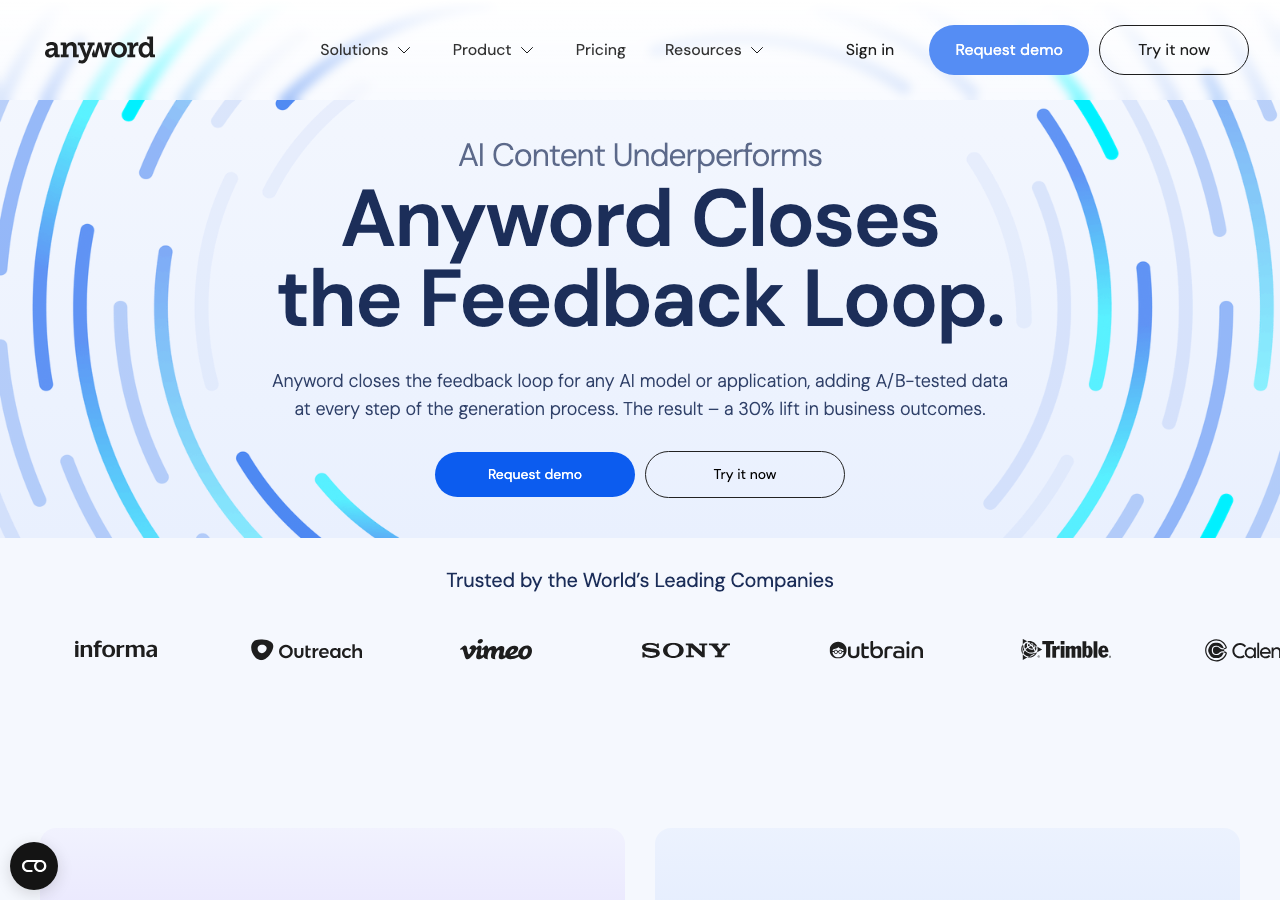
Anyword’s signature feature generates multiple copy variants and assigns predictive engagement scores — useful when your grade depends on A/B testing hypothetical Facebook ads, useless when your rubric demands Chicago-style footnotes. Templates span blog intros, product descriptions, and social captions; ‘long-form’ modes exist but inherit marketing DNA. Essay fit 6.8 is generous given mismatch — we score partial credit for students in business communication courses writing persuasive memos aligned with the tool’s training.
Compared with Jasper or Copy.ai, Anyword doubles down on analytics rather than sheer creative breadth. Compared with Frase or Scalenut, it lacks SERP research depth for informational essays. Undergraduates without marketing coursework should almost always spend $39 elsewhere — Jenni, Grammarly, or ChatGPT Plus — unless a specific assignment mimics performance copy.
Anyword belongs to the marketing category in our catalog — a deliberate warning label for essay shoppers browsing aggregate lists. Rank #26 reflects affiliate visibility and feature polish, not classroom suitability for typical argumentative research papers. The platform targets growth teams justifying copy choices with score predictions; professors grading academic argumentation care about evidence quality, not predicted click-through rate.
Essay fit 6.8 acknowledges narrow legitimate use: marketing majors drafting campaign briefs, entrepreneurship club pitch scripts, communications classes evaluating persuasive language mechanics. For expository essays, literature analysis, or problem sets with written components, Anyword misaligns — you fight the tool to remove sales tone. Data-driven persona fields (‘target audience: millennials’) produce awkward fit when your audience is one TA who hates buzzwords.
Long-form generator modes produce volume quickly — same integrity risks as Koala or Frase with extra corporate varnish. Performance scores have zero LMS mapping; optimizing for Anyword’s ‘confidence’ metric can make prose sound assertive without scholarly hedging where sources disagree.
International students sometimes trial Anyword misunderstanding ‘essay templates’ in review blogs — cancel quickly if citations and academic tone dominate your rubric. Native English marketing interns get more value than first-year biology lab reports.
Faculty advisors occasionally recommend industry tools for experiential assignments — ad campaign plans, brand voice guides, investor one-pagers — where Anyword belongs. Those same advisors rarely endorse it for core writing-intensive requirements in history, English, or sociology departments where argument and evidence, not predicted CTR, determine grades.
When students actually use it
Legitimate workflow: communications assignment asks for three ad variants plus rationale — generate variants in Anyword, paste into report, write your own analysis connecting choices to course readings on persuasion theory. The AI drafts are examples you critique, not final academic voice. Document that structure in cover memo if policy requires AI disclosure.
Business school case memos recommending market entry — Anyword helps headline executive summary bullets; body analysis still needs your Excel and case facts. Do not let predicted scores override case evidence — professors grade reasoning, not Anyword’s engagement guess.
Avoid: history research papers, philosophy thesis drafts, nursing care plans — category mismatch wastes money and rewrite time stripping ‘Unlock your potential’ cadence from every paragraph.
If tempted for general essays because YouTube promised ‘high-scoring AI,’ run sample output through your syllabus AI policy first — likely prohibited or disclosure-required with little quality upside versus cheaper tools.
Turnitin, detectors, and campus policy
Marketing-optimized AI copy scans as AI-generated on Turnitin — no special exemption. Performance prediction does not humanize text. Humanizer-free positioning is honest but does not help integrity if you submit generated memos as original analysis without disclosure.
Promotional tone can differ from typical ChatGPT essay voice — heuristic professor reads still catch unsupported claims and missing citations. 2026 policies treat undisclosed generative text as misconduct regardless of tool category.
Group marketing projects using Anyword on shared brand voice converge — acceptable when assignment is team ad campaign; problematic if partners split individual reflection essays generated from same persona settings.
False positives elsewhere on campus remind you detectors are imperfect; Anyword users are not immune. Keep drafts showing manual strategic analysis wrapped around any generated copy variants.
Pricing and tiers
$39 monthly entry pricing exceeds ChatGPT Plus, Jenni, Frase, and most student stacks — the steepest in ranks 21–30. Higher tiers add seats and brand voice libraries irrelevant to solo coursework. Free trials help confirm mismatch before charge — use them deliberately.
Opportunity cost: two months of Anyword equals a year of Koala or multiple Grammarly months. Unless marketing coursework consumes half your credits, economics fail.
Annual enterprise-style billing discounts target startups, not dorm rooms. Student discount programs are limited — verify anyword.com before assuming .edu pricing.
Hidden cost: stripping marketing tone from long-form exports burns hours — net time loss versus writing academically from scratch.
Bottom line
Anyword earns rank #26 and essay fit 6.8 as a marketing copy platform — not a student essay default. Buy it when assignments look like campaigns; skip it for standard research papers.
Marketing majors should still write analysis connecting Anyword variants to course theory — not submit scores alone. Everyone else should redirect budget to academic or editing tools in our list.
Student experiences below skew low for general essay use — higher when coursework actually matched the product category.
Pros
- strong for marketing communications assignments requiring variant copy and performance framing.
- persona and score metadata teach persuasion mechanics when analyzed critically in reports.
- polished UI and template library if your major aligns with growth content.
Cons
- essay fit 6.8 — poor default fit for research papers and humanities essays.
- $39 monthly among the priciest tools in our top 50 for typical undergrad use.
- promotional cadence fights academic nuance and citation-heavy argument structure.
Pricing
- Listed from $39/mo for Anyword — annual billing and student promos change the total.
- Category: Long-form / marketing. Features and pricing change; verify before you subscribe.
What this tool does
Long-form / marketing — Performance copy with score predictions. Feature sets and export limits change; confirm on anyword.com before subscribing. For raw chat drafting, see our AI engines list instead.
Compare alternatives
Who it's for
- strong for marketing communications assignments requiring variant copy and performance framing.
- persona and score metadata teach persuasion mechanics when analyzed critically in reports.
- polished UI and template library if your major aligns with growth content.
Who should compare alternatives
- essay fit 6.8 — poor default fit for research papers and humanities essays.
- $39 monthly among the priciest tools in our top 50 for typical undergrad use.
- promotional cadence fights academic nuance and citation-heavy argument structure.
Student experiences
Ratings from students who used Anyword on real assignments — includes critical reviews.
Loading student reviews…
1,022 words · Updated 2026