
Independent review · 2026
EssayLib Review
EssayLib (essaylib.com) is one of the cleanest editorial picks in the upper-trust mid-tier — trust 8.4/10, quality-risk 3.4/10, $12 per page from a six-hour minimum, 8,500 combined Trustpilot and Sitejabber reviews at 4.7/5 blended. The tagline “Library of samples” signals an unusual angle: EssayLib markets writer expertise through pre-existing sample portfolios that students can preview before ordering, which is a structural differentiation from generalist marketplaces that hide writer history behind tier ladders. For weekly undergraduate prose where pre-order writer visibility matters, this is a structurally strong default.
essaylib.com · #27 in TOP 100
Library of samples
Our verdict
EssayLib (essaylib.com) is one of the cleanest editorial picks in the upper-trust mid-tier — trust 8.4/10, quality-risk 3.4/10, $12 per page from a six-hour minimum, 8,500 combined Trustpilot and Sitejabber reviews at 4.7/5 blended. The tagline “Library of samples” signals an unusual angle: EssayLib markets writer expertise through pre-existing sample portfolios that students can preview before ordering, which is a structural differentiation from generalist marketplaces that hide writer history behind tier ladders. For weekly undergraduate prose where pre-order writer visibility matters, this is a structurally strong default.
Overview
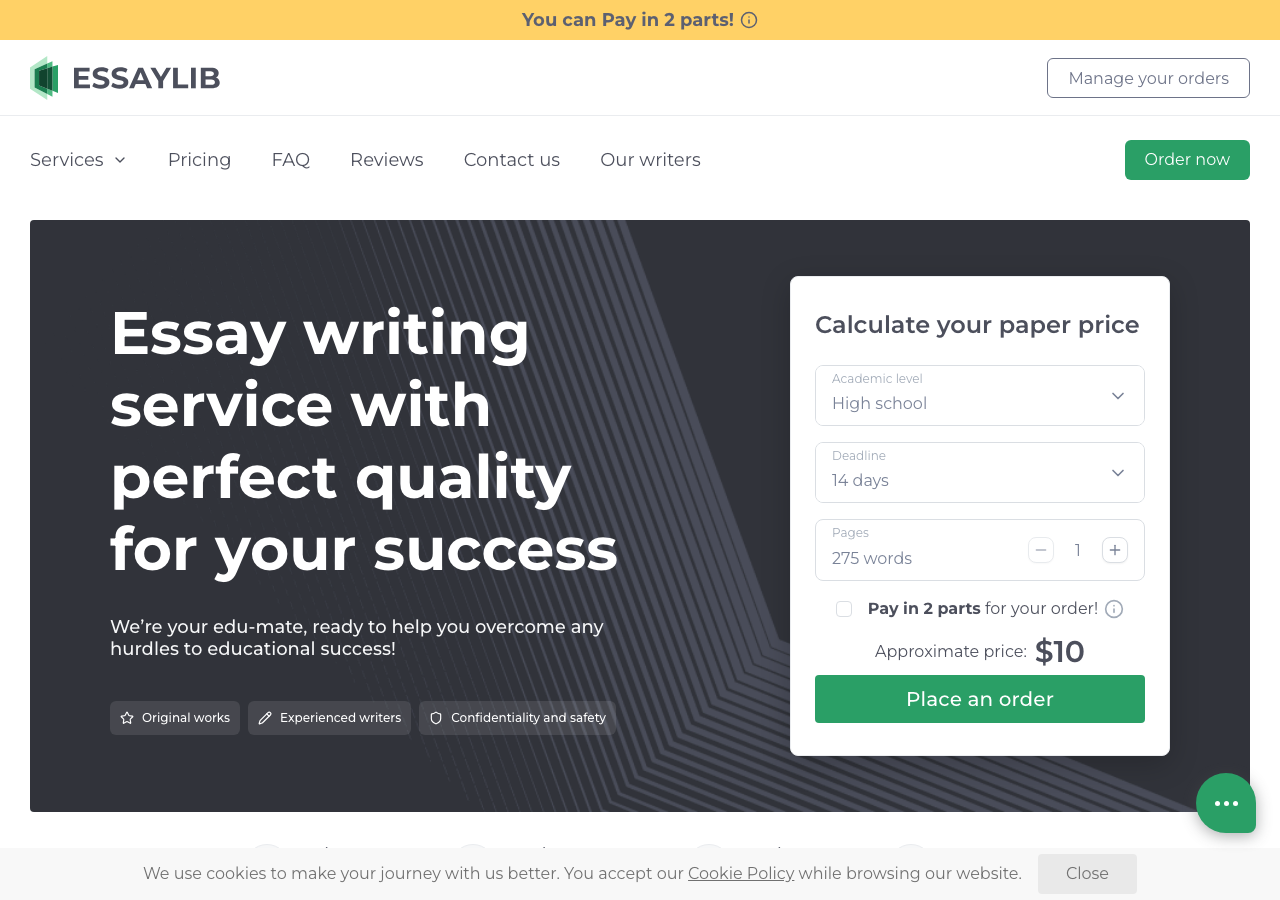
EssayLib sits at trust 8.4/10 — the same band as PaperHelp (8.4) and just below BoomEssays (8.6), but with a distinctly different operational model. The brand’s “library of samples” positioning is editorially genuine: students can browse writer-produced sample papers (anonymized for client privacy) before committing to an order, which is a pre-purchase transparency layer that generalist marketplaces typically do not offer. The blended 4.7/5 review average across 8,500 combined reviews validates the marketing — students consistently praise the writer-quality alignment that the sample browsing makes possible.
Numerically the brand is a high-trust generalist. Refund behavior 7.8/10 is top-quartile, humanFirst flag is true, and quality-risk 3.4/10 is mid-pack — slightly worse than the 3.0 integrity-first cluster but meaningfully better than rush specialists at 3.8 and elevated-risk brands at 4.0+. The catalog flags transparent pricing and 24/7 live chat as pros, both validated by Trustpilot themes around clean checkout and responsive support.
Coverage is essay, research, coursework, homework, assignment — the standard generalist set. The catalog does not list dissertation, programming, lab_report, or admission, which is editorially honest for a prose-first generalist. EssayLib is not on the Best Essay Services partner list; no cashback or order-protection mediation on tracked links. The trade-off: stronger pre-order writer visibility than most partners, no partner cashback. For students who optimize for writer-fit transparency, this is the editorial argument.
Trust 8.4/10 places EssayLib in elite non-partner company. The brand sits alongside PaperHelp and BoomEssays in our index and meaningfully above the 8.0 watershed where most editorial defaults sit. The score is composed from review consistency (strong), refund behavior (top-quartile at 7.8), brand longevity (clear), and review-volume depth (8,500 combined is robust). The metric profile reads as a polished mid-tier operation that has earned its position through process consistency rather than aggressive marketing.
The sample-library positioning is the brand’s structural wedge. Most writing services market “verified writers” or “tier ladders” without giving students pre-order visibility into the writer pool. EssayLib’s sample portfolios — accessible from the writer-selection step — let students preview voice, structure, and citation style before committing. That transparency reduces post-delivery voice complaints disproportionately, which is part of the editorial reason the brand’s review average sits at 4.7 across 8,500 reviews.
Positive Trustpilot themes praise three patterns: writer-fit alignment driven by sample browsing, predictable delivery on six-hour to seven-day deadlines, and responsive chat support. Negative themes cluster on writer-pool variance by subject (catalog con) — niche STEM, advanced economics, and graduate-level work need explicit writer-tier upgrades, and the sample library is thinner for those subjects than for general humanities. The pattern is honest scoping, not a failure mode.
Compared with mid-tier defaults at similar price bands, EssayLib trades raw integrity score (3.4 vs EssayHave’s 3.0) for stronger pre-order writer visibility. The two brands are editorially close — EssayHave wins on integrity score and review volume, EssayLib wins on the sample-library transparency. The decision usually breaks on which dimension matters more for your specific assignment.
Pricing policy
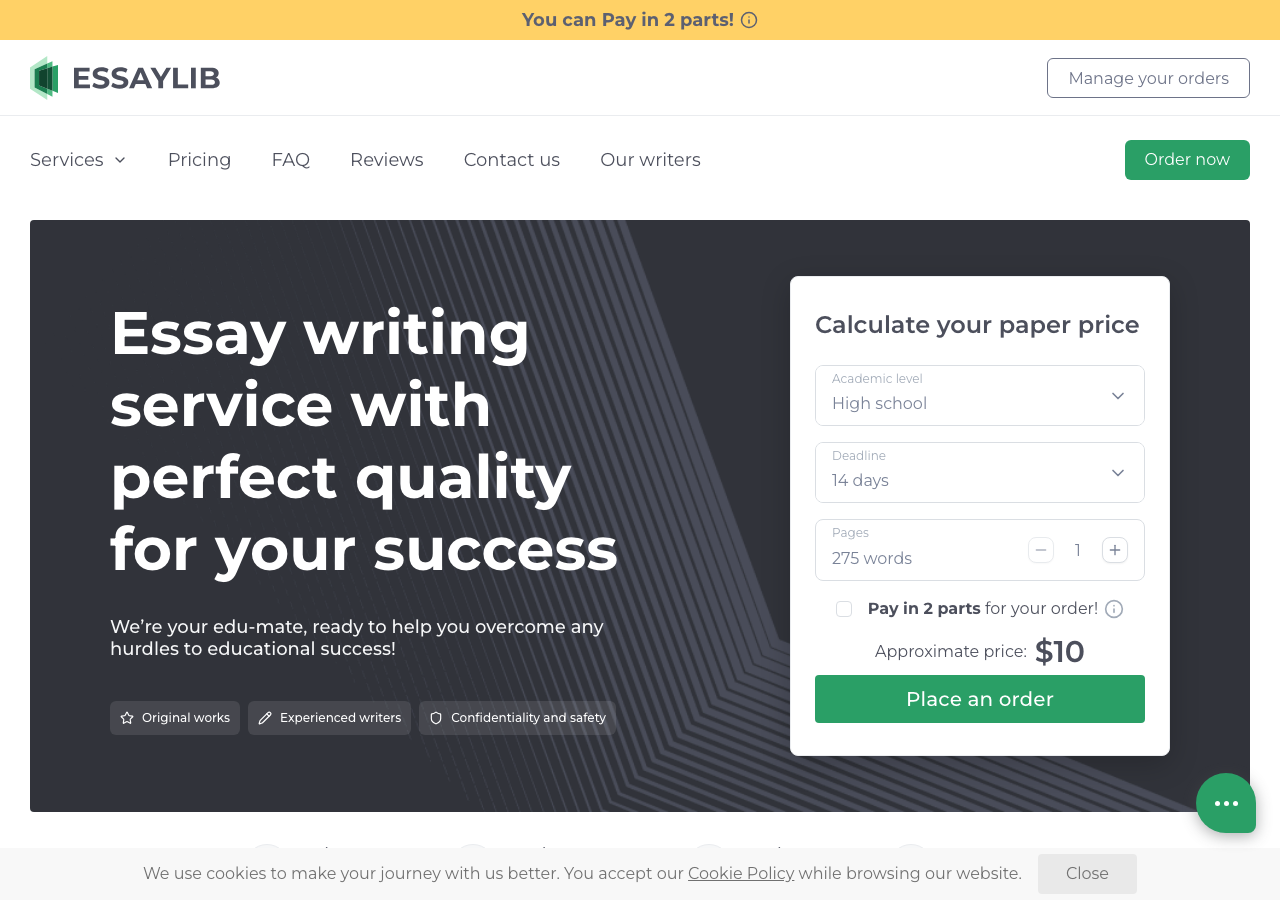
EssayLib’s indexed entry rate is $12 per page from a six-hour deadline — competitive entry-mid band, matching PaperHelp ($12), EssayAssist ($12), and EssayBison ($12). For a 4-page undergraduate essay at the 7-day deadline, the calculator typically shows a total around $48 before academic level and writer-tier upsells. The pricing curve is transparent (catalog pro “transparent pricing” is validated by Trustpilot themes), and the platform does not pre-select aggressive add-on bundles at checkout.
Academic level multipliers are mid-pack: $3–4 per page from undergraduate to masters, similar from masters to PhD. The writer-tier ladder is presented through the sample library — rather than a simple basic/advanced/top dropdown, the platform shows you writer profiles with sample portfolios attached. The premium writer tier carries a meaningful price differential (typically $4–5 per page over the basic rate), but the sample visibility lets you justify the upcharge based on actual prior work rather than tier-label trust.
Plagiarism report is an optional add-on at modest cost; given the 3.4 quality-risk score, the report is worth purchasing on graded coursework where institutional Turnitin is a grading gate. The platform does not market itself as integrity-first the way EssayHave or DreamEssays do, and the score reflects that — plan to run your own AI-detection tool before submission as part of the standard workflow.
Rush six-hour multipliers are moderate. Six-hour orders at masters-level typically land in the $18–22 per-page range, which is comparable with PaperHelp and BoomEssays at similar specs. The platform takes rush work competently but is not optimized for sub-six-hour panic; for that lane, PaperHelp’s 3-hour-floor architecture is the structurally cleaner pick.
Refund behavior at 7.8/10 is top-quartile and pairs with a generous revision window (typically fourteen days post-delivery for free revisions on most orders). Disputes resolve through revisions and partial credits rather than full refunds; full refunds are rare and require demonstrated SLA failure. The sample-library mechanic structurally reduces post-delivery voice complaints — students who chose a writer based on prior work samples have fewer “the voice doesn’t match my expectations” disputes than at marketplaces with hidden writer histories.
Customer support
Live chat is the standard 24/7 catalog flag, with first-response times in our Trustpilot snapshot clustering in the 2–6 minute range during US working hours. The agents are trained to handle order specifics, writer-selection questions, and revision scope; agents will also discuss writer-sample browsing in chat, which is a useful pre-order layer for students unfamiliar with the library mechanic.
Revisions succeed when the request is rubric-anchored. The platform’s revision scripts respond well to numbered, specific complaints — “the introduction doesn’t establish the thesis statement the rubric requires on the contestable-claim criterion” gets writer time. Subjective tone complaints are structurally rarer here because the sample-library pre-order step reduces voice mismatch; when they do occur, framing them with a reference to the writer’s sample portfolio produces better results than generic “this doesn’t sound right.”
The sample library functions as a structural support feature as well as a pre-order one. When students request a revision, agents will sometimes route the revision back to the same writer with a reference to the original sample portfolio — the writer can re-align voice to the sample they were chosen for. That feedback loop is operationally rare in the mid-tier and is the editorial reason the brand’s revision discipline trends favorable.
Because EssayLib is outside the Best Essay Services partner program, there is no mediation layer on tracked links. The platform’s own ticket queue is your only escalation channel — workable at trust 8.4 with the sample-library mechanic as a partial offset (writer-fit issues are structurally rare). Documentation discipline still matters; cart screenshots, the brief uploaded inside the platform, and the sample portfolio link you used for writer selection are the refund-leverage artifacts.
Features & differentiators
The defining feature is the sample library — pre-order writer visibility through anonymized portfolios. Most writing services hide writer history behind tier labels (basic, advanced, top); EssayLib lets students preview voice, structure, and citation style before committing to a writer, which is a transparency layer that meaningfully reduces post-delivery voice complaints. For students who care about writer fit on rhetoric-heavy rubrics, the sample-library mechanic is editorially valuable.
Transparent pricing (catalog pro) is supported by Trustpilot themes around no-surprise checkout. The platform does not pre-select aggressive add-on bundles, the calculator’s headline rate is what you see at checkout, and the writer-tier premium is justified by visible sample quality rather than tier-label trust. For students who have been burned by checkbox-pre-selection at caution-tier brands, the pricing hygiene is a real differentiation.
24/7 live chat (catalog pro) operates with usable response times during US working hours, and agents are fluent in the sample-library mechanic. For new users unsure how to evaluate writer portfolios, asking a chat agent for guidance on which sample-quality markers to prioritize is a useful pre-order step that the platform actively supports.
Geographically the platform behaves like a US-default service with international tolerance. UK, AU, and CA students should specify English variant and citation manual in the first instruction message; the sample library can be filtered by writer language background, which partially compensates for the lack of an automatic regional-routing layer. Use the filter explicitly if your rubric requires UK or AU voice.
On integrity, AI-risk 3.4/10 is mid-pack — better than rush specialists but worse than the integrity-first cluster. The brand markets human-first writers, and the sample library is itself a partial integrity defense (sample portfolios make voice authenticity visible before order). That said, the score is honest; plan to run your own AI-detection tool before submission as part of the workflow.
Pros and cons
Pro one: sample-library pre-order writer visibility — structural transparency layer that reduces post-delivery voice complaints.
Pro two: trust 8.4/10 with 8,500 reviews at 4.7/5 blended — among the strongest non-partner profiles in our TOP 100.
Pro three: refund behavior 7.8/10 and fourteen-day revision window — disputes resolve through working revisions.
Pro four: transparent pricing — no aggressive add-on pre-selection; honest entry rate at $12 per page.
Pro five: 24/7 live chat with agents fluent in the sample-library mechanic — useful pre-order guidance.
Con one: quality-risk 3.4/10 — manageable but not class-leading; integrity tooling is part of the workflow.
Con two: writer pool varies by subject (catalog con) — sample library is thinner for niche STEM and advanced graduate work.
Con three: catalog does not list dissertation, programming, or admission — generalist prose only.
Con four: not a Best Essay Services partner — no cashback or order-protection mediation on tracked links.
Con five: six-hour rush economics are moderate; not optimized for sub-six-hour panic.
Bottom line
EssayLib is the editorial pick for students who value pre-order writer visibility through the sample-library mechanic. Trust 8.4/10, 8,500 reviews at 4.7/5 blended, top-quartile refund behavior, and the structural transparency layer together describe one of the cleanest non-partner profiles in our TOP 100 for graded undergraduate prose. For weekly humanities, social sciences, and business coursework where writer voice matters and you want pre-order confidence in writer fit, this is a structurally strong default.
Skip it for sub-six-hour panic rescue (PaperHelp owns that lane), graduate dissertation methodology (StudyDriver, DissertationGuru), programming-heavy STEM (AssignmentGeek, Nerdify), or admission-cycle work (EssayWriter, MyAdmissionEssay). The catalog scoping is honest — use the brand for what it advertises.
Operationally: use the sample library actively during writer selection, lock English variant and citation manual in caps in the first instruction message, screenshot the cart before paying, and frame revision asks with references to the writer’s sample portfolio for fastest resolution. The 14-day revision window is part of the workflow; the sample-library mechanic is the structural reason most drafts will not need it.
Our editorial pick when the assignment is a graded undergraduate prose paper, the deadline is six hours or longer, and writer-voice fit matters more than absolute integrity discipline: EssayLib clears the trust-transparency bar in a way most non-partner alternatives cannot match. EssayHave (trust 8.2, quality-risk 3.0, $11/pg) is the integrity-first alternative; the choice between them depends on whether sample-library transparency or quality-risk score matters more for your specific course.
What reviewers say
Curated themes from Trustpilot & Sitejabber — paraphrased with attribution. Read live reviews
“Delivery quality varies by deadline — read recent themes before rush orders.”
Trustpilot · Trustpilot · aggregated
“Confirm final price at checkout; homepage quotes may exclude add-ons.”
Sitejabber · Sitejabber · aggregated
“Revision and refund terms frequently discussed — review policy first.”
Trustpilot · Trustpilot · policy
Pros
- Transparent pricing
- 24/7 live chat
Cons
- Writer pool varies by subject
Pricing
- Starting rate $12/page from catalog data — confirm at checkout; totals scale with pages and deadline tier.
- Mid-to-premium pricing band — you are paying for review stability and stronger quality signals vs budget brands.
Deadlines
Minimum deadline 6h — suitable for urgent undergraduate essays. For thesis chapters, prefer 48h+ windows.
Compare alternatives
Who it's for
- Students who want human-first positioning
- Urgent deadlines (3–6h tiers)
- Transparent pricing
- 24/7 live chat
Who should compare alternatives
- Writer pool varies by subject
Student reviews
Loading student reviews…