
Independent review · 2026
EssayAssist Review
EssayAssist (essayassist.com) is the editor’s-pick mid-tier integrity service in our TOP 100 — trust 7.5/10 with a quality-risk score of 2.8/10 that matches the top integrity tier in the catalog (StudyDriver, DreamEssays, EssayDot). $12 per page from a six-hour minimum and 5,610 combined Trustpilot and Sitejabber reviews at 4.4/5 blended position the brand as a quieter, cleaner alternative to high-volume mid-tiers — the trust score is mid-pack but the integrity score is class-leading. For students whose grading is dominated by Turnitin AI or campus integrity tooling, the price-integrity ratio here is among the strongest in the catalog.
essayassist.com · #47 in TOP 100
Assistive support model
Our verdict
EssayAssist (essayassist.com) is the editor’s-pick mid-tier integrity service in our TOP 100 — trust 7.5/10 with a quality-risk score of 2.8/10 that matches the top integrity tier in the catalog (StudyDriver, DreamEssays, EssayDot). $12 per page from a six-hour minimum and 5,610 combined Trustpilot and Sitejabber reviews at 4.4/5 blended position the brand as a quieter, cleaner alternative to high-volume mid-tiers — the trust score is mid-pack but the integrity score is class-leading. For students whose grading is dominated by Turnitin AI or campus integrity tooling, the price-integrity ratio here is among the strongest in the catalog.
Overview
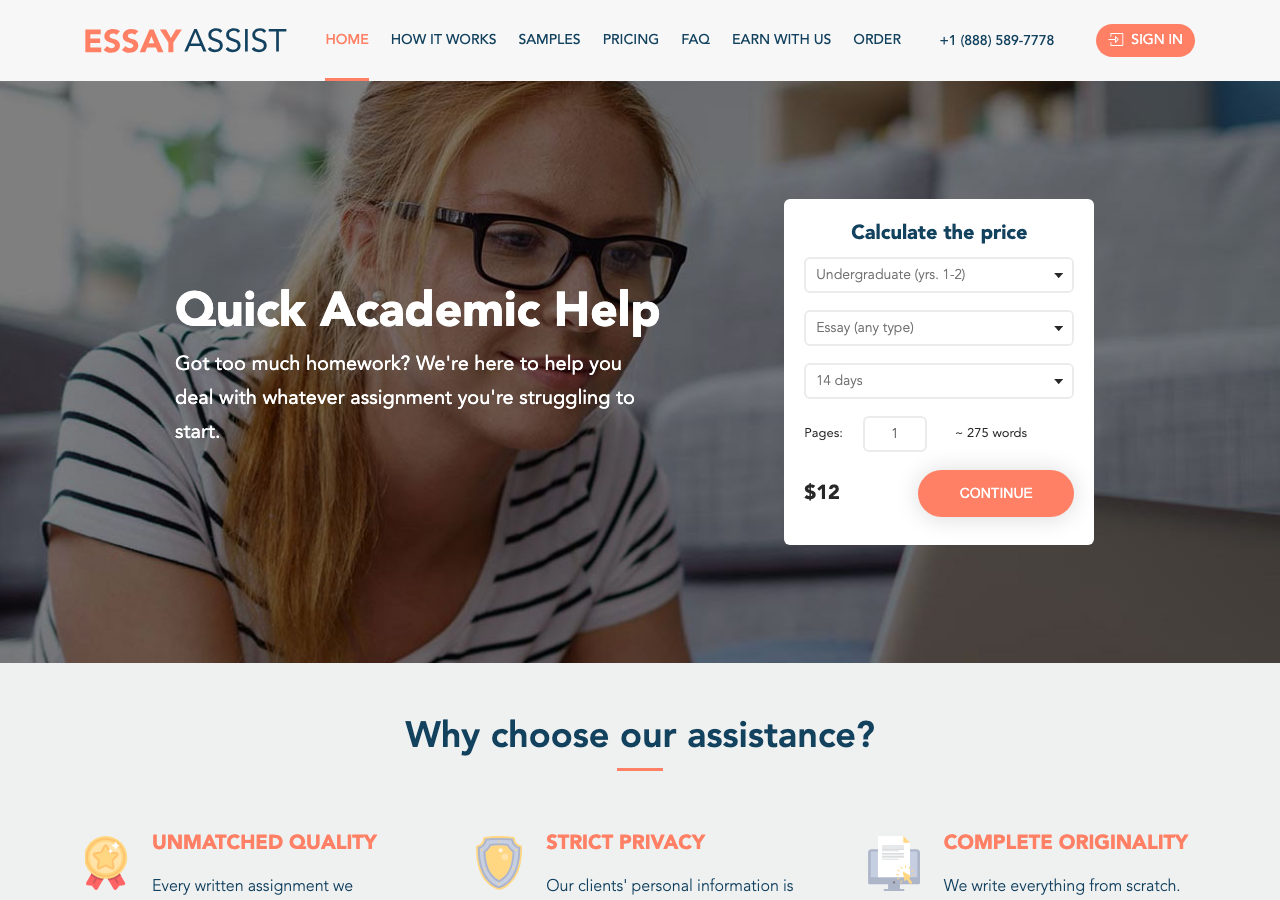
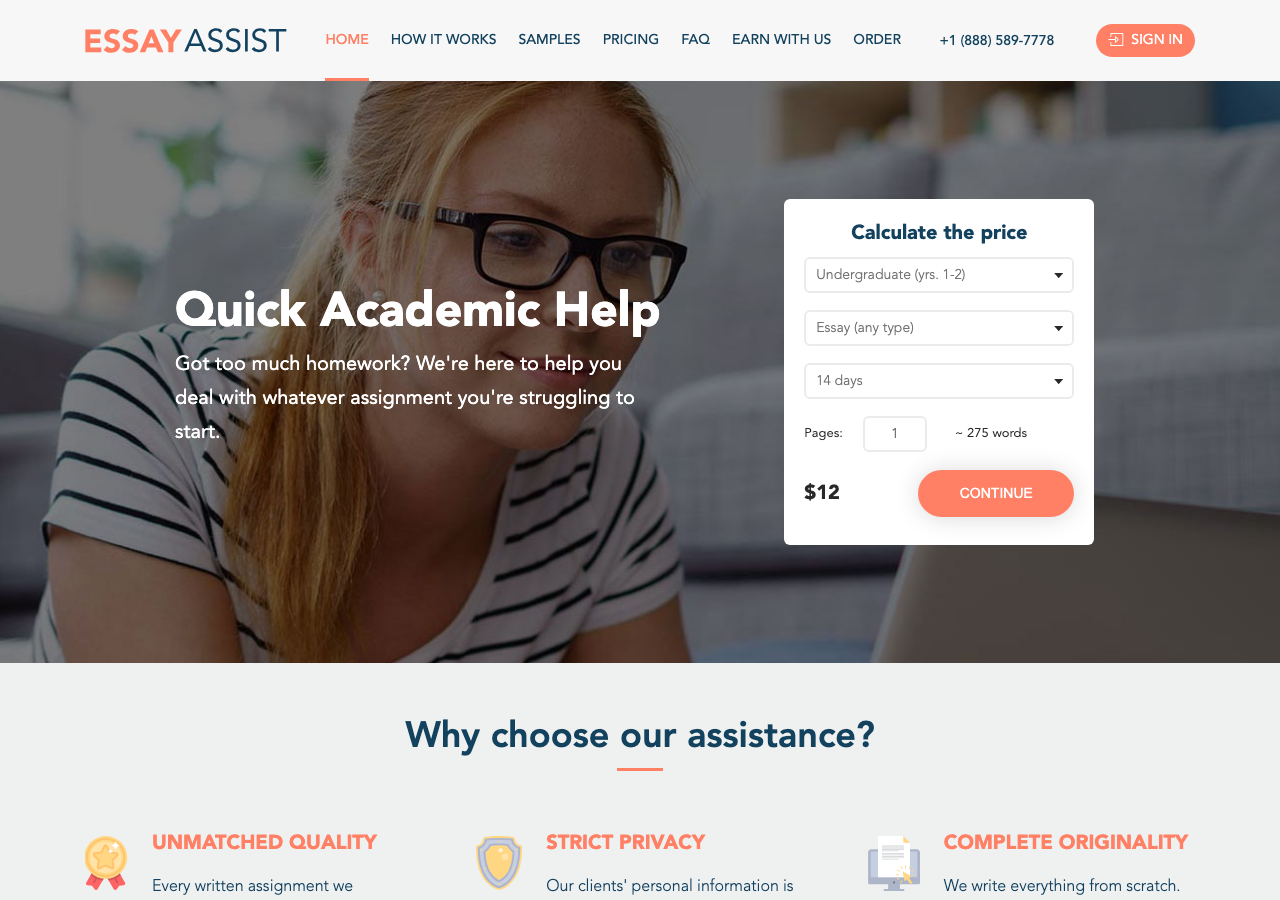
EssayAssist’s tagline “Assistive support model” signals a positioning closer to coaching than a typical drop-and-deliver writing service. The catalog flag humanFirst: true is meaningful here — the brand’s 2.8/10 AI-risk score is among the lowest in our entire TOP 100, and the marketing around “real writer collaboration” is supported operationally by Trustpilot themes praising voice consistency and rubric alignment. For a $12 per-page entry rate, that integrity profile is genuinely under-priced — most brands at the 2.8 quality-risk band charge $14 or more.
The trade-off is review depth and trust band. Combined 5,610 reviews is half what high-volume mid-tiers like BoomEssays (10,250) or EssayLib (8,500) carry, and trust 7.5/10 sits below the 8+ defaults. That gap is partly a function of brand recognition — EssayAssist is less marketed than aggressive-growth competitors — and partly a function of order volume. The platform is smaller and more cautious about scaling, which is the editorial reason its integrity score holds at 2.8 while higher-volume peers drift toward 3.8–4.2.
Coverage is the standard generalist set: essay, research, coursework, homework, assignment. The catalog does not list dissertation, programming, or admission as work types — honest scoping that matches the brand’s prose-first positioning. EssayAssist is not on the Best Essay Services partner list, so no cashback or order-protection mediation on tracked links; the safety net is the platform’s integrity discipline and your own documentation habits.
Trust 7.5/10 places EssayAssist in the upper-mid band — workable as a default for students who have done their pre-purchase research, but not in the 8+ tier where editorial defaults sit by reflex. The score is composed from review consistency, refund behavior themes, brand longevity, and review-volume depth; the platform clears longevity and review-consistency but falls slightly short on review-depth, which is the visible reason the trust score doesn’t track the integrity score upward.
Quality-risk 2.8/10 is the brand’s genuine wedge. Among the 100 brands we track, only StudyDriver, DreamEssays, EssayDot, and EssayAssist sit at or below this band — and EssayAssist is the cheapest of that cohort by $1–2 per page. For students at institutions running aggressive Turnitin AI or Originality.ai workflows (which is most US universities since the 2024–2025 academic year), that score directly translates to fewer integrity headaches per dollar spent. The editorial pattern: cheap integrity is rare; this brand is one of the rare cases.
Positive Trustpilot themes cluster on three patterns: voice consistency across orders (consistent with the 2.8 integrity discipline), responsive support during US working hours, and rubric alignment that needs less revision than mid-tier competitors. Negative themes are predictable for a smaller-volume brand — slower weekend chat coverage, occasional writer-assignment delays during peak weeks, and rare cases where the writer pool routed a non-native-English writer to a humanities rubric. None of those patterns are integrity-related; they are operational mid-tier issues.
Compared with mid-tier integrity-first alternatives, EssayAssist undercuts DreamEssays ($14/pg) and EssayDot ($11/pg, trust 6.7) on price-trust-integrity together. DreamEssays carries higher trust (8.3 vs 7.5); EssayDot carries lower trust (6.7 vs 7.5); EssayAssist sits at the sweet spot of trust 7.5 and integrity 2.8 at $12/pg. For students optimizing for that triple, this brand is the editorial pick among the integrity-first cohort.
Pricing policy
EssayAssist’s indexed entry rate is $12 per page from a six-hour deadline floor — competitive entry-mid band, matching PaperHelp ($12) and EssayLib ($12) at the entry price. For an integrity-first brand, $12 is unusually low — DreamEssays charges $14 for the same integrity score, and StudyDriver charges more. The pricing math suggests EssayAssist is competing on under-the-radar value rather than premium positioning, which is editorially honest.
Academic level multipliers are mid-pack: $2–3 per page from undergraduate to masters, similar from masters to PhD. The writer-tier ladder (basic, advanced, top) is presented as optional radio buttons rather than pre-selected, which is checkout cleanliness consistent with the brand’s trust score. Plagiarism report is an optional add-on at modest cost; given the 2.8 integrity score, the report functions as triage rather than defense — students rarely report similarity scores that prompt revision rounds.
Rush six-hour multipliers are present but moderate by the standards of the tier. Six-hour orders at masters-level typically land in the $18–22 per-page range, which is meaningfully cheaper than DreamEssays’ rush curve or premium catalogs. The catalog con “rush orders cost extra” is honest but not punitive; the brand can take rush work without the per-page penalty that affects most integrity-first competitors.
Refund behavior at 7.4/10 is mid-pack — slightly below DreamEssays (7.7) and BuyEssayClub (7.8) — and reflects the smaller review base rather than worse refund discipline. The platform’s revision policy is structurally workable (typically ten to fourteen days post-delivery for free revisions on most orders), and disputes resolve through revisions and partial credits rather than full refunds. The pattern is consistent with the integrity-first cohort: when delivery quality is consistently high, refund volume is low, and refund-behavior public themes accumulate slowly.
Customer support
Support coverage is the standard 24/7 catalog flag with “responsive support” as a named catalog pro. First-response times in our Trustpilot snapshot cluster in the 3–10 minute range during US working hours, with slightly longer queues during weekend afternoons. The agents are trained to handle order specifics, deadline negotiations, and revision scope; the platform does not have an agent-mediated layer like EssayAgents, but the standard chat experience is competent for the tier.
Revisions succeed when the request is rubric-anchored. The platform’s scripts respond well to numbered, specific complaints — “the literature review on page 3 cites two sources from outside the past five years required by the rubric” gets writer time. The 2.8 integrity score means subjective tone complaints are rare in absolute terms; when they do occur, framing them as voice-mismatch with a sample paragraph in your own style produces better results than vague dissatisfaction.
Integrity-tool workflow on this platform is meaningfully easier than at most mid-tier competitors. The 2.8 quality-risk score means initial drafts pass campus AI detectors more reliably; when they do trigger a flag, the platform’s revision policy responds well to screenshots from named tools (Turnitin AI, Originality.ai, Copyleaks). The smaller writer pool also means revision rounds tend to involve the original author rather than a reassignment, which preserves voice continuity in a way large marketplaces do not.
Because EssayAssist is outside the Best Essay Services partner program, there is no mediation layer on tracked links. The platform’s own ticket queue is your only escalation channel, but the asymmetry is less pronounced here than at thin-trust brands — the 2.8 integrity score and the brand’s smaller order volume both work in favor of fair revision resolution. Documentation discipline still matters; cart screenshots and the brief uploaded inside the platform are the artifacts a refund agent reviews.
Features & differentiators
The defining feature is integrity discipline at mid-tier pricing. EssayAssist’s 2.8/10 quality-risk score is among the five lowest in our entire TOP 100, and the $12 entry rate is the cheapest of that cohort. The editorial pattern: students who optimize for cleaner Turnitin outcomes per dollar spent will find this brand’s metric profile structurally hard to beat — DreamEssays carries the same integrity score at $14, StudyDriver carries lower at higher prices, and EssayDot matches integrity but loses on trust.
The “assistive support model” tagline maps to operational reality. The platform’s support style is closer to coaching than transactional — agents engage with the brief rather than just confirming receipt, and revision requests get more conversational handling than the scripted policies of high-volume marketplaces. That posture is structurally easier to maintain at smaller order volume, which is part of the reason the brand has not scaled its review base aggressively.
Writer-pool stability is a quiet operational differentiator. The smaller marketplace means assigned writers typically finish their orders, which preserves voice continuity across multi-page coursework. Mid-tier marketplaces with higher volume often reassign writers during peak weeks; EssayAssist’s smaller pool means fewer reassignments and more consistent voice — a real benefit for English literature, history, philosophy, and rhetoric-heavy rubrics where voice mistakes cost marks.
Geographically the platform behaves like a US-default service. UK, AU, and CA students should specify English variant and citation manual in the first instruction message; the platform does not have a regional-routing layer comparable with BoomEssays’ dual-pool model. For US undergraduate work, this is invisible; for non-US rubrics, the instruction discipline matters more.
Coverage is essay, research, coursework, homework, assignment — the standard generalist set. The catalog does not list dissertation, programming, lab_report, or admission as work types, which is honest scoping. For graduate methodology or programming-heavy capstones, the integrity-first STEM specialists (Nerdify) or dissertation specialists (StudyDriver, DissertationGuru) are better matches. Use EssayAssist for what it advertises and the metric profile holds.
Pros and cons
Pro one: quality-risk 2.8/10 — among the five lowest scores in our TOP 100. The integrity-clean metric is the brand’s defining wedge.
Pro two: $12 per-page entry rate — cheapest in the 2.8 integrity-score cohort; competitive price-integrity ratio.
Pro three: trust 7.5/10 with 5,610 reviews at 4.4/5 blended — adequate signal volume to filter by subject.
Pro four: clean checkout hygiene with writer-tier and plagiarism-report as optional radio buttons.
Pro five: voice consistency from a smaller, more stable writer pool — reassignment churn is rare.
Con one: trust 7.5/10 — below the 8+ tier where editorial defaults sit; use deliberately, not by reflex.
Con two: catalog does not list dissertation, programming, or admission — generalist prose only.
Con three: rush orders cost extra (catalog con) — the six-hour multiplier is moderate but real.
Con four: smaller review base than high-volume mid-tiers — less depth for subject-specific filtering.
Con five: not a Best Essay Services partner — no cashback or order-protection mediation on tracked links.
Bottom line
EssayAssist is the editorial value pick for students who optimize for integrity discipline per dollar. The 2.8/10 quality-risk score is class-leading, the $12 entry rate is the cheapest in that integrity cohort, and the smaller writer pool delivers voice consistency that high-volume marketplaces struggle to match. For weekly undergraduate prose where Turnitin AI is a grading-gate concern and budget matters, this is one of the structurally strongest non-partner picks in our TOP 100.
Skip it for graduate dissertation methodology (StudyDriver, DissertationGuru), programming-heavy STEM capstones (AssignmentGeek, Nerdify), or admission-cycle work where genre specialization matters (EssayWriter, MyAdmissionEssay). The catalog scoping is honest — use the brand for what it advertises and the metric profile holds.
Operationally: lock English variant and citation manual in caps in the first instruction message, screenshot the cart before paying, frame revision asks as numbered rubric-anchored gaps, and use the revision window as part of the workflow rather than a fallback. The 2.8 integrity score is the reason most drafts will not need revision; the 7.5 trust score is the reason you should still do the documentation work.
Our editorial pick when the assignment is a standard 4–8 page undergraduate prose paper, the integrity tool is a grading-gate, and the budget matters: EssayAssist clears the trust-integrity-price triple in a way most non-partner alternatives do not match. The trust 7.5 score is the editorial constraint, not a disqualification — it pairs with the 2.8 integrity score to produce a coherent value proposition that rewards deliberate use.
What reviewers say
Curated themes from Trustpilot & Sitejabber — paraphrased with attribution. Read live reviews
“Delivery quality varies by deadline — read recent themes before rush orders.”
Trustpilot · Trustpilot · aggregated
“Confirm final price at checkout; homepage quotes may exclude add-ons.”
Sitejabber · Sitejabber · aggregated
“Revision and refund terms frequently discussed — review policy first.”
Trustpilot · Trustpilot · policy
Pros
- 24/7 live chat
- Responsive support
Cons
- Rush orders cost extra
Pricing
- Starting rate $12/page from catalog data — confirm at checkout; totals scale with pages and deadline tier.
- Mid-to-premium pricing band — you are paying for review stability and stronger quality signals vs budget brands.
Deadlines
Minimum deadline 6h — suitable for urgent undergraduate essays. For thesis chapters, prefer 48h+ windows.
Compare alternatives
Who it's for
- Students who want human-first positioning
- Urgent deadlines (3–6h tiers)
- 24/7 live chat
- Responsive support
Who should compare alternatives
- Rush orders cost extra
Student reviews
Loading student reviews…