
Independent review · 2026
EssayAgents Review
EssayAgents (essayagents.com) is one of the most polarising metric profiles in our TOP 100 — trust 8.9/10 (top-tier non-partner) paired with quality-risk 4.2/10 (one of the elevated scores). $13 per page from a six-hour minimum and 9,860 combined Trustpilot and Sitejabber reviews at 4.7/5 blended make this look like an obvious recommendation; the integrity score makes it a conditional one. The brand’s “agent-assisted” model — human concierge layer between student and writer — is the operational reason for the trust score, and the elevated AI-risk is the cost of routing volume aggressively. Use for planned undergraduate prose with a campus integrity-check workflow attached.
essayagents.com · #19 in TOP 100
Agent-assisted orders
Our verdict
EssayAgents (essayagents.com) is one of the most polarising metric profiles in our TOP 100 — trust 8.9/10 (top-tier non-partner) paired with quality-risk 4.2/10 (one of the elevated scores). $13 per page from a six-hour minimum and 9,860 combined Trustpilot and Sitejabber reviews at 4.7/5 blended make this look like an obvious recommendation; the integrity score makes it a conditional one. The brand’s “agent-assisted” model — human concierge layer between student and writer — is the operational reason for the trust score, and the elevated AI-risk is the cost of routing volume aggressively. Use for planned undergraduate prose with a campus integrity-check workflow attached.
Overview
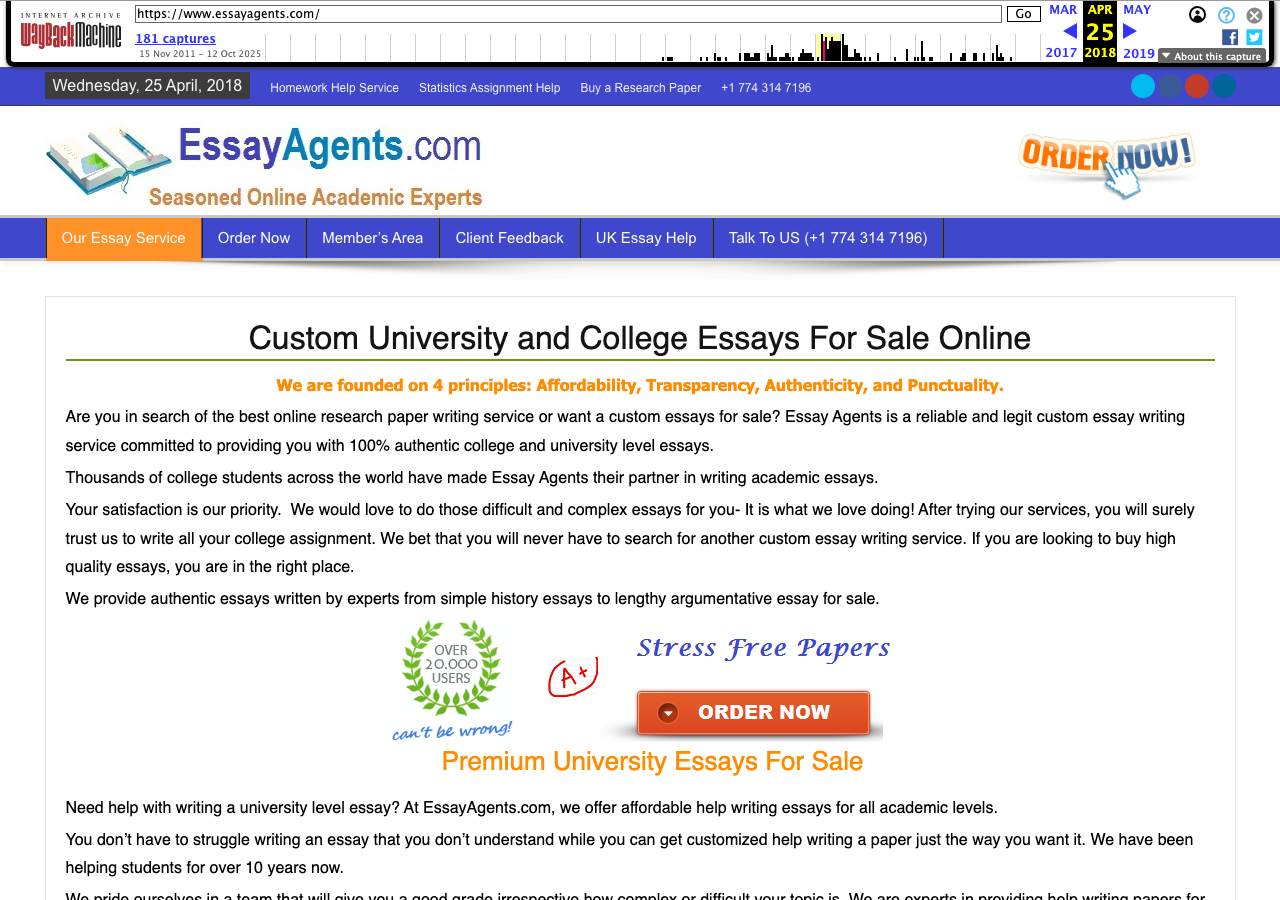
EssayAgents’ tagline “Agent-assisted orders” describes a genuinely different operating model from the standard writer-marketplace pattern. Rather than dropping students directly into a writer chat after payment, the platform routes orders through a human agent who refines the brief, confirms the writer assignment, and mediates revision requests. That extra layer is the editorial reason for the unusual trust-quality split: students consistently rate the order experience and support quality highly (4.7 blended is rarefied for a non-partner), but the writer-pool variance behind the agent layer produces the elevated quality-risk score.
Numerically the brand sits just below partner territory. Trust 8.9/10 is second only to BuyEssayClub (9.0) among non-partner brands; review volume of 9,860 is in the top quartile; refund behavior 7.8/10 is top-quartile and matches the strongest partners. The metric profile reads as a high-trust polished operation — and that read is accurate operationally, except on the integrity metric where the 4.2 score signals that the agent layer is not screening for AI-tool usage by writers as aggressively as the trust-first brands.
Coverage is the standard generalist set: essay, research, coursework, homework, assignment. The catalog does not list dissertation, programming, lab_report, or admission as work types — honest scoping, and consistent with the agent-mediated generalist model that does not pretend to be a specialist shop. EssayAgents is not on the Best Essay Services partner list, so cashback and order protection do not apply on tracked links; your safety net is the platform’s strong revision policy (7.8 refund score, fourteen-day window) and your own integrity-tool workflow before submission.
The agent-assisted model is the brand’s defining operational choice and the reason its trust metrics outperform its quality-risk profile. In practice, the agent layer behaves like a project manager: confirms the brief specifications, escalates writer reassignment if early drafts miss the mark, and translates rubric requirements between student and writer in a way that mid-tier marketplaces do not. That experience is what drives the 4.7/5 review average — students consistently report feeling “handled” rather than fending for themselves in a writer chat.
The cost of the agent layer is the writer-pool routing. To support agent-mediated volume, EssayAgents draws from a broader writer pool than the strictest quality-first brands, and the quality-risk score of 4.2/10 reflects that breadth. The catalog flag humanFirst: true aligns with the brand’s marketing, but human-first positioning is not the same as a strict no-AI-tools policy, and the brand’s 4.2 score is the same band as PaperHelp and BoomEssays despite a noticeably higher trust score. Integrity-tool workflows are part of using this brand responsibly, not optional add-ons.
Positive Trustpilot themes cluster on the agent experience — clear communication, proactive updates on writer assignment, and revision requests that go through a human rather than a script. Negative themes cluster on the predictable integrity issues — a non-trivial subset of reviews mention drafts that triggered campus AI detectors, requiring revision rounds before submission. Both patterns are consistent with the metric profile; the agent layer cannot fully compensate for a 4.2 underlying integrity risk.
Compared with EssayState (trust 8.8, quality-risk 4.2, $13/pg) — the closest editorial comparison in our TOP 100 — EssayAgents wins on review volume and refund behavior while matching on price and integrity risk. EssayState’s mass-market positioning is slightly different from EssayAgents’ agent-mediated model, but the two brands occupy similar editorial space: high-trust generalists with an integrity caveat that must be planned around.
Pricing policy
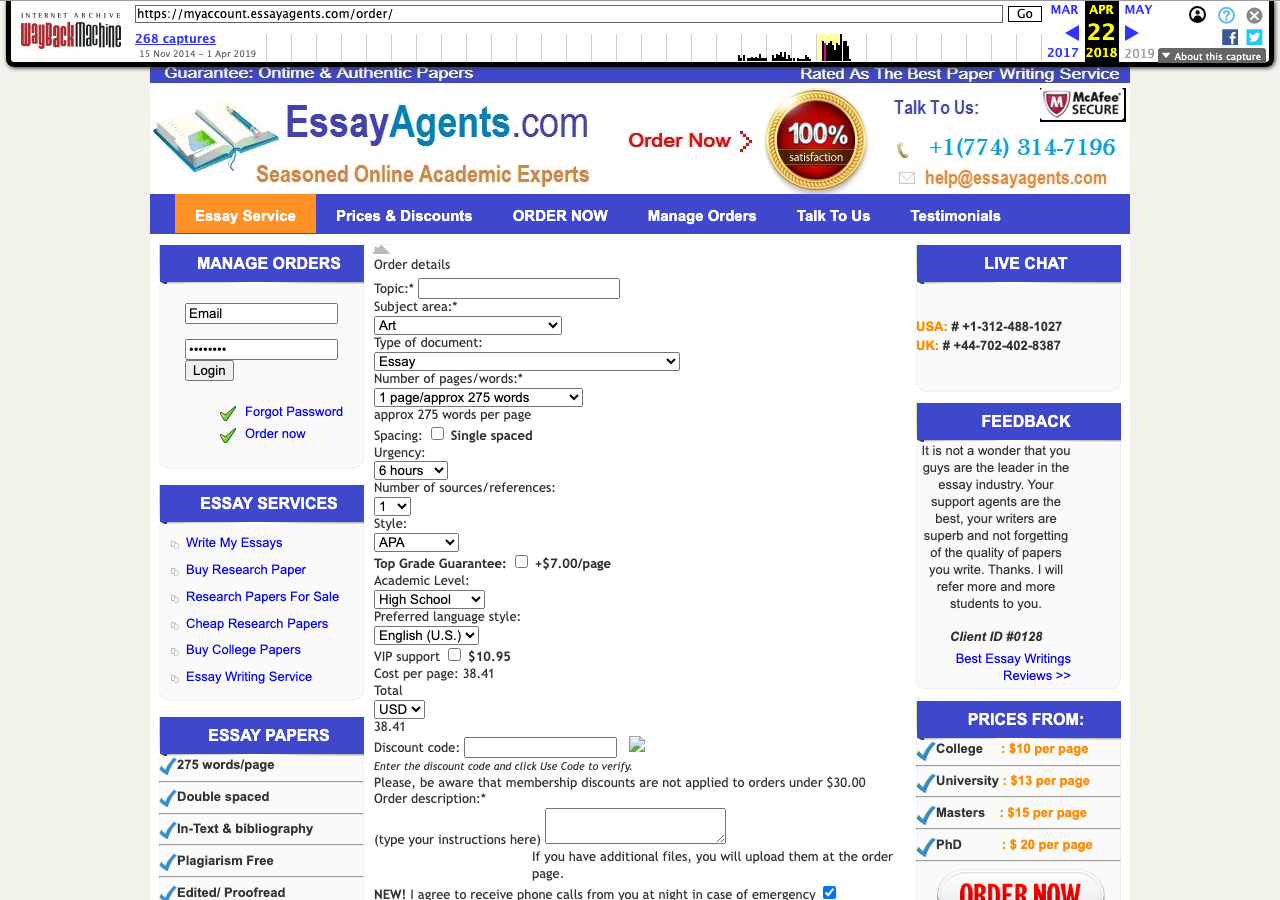
EssayAgents’ indexed entry rate is $13 per page from a six-hour deadline — competitive entry-mid band, slightly above PaperHelp ($12) and below the premium-marketed catalogs. The agent-mediated model does not visibly affect base pricing; the brand is not charging a concierge premium on the per-page rate. For a 4-page undergraduate essay at the 7-day deadline, the calculator typically shows a total around $52 before academic level and writer-tier upsells.
Where the pricing diverges from generalist competitors is in the upsell hygiene. EssayAgents’ checkout presents writer-tier (basic, advanced, top) and plagiarism-report as optional rather than pre-selected, which is checkout cleanliness the caution-tier shops do not match. Loyalty discounts (catalog pro) attach after a verified second order and compound with seasonal promotional codes, making the brand more economical as a semester default than as a one-shot purchase.
Rush six-hour multipliers are moderate by the standards of the tier — typically pushing per-page rates into the $20–25 range for masters-level work, which is more rational than DreamEssays’ steep rush curve or the premium catalogs’ surcharges. The agent layer also smooths rush ordering operationally — the agent confirms writer availability before the multiplier locks in, which reduces the “paid for rush, writer didn’t materialize” complaint pattern that affects mid-tier marketplaces.
Refund behavior at 7.8/10 is top-quartile and pairs well with the fourteen-day revision window. Disputes routinely resolve through partial credits and free re-writes; full refunds are rare and require demonstrated SLA failure rather than rubric disagreement. The agent layer is structurally helpful here — agents are trained to deflect rubric-disagreement disputes toward revisions and to escalate SLA-failure disputes faster, which keeps both student and platform on track without unnecessary refund pressure.
Customer support
Support is the brand’s genuine differentiator and the reason for the 4.7 review average. The agent-mediated model means the first contact after payment is a human project manager, not a generic chat agent, and the same agent typically owns the order through delivery and revisions. That continuity is operationally rare in the mid-tier and structurally explains why students consistently rate the experience higher than the integrity metric alone would predict.
Revisions succeed when the request is rubric-anchored. The agent layer responds well to “the rubric requires three primary sources from the past five years; the draft cites two textbook sources from 2014” — that gets routed to the writer with a specific scope. Subjective complaints (“sounds AI,” “not what I wanted”) get coached by the agent into more specific asks before being escalated to the writer, which is more efficient than the typical mid-tier pattern of scripted policy responses.
Integrity-tool concerns deserve their own escalation track. If a draft triggers a campus AI detector, send the screenshot to the agent immediately rather than to the writer — the agent can route to a revision-focused writer rather than the original author, which is the cleaner path on a 4.2-risk platform. The brand does not have a formal AI-revision queue, but the agent-mediated model gives you a faster path to a different writer if the first draft fails an integrity check.
Limited weekend support is the catalog con. Saturday and Sunday queue depth balloons relative to weekdays, which is industry-standard. The agent-mediated model softens this somewhat — your assigned agent will sometimes respond outside posted business hours on existing orders — but the brand does not offer 24/7 agent coverage. Plan deadlines and clarification questions on a Monday-Thursday cadence for fastest resolution.
Features & differentiators
The agent-assisted model is the brand’s defining differentiator and is editorially genuine. Other mid-tier brands market “personal account managers” without operational substance behind the language; EssayAgents’ agent layer actually mediates orders, refines briefs, and owns revision flows. For students who have been burned by writer-direct marketplaces — where the writer is responsible for everything from spec interpretation to deadline management — the agent layer is the structural reason this brand’s reviews skew so consistently positive.
Plagiarism report inclusion is a catalog pro, presented at checkout as an optional add-on. The platform does not market itself as integrity-first the way DreamEssays or EssayHave do, and the 4.2/10 quality-risk score reflects that — plan to run your own campus integrity tool before submission as part of the workflow. The plagiarism report is a useful triage artifact but is not a substitute for institutional integrity checks.
Loyalty discounts (catalog pro) compound for semester users. The agent-mediated model is more economical at scale because the agent layer reduces the workflow tax on each order — repeat users build a relationship with their assigned agent who knows their preferences, which compresses the per-order briefing time. For students using one vendor across an academic year, that workflow efficiency is a quiet operational benefit.
Geographically the platform behaves like a US-default service with international tolerance. UK, AU, and CA students should specify English variant and citation manual explicitly in the first instruction message; the agent will route to writers with the relevant background, but the default is US English with APA. For non-US rubrics, the agent layer is structurally helpful because the human can confirm regional voice requirements before the writer starts — a capability mid-tier marketplaces typically do not offer.
Compared with the priority-partner cohort, EssayAgents lacks cashback and order-protection mediation but offers a polish in the order experience that several partners do not match. The trade-off is genuine: for students who value the agent-mediated experience over partner cashback economics, EssayAgents is the editorial pick; for students optimizing for cashback recovery, partner brands like PaperHelp (3h floor) or EssayPro (writer marketplace) are stronger picks at similar price bands.
Pros and cons
Pro one: agent-assisted order experience — genuine human concierge layer between student and writer, not marketing language.
Pro two: trust 8.9/10 — second-highest non-partner score in our TOP 100, with 9,860 reviews at 4.7/5 blended.
Pro three: refund behavior 7.8/10 and fourteen-day revision window — disputes resolve through working revisions, not refund battles.
Pro four: clean checkout hygiene — writer-tier and plagiarism-report as optional radio buttons, not pre-selected.
Pro five: loyalty discounts compound for semester users — economically rational as an academic-year default.
Con one: quality-risk 4.2/10 — one of the elevated integrity scores in the upper-trust band; integrity tools are part of the workflow, not optional.
Con two: writer pool varies by subject — niche topics need explicit writer-tier upgrades and longer SLAs.
Con three: catalog does not list dissertation, programming, or lab_report — generalist prose only.
Con four: limited weekend support — agent coverage is weekday-anchored, queue depth balloons Sat/Sun.
Con five: not a Best Essay Services partner — no cashback or order-protection mediation on tracked links.
Bottom line
EssayAgents is the editorial pick for students who value order-experience polish over absolute integrity discipline. The agent-mediated model delivers a measurably different workflow from standard writer marketplaces, the trust score is among the strongest non-partner profiles in our TOP 100, and the refund discipline is top-quartile. For weekly undergraduate prose where you can pair the platform with your own integrity-tool workflow, this is one of the strongest defaults.
Skip it for high-stakes graded assignments where Turnitin AI scoring is a grading gate — the 4.2 quality-risk score means you cannot rely on the platform’s default workflow alone. DreamEssays (trust 8.3, quality-risk 2.8) is the structurally cleaner integrity-first pick at a similar price; EssayHave (trust 8.2, quality-risk 3.0, $11/pg) is the cheaper integrity-first alternative. Compare both before committing if integrity is your top constraint.
Operationally: lean on the agent layer. Use the first conversation after payment to refine the brief, request the advanced or top writer tier for graded coursework, route any integrity-tool concerns through the agent rather than directly to the writer, and use the fourteen-day revision window as part of the workflow. The agent-mediated model rewards specific briefs and disciplined revision asks more than any other mid-tier brand in our catalog.
Our editorial pick when the assignment is a standard 4–8 page undergraduate paper, the order experience matters as much as the deliverable, and you have a campus integrity-tool workflow you can run before submission: EssayAgents is the polished generalist that most non-partner brands at the same price band do not match — provided you accept the 4.2 integrity caveat as a planning constraint, not a deal-breaker.
What reviewers say
Curated themes from Trustpilot & Sitejabber — paraphrased with attribution. Read live reviews
“Delivery quality varies by deadline — read recent themes before rush orders.”
Trustpilot · Trustpilot · aggregated
“Confirm final price at checkout; homepage quotes may exclude add-ons.”
Sitejabber · Sitejabber · aggregated
“Revision and refund terms frequently discussed — review policy first.”
Trustpilot · Trustpilot · policy
Pros
- Plagiarism report included
- Loyalty discounts
Cons
- Writer pool varies by subject
Pricing
- Starting rate $13/page from catalog data — confirm at checkout; totals scale with pages and deadline tier.
- Mid-to-premium pricing band — you are paying for review stability and stronger quality signals vs budget brands.
Deadlines
Minimum deadline 6h — suitable for urgent undergraduate essays. For thesis chapters, prefer 48h+ windows.
Compare alternatives
Who it's for
- Students who want human-first positioning
- Urgent deadlines (3–6h tiers)
- Plagiarism report included
- Loyalty discounts
Who should compare alternatives
- Writer pool varies by subject
Student reviews
Loading student reviews…