
Independent review · 2026
College-Paper Review
College-Paper (college-paper.org) is the college-focused generalist of the lower-mid tier — trust 6.5/10, quality-risk 3.8/10, $13 per page from a six-hour minimum, 6,060 combined Trustpilot and Sitejabber reviews at 4.3/5 blended. The brand markets to US undergraduate students specifically (admission essays, personal statements, scholarship essays are listed in the work-type catalog), and the metric profile is workable for routine coursework if the trust gap to mid-tier competitors is acceptable for your stakes. The honest editorial read: it is a reasonable fallback when higher-trust brands are unavailable, not a default.
college-paper.org · #65 in TOP 100
College-focused UX
Our verdict
College-Paper (college-paper.org) is the college-focused generalist of the lower-mid tier — trust 6.5/10, quality-risk 3.8/10, $13 per page from a six-hour minimum, 6,060 combined Trustpilot and Sitejabber reviews at 4.3/5 blended. The brand markets to US undergraduate students specifically (admission essays, personal statements, scholarship essays are listed in the work-type catalog), and the metric profile is workable for routine coursework if the trust gap to mid-tier competitors is acceptable for your stakes. The honest editorial read: it is a reasonable fallback when higher-trust brands are unavailable, not a default.
Overview
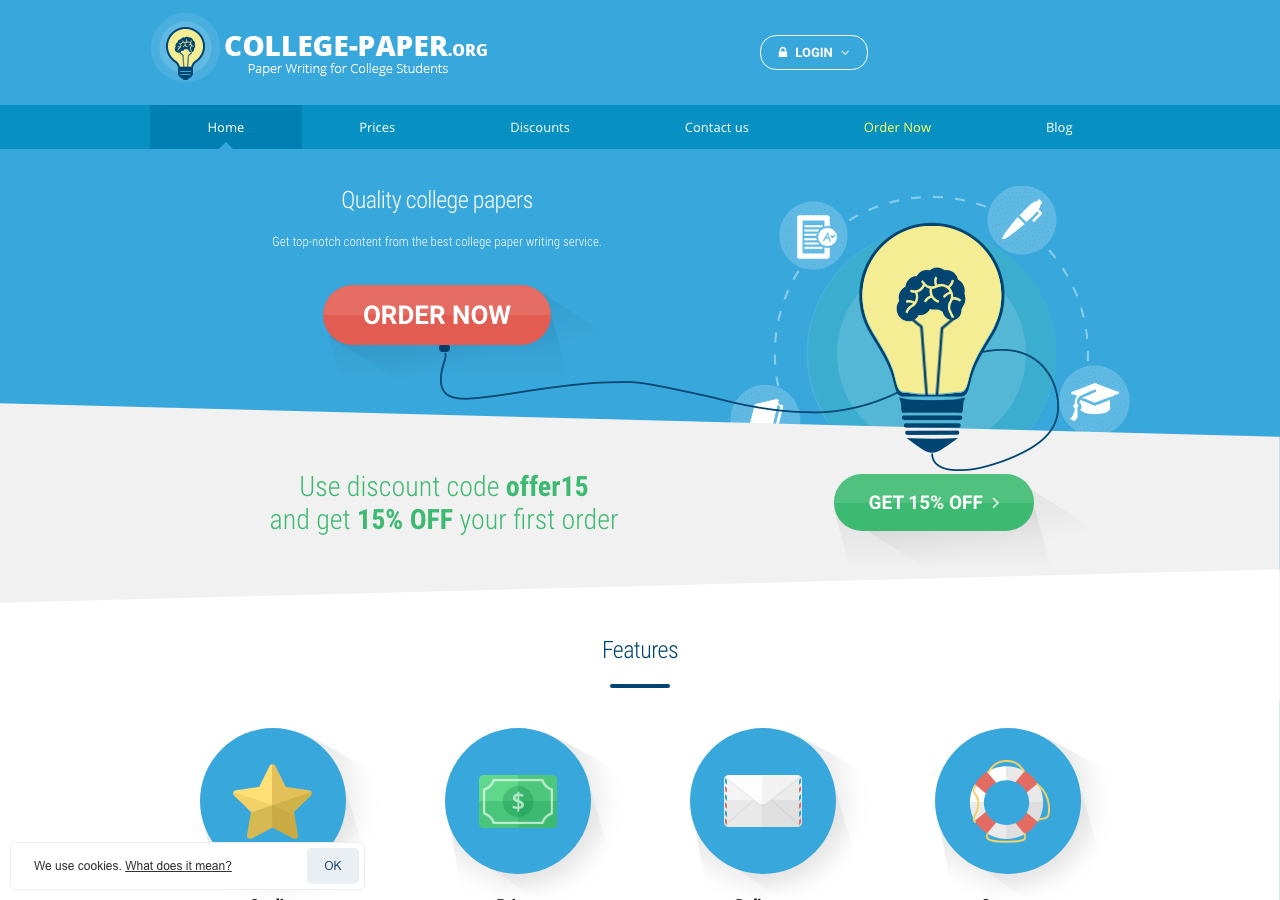
College-Paper occupies a specific niche in the catalog — generalist writing positioned around college-stage students with explicit admission and scholarship-essay coverage. The .org domain reads as institutional but the platform operates as a standard commercial writing service, not a non-profit. Trust 6.5/10 puts the brand below the 7.0 watershed where editorial defaults typically sit, which is the metric signal you should plan around regardless of how college-oriented the marketing reads.
The work-type catalog is genuinely college-specific: admission, personal_statement, scholarship_essay, and term_paper sit alongside the standard essay, research, coursework, homework, and assignment set. That breadth matters operationally — admission and scholarship writing is a particular voice and structure that generalist services often deliver poorly, and listing those types explicitly suggests the platform has writers who have done them before. Whether the delivery matches the marketing is the editorial question; our Trustpilot snapshot is mixed on admission specifically.
On metrics, College-Paper sits in the lower-mid tier across the board. Quality-risk 3.8/10 is the same band as PaperHelp and BoomEssays, refund behavior 7.3/10 is mid-pack, humanFirst flag is false (no human-only marketing commitment), and the 6,060 combined review base is adequate but not deep. The brand is not on the Best Essay Services partner list, so no cashback or order-protection mediation on tracked links — your safety net is documentation discipline and your own integrity tooling before submission.
College-Paper’s positioning is the brand’s clearest editorial signal: the domain, the .org TLD, the work-type catalog with admission and scholarship coverage, and the marketing voice all point to first-year and rising-sophomore students navigating their first writing service purchase. That matches the trust score — 6.5/10 is the band where students with less prior experience often land, and where the deliverable-to-promise ratio sometimes diverges from the homepage marketing.
Trust 6.5/10 places the brand below established mid-tier defaults like EssayHave (8.2), EssayLib (8.4), and BoomEssays (8.6), but above the caution-tier shops with sub-6 scores like BestCustomWriting (5.4) and EssayCapital (5.2). The position is editorially significant: this is the band where you can use the platform with documentation discipline but not by default. Read the most recent thirty Trustpilot reviews for your subject before paying — the social-proof signal at 6,060 reviews is enough to detect failure patterns but not so deep that the brand can absorb individual bad outcomes invisibly.
Positive Trustpilot themes praise the platform’s admission and scholarship support specifically — students working on Common App essays and need-based scholarship statements report writers who understood the genre conventions and produced workable drafts. Negative themes cluster on plagiarism-report disputes (the report sometimes shows higher similarity scores than students expect, leading to revision rounds), writer voice inconsistency, and add-on confusion at checkout. The admission-positive signal is the brand’s genuine wedge; the negative patterns are mid-tier industry-standard.
Compared with admission-specific competitors, College-Paper is less specialized than EssayWriter (priority partner, $12/pg, trust 8.5) or MyAdmissionEssay, both of which carry stronger trust profiles for the admission use case specifically. The College-Paper differentiator is breadth — admission and scholarship listed alongside standard coursework means you can use a single vendor across the application season — but the per-piece quality on admission specifically is not the brand’s strongest metric.
Pricing policy
College-Paper’s indexed starting rate is $13 per page from a six-hour deadline — entry-mid band, slightly above PaperHelp ($12) and below the premium catalogs. For a standard undergraduate 4-page essay at the 7-day deadline, the calculator typically shows a total around $52 before academic level and writer-tier upsells; rush within six hours pushes the per-page closer to $20 depending on academic level. The rush curve is steeper than at quality-first brands but in line with the broader mid-tier.
Admission-essay pricing is the brand’s special case. The work-type list includes admission, personal_statement, and scholarship_essay, and the platform sometimes prices these differently from standard essays — typically a premium of $3–5 per page over the standard rate, justified by the genre specialization. For students who genuinely need admission-experienced writers, the premium is workable; for personal statements that read like standard reflective essays, the premium can feel like a category labeling tax rather than a quality differential.
Plagiarism report inclusion is a catalog pro and a recurring theme in our Trustpilot snapshot — both positive and negative. The report is included on most orders, which is a real value-add at this price band, but students sometimes report similarity scores that prompt revision rounds when the underlying content is fine. Read the report carefully before requesting a revision; cosmetic similarity (citation strings, common phrases, methodology stock language) is often flagged by Turnitin-style tools and is not the same as actual plagiarism.
Refund behavior at 7.3/10 is mid-pack. The platform resolves most disputes through revisions and partial credits rather than full refunds, and the revision window is typically seven to ten days post-delivery — narrower than the fourteen days at trust 8+ brands. Loyalty discounts attach after a verified second order (catalog pro), which makes the brand more economical as a semester default than as a single-shot admission purchase. Plan accordingly if you intend to use it across application season.
Customer support
Live chat is the standard 24/7 catalog flag, with first-response times in our Trustpilot snapshot clustering in the 3–10 minute range during US working hours. The agents are trained to discuss order specifics, deadline confirmations, and writer assignment status, and they will sometimes route admission and scholarship inquiries to a more specialized agent on request. For high-stakes admission work, ask for the admission-experienced team rather than accepting the first triage agent — the brand has the capacity, but you have to request it.
Revisions succeed when the request is rubric-anchored or, for admission work, anchored to the prompt and application context. College-Paper’s scripts respond well to “the personal statement’s opening anecdote doesn’t connect to the prompt’s leadership theme on page 2 of the application brief” and respond poorly to “the essay doesn’t sound like me.” Voice complaints on admission essays are inherently subjective; preparing a sample paragraph in your own voice for the writer to model is more effective than relying on revision to correct voice after delivery.
Limited weekend support is the catalog con and is consistent with Trustpilot themes. Saturday and Sunday chat queue depth balloons measurably, which is a particular operational concern for admission deadlines that often fall on Sunday-night or Monday-morning. Resolve clarification questions by Friday afternoon for any application-cycle work, and book deadlines that leave at least one Monday business day of revision buffer before final submission to the application portal.
Add-on dispute themes recur in negative Trustpilot reviews. The platform’s checkout has historically pre-selected certain add-ons during high-traffic periods (back-to-semester, application season), leading to totals that exceeded students’ mental budget. Screenshot the cart before paying with every checkbox visible — this is the same defensive workflow we recommend on any non-partner brand, and it is especially important on a 6.5-trust platform without external mediation.
Features & differentiators
The college-stage positioning is the brand’s defining feature. Most generalist services list admission essays in their work-type catalog only nominally — College-Paper’s explicit support for admission, personal_statement, scholarship_essay, and reaction_paper alongside the standard set means the order form and writer routing are tuned for the use case. For a first-year student writing a transfer-application personal statement, that infrastructure is meaningfully different from a generalist that quietly downgrades the order to a standard essay.
Writer-tier transparency is mid-tier — a basic, advanced, top ladder without marketplace browsing. For admission and scholarship work specifically, requesting the advanced or top tier is editorially defensible: the genre specialization the brand markets is genuine at the higher tiers and inconsistent at the basic tier. The price difference is meaningful (typically $3–4 per page across tiers) but the application-cycle stakes usually justify it.
Plagiarism report inclusion is a real value-add at the price band, though the report’s sensitivity sometimes creates revision noise. The platform does not market humanFirst (the catalog flag is false), so plan to run your own AI-detection check before submission — admission portals are increasingly running their own integrity checks, and Common App in particular has tightened guidance on AI-assisted writing since the 2024–2025 cycle.
Geographically the platform behaves like a US-default service, which matches the US college-application positioning. International students applying to US universities are well-served by this default; students applying to UK, AU, or CA institutions should look elsewhere — the platform’s admission writers are tuned for Common App and US institutional supplemental essays, not UCAS personal statements or AU EAS scholarship prompts.
Compared with admission-specific specialists, College-Paper trades depth for breadth. EssayWriter (priority partner) and MyAdmissionEssay carry stronger admission-specific metric profiles; College-Paper carries the broader work-type list at a slightly weaker trust score. For students who want one vendor across the academic year and across application season, the breadth is the editorial reason to choose this brand despite the trust gap.
Pros and cons
Pro one: explicit admission, personal_statement, and scholarship_essay coverage in the work-type catalog. The infrastructure is tuned for the college-application use case.
Pro two: plagiarism report inclusion at the entry price band — real value-add even when the report’s sensitivity sometimes creates revision noise.
Pro three: loyalty discounts compound for semester users — economically rational as an academic-year default if you accept the trust band.
Pro four: 24/7 live chat with mid-pack response times and admission-experienced support routing on request.
Pro five: broad work-type coverage including reaction papers, term papers, and summary work alongside the standard set.
Con one: trust 6.5/10 — below the 7.0 default threshold; use deliberately, not by default, especially for high-stakes admission work.
Con two: refund behavior 7.3/10 with a narrower revision window than at trust 8+ brands.
Con three: humanFirst flag is false — plan your own integrity check before submission, especially for Common App.
Con four: limited weekend support — Saturday and Sunday queue depth balloons during application season.
Con five: not a Best Essay Services partner — no cashback or order-protection mediation on tracked links.
Bottom line
College-Paper is a reasonable fallback for college-stage US students who need a single vendor across coursework and application season, are comfortable with the trust 6.5/10 profile, and will apply documentation discipline at checkout. The catalog breadth around admission and scholarship work is the brand’s genuine wedge; the metric profile is workable but not strong, and the trust gap to mid-tier defaults is real.
Skip it for high-stakes admission decisions where the per-essay quality dominates the application — EssayWriter (priority partner, trust 8.5), MyAdmissionEssay, or a dedicated admissions consultant are stronger picks for selective Ivy or T20 application work. For UK UCAS or AU EAS applications, the US-default writer pool is a meaningful constraint; look at UKEssays or AustralianWritings for region-appropriate voice.
Operationally: request the advanced or top writer tier for admission and scholarship work, screenshot the cart with every checkbox visible, resolve clarification questions by Friday afternoon for any application-cycle deadlines, and run your own AI-detection check before submission to Common App. Treat the plagiarism report on delivery as a starting point — cosmetic similarity is not the same as plagiarism, but high scores do warrant a revision round before submission.
Our editorial position: College-Paper earns its place in the TOP 100 because the college-stage niche needs honest entries, and the platform is more genre-tuned than generalist alternatives at the same price band. The 6.5 trust score is a warning, not a disqualification — use it deliberately for the use cases the brand actually supports, and pair every order with the documentation habits that a non-partner mid-tier platform requires.
What reviewers say
Curated themes from Trustpilot & Sitejabber — paraphrased with attribution. Read live reviews
“Delivery quality varies by deadline — read recent themes before rush orders.”
Trustpilot · Trustpilot · aggregated
“Confirm final price at checkout; homepage quotes may exclude add-ons.”
Sitejabber · Sitejabber · aggregated
“Revision and refund terms frequently discussed — review policy first.”
Trustpilot · Trustpilot · policy
Pros
- Plagiarism report included
- Loyalty discounts
Cons
- Limited weekend support
Pricing
- Starting rate $13/page from catalog data — confirm at checkout; totals scale with pages and deadline tier.
- Mid-to-premium pricing band — you are paying for review stability and stronger quality signals vs budget brands.
Deadlines
Minimum deadline 6h — suitable for urgent undergraduate essays. For thesis chapters, prefer 48h+ windows.
Compare alternatives
Who it's for
- Urgent deadlines (3–6h tiers)
- Plagiarism report included
- Loyalty discounts
Who should compare alternatives
- Limited weekend support
Student reviews
Loading student reviews…