
Independent review · 2026
AssignmentGeek Review
AssignmentGeek (assignmentgeek.com) is the rare generalist shop that actually lists programming, lab reports, and problem sets in its work-type catalog — trust 7.4/10, quality-risk 4.2/10, $15 per page from a six-hour floor. The numbers say mid-tier with elevated edit risk, and the brand fits that profile honestly: STEM coursework where you can verify the math yourself, not graduate theses where reviewer integrity is the rubric. Blended 4.5/5 across 6,250 third-party reviews supports the catalog price, but the AI-risk score is the highest of any “STEM-positioning” brand in our index, which is the planning constraint that should drive deadline and writer-tier choices.
assignmentgeek.com · #49 in TOP 100
STEM & tech assignments
Our verdict
AssignmentGeek (assignmentgeek.com) is the rare generalist shop that actually lists programming, lab reports, and problem sets in its work-type catalog — trust 7.4/10, quality-risk 4.2/10, $15 per page from a six-hour floor. The numbers say mid-tier with elevated edit risk, and the brand fits that profile honestly: STEM coursework where you can verify the math yourself, not graduate theses where reviewer integrity is the rubric. Blended 4.5/5 across 6,250 third-party reviews supports the catalog price, but the AI-risk score is the highest of any “STEM-positioning” brand in our index, which is the planning constraint that should drive deadline and writer-tier choices.
Overview
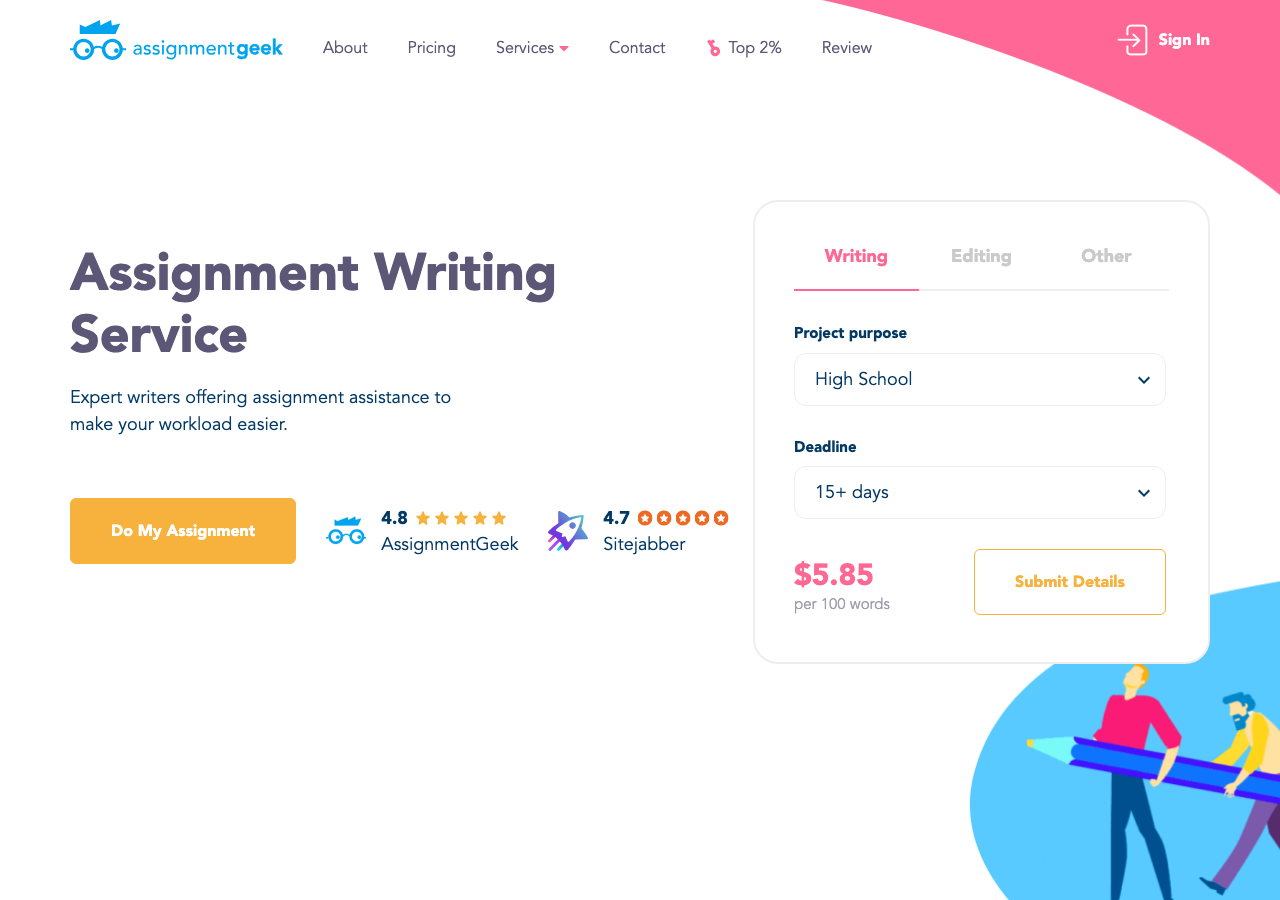
AssignmentGeek arrived in our database under the banner “STEM & tech assignments,” and that tagline matters because most generalist competitors quietly back-fill programming and lab work without naming it on the homepage. Listing problem_set, lab_report, and programming as supported work types means the order form actually accepts a GitHub link, a dataset, and a software version field — which sounds trivial until you have used a generalist that quietly downgrades your prompt to “write a 5-page essay about coding.” On metrics, AssignmentGeek lands at trust 7.4/10 with 6,250 combined Trustpilot and Sitejabber signals, refund behavior 7.6/10, and a starting rate of $15 per page that puts it firmly in the premium-entry band.
The trade-off is quality-risk 4.2/10, which is higher than the dedicated STEM tutoring brands like Nerdify (3.5) and more than a full point above StudyDriver (2.8). That gap is what you would expect from a writer marketplace that scales generalist supply to fit technical demand: most orders come back competent, some come back with code that compiles but does not explain its complexity, and a noisy minority show plagiarized methodology sections that the writer copy-pasted from textbook examples. Treat the deliverable as a draft your TA could mark, not a polished portfolio piece, and the brand’s value becomes legible.
AssignmentGeek is not on the Best Essay Services partner list, which means no cashback on tracked links and no order-protection mediation through our team. Your safety net is your own documentation discipline — screenshots of the cart, the brief sent in writing, and a numbered list of rubric items you will check on delivery. That sounds tedious, but it is the same hygiene we recommend for EssayPro or PaperHelp, and it pays off precisely on the brands where AI-risk metrics sit above 4.0.
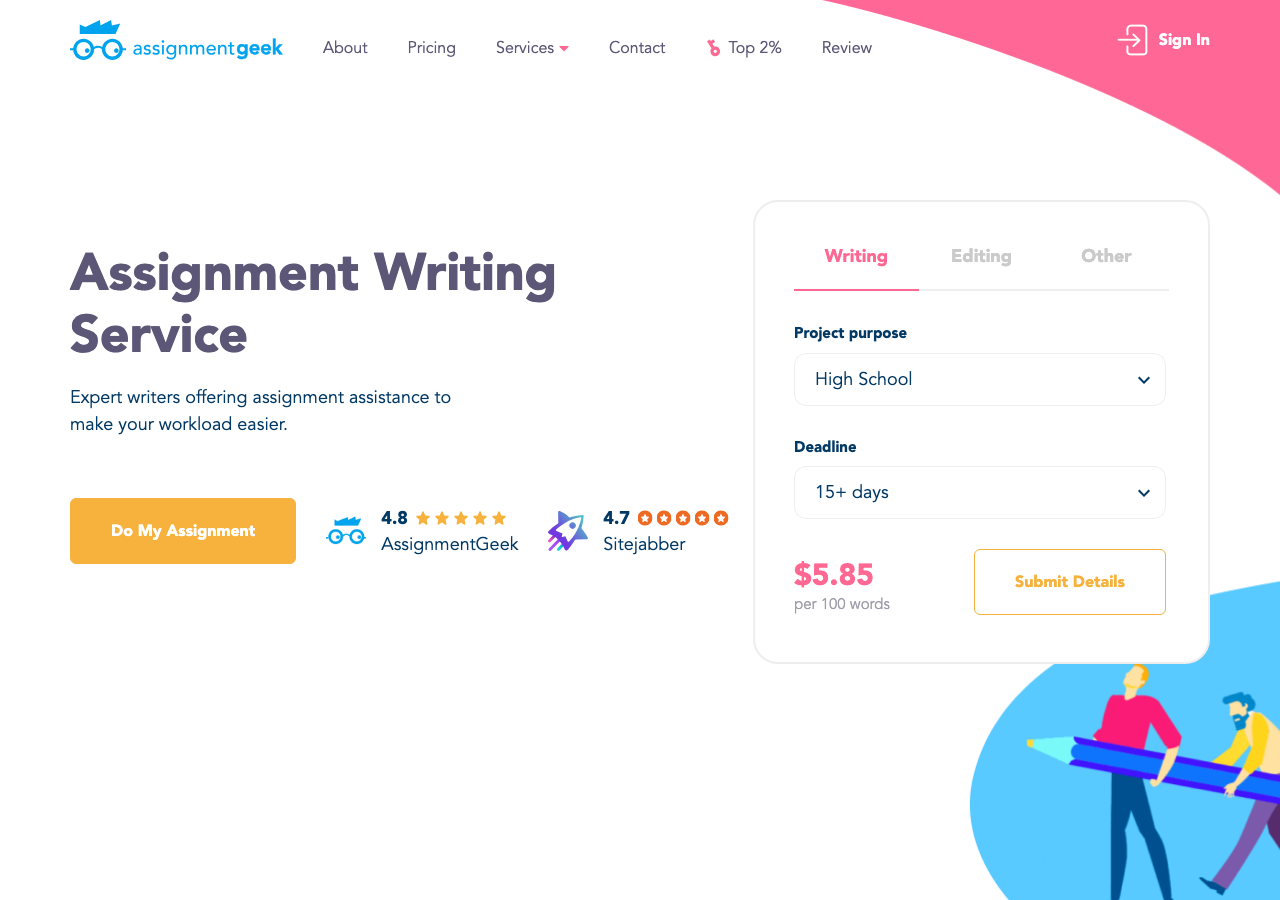
If you only look at the homepage, AssignmentGeek can pass for a tutoring service — calculators, badge mosaic, “our experts hold MS and PhD” copy. Our metric profile says something more specific: this is a writing shop with a respectable STEM lane, not a tutoring marketplace where you book a person. Trust 7.4/10 places it between generalist mid-tiers like EssayBison (7.2) and clearly above caution-tier brands like BestCustomWriting (5.4) and EssayCapital (5.2), so the brand has earned its place in the TOP 100 — it has not earned blind submission.
The work-type catalog is the differentiator. AssignmentGeek lists programming and problem sets next to essays and coursework, and our editorial read is that you should use that surface area honestly: send the assignment with code samples, equations, and the IDE or framework version. Generalist writers asked to “solve” without a working environment will hand back pseudo-code that compiles in their heads, not yours. When you upload the working environment up front, the order becomes a contract instead of a guess.
Public reviews cluster around two themes. Positive Trustpilot stories praise turnaround on standard undergraduate STEM courses — discrete math problem sets, intro statistics homework, lab write-ups for chem or bio labs that already supplied the dataset. Negative themes cluster on senior-year capstone work where the rubric demanded original methodology — a category where AssignmentGeek’s quality-risk score of 4.2/10 is in tension with the assignment grade weight. Read the recent thirty reviews for your subject before assuming the star average covers your case.
Compared with EssayPro (trust 8.7, $14/pg, quality-risk 3.2), AssignmentGeek loses on raw trust and quality-risk but wins on intent matching — EssayPro is a marketplace that can do STEM, AssignmentGeek is a generalist that names STEM in its catalog. For a $35 problem set you are not running through the marketplace browsing flow; for a 12-page senior project you probably should. Run our match tool with your actual deadline and page count before assuming either is cheapest.
Pricing policy
AssignmentGeek’s indexed starting rate is $15 per page from a six-hour minimum deadline. That puts the entry price above PaperHelp ($12), level with the higher-priced generalists, and noticeably above subject-only tutoring brands. The base rate is honest, but it is also the cleanest case in our index: total invoice is rarely the page-rate times the page-count. Academic level, writer tier, six-hour rush multiplier, and plagiarism-report add-ons compose the real total, and the calculator on the homepage rounds in the platform’s favor.
Programming and problem-set work bills slightly differently from prose. AssignmentGeek quotes by page on the calculator but agents will sometimes restate the price by problem count or per-question on chat — useful when your discrete math homework is technically two pages but logically twelve problems. Get the agent restatement in writing inside the order ticket, not over external email, so support can reference the same record when something goes wrong. Verbal pricing promises do not survive refund disputes.
Multi-page coursework at twenty-four hours or longer often lands closer to EssayPro’s totals than rush six-hour tiers would suggest. The brand’s rush multiplier is steeper than its peers — explicitly listed in catalog cons under “rush orders cost extra” — so the value proposition collapses when you stack rush plus premium writer plus add-ons. Realistic budgeting: take the homepage calculator number, add 20–30% for the writer tier and plagiarism report you will be tempted to buy, and treat that figure as the true sticker price.
Refund behavior at 7.6/10 supports revisions and partial credits more than full refunds. AssignmentGeek’s revision policy is workable when you bring rubric evidence — a screenshot of the prompt with grading criteria, a specific list of unmet items, and the original instructions ticket. Vague “the writer used AI” complaints bounce; “the lab report omits the discussion section the rubric requires on page 2” gets writer time. Because there is no partner protection on our tracked links, your documentation is the only escalation lever you have.
Customer support
Live chat is AssignmentGeek’s strongest operational lane. Catalog data flags “24/7 live chat” as one of two highlighted pros, and Trustpilot review samples corroborate that agents respond within a few minutes during US working hours, with slower turnaround on Sunday evenings — the moment STEM students panic most. Use the first ten minutes after payment to confirm writer assignment, citation style, and whether the brief includes attached files. Agents will sometimes upload missing instructions for you if you send them by email — get that written confirmation.
Revision requests are where the support model earns or loses its stars. AssignmentGeek’s scripts respond well to numbered, rubric-anchored requests: “Problem 4 missing the variance step from the lecture notes uploaded as exhibit B” works; “the answer feels generic” does not. Three numbered revision items in one ticket is the editorial sweet spot — fewer reads as triviality, more starts to look like a rewrite request the platform can deflect as scope creep.
Negative themes to watch for: writer reassignment delays during finals weeks, ambiguous communication around add-on packages, and rare cases where the assigned writer’s English is workable for code but rough for the methodology paragraphs that a US TA will mark heavily. None of these are unique to AssignmentGeek — they recur across mid-tier writer marketplaces — but they are the predictable failure modes. Plan a buffer if your draft will need a discussion paragraph rewrite rather than a number-fix revision.
Because AssignmentGeek is outside our partner program, you cannot escalate through Best Essay Services on tracked links. That means the platform’s own ticket queue is your only channel, and the way you write the first ticket determines how seriously it gets taken. Open with the order ID, the rubric quote, the writer message timestamp, and a single revision goal — not a multi-paragraph complaint about value for money.
Features & differentiators
The standout feature is honest STEM coverage. Most generalist services accept programming or lab orders through the same essay form and quietly assign whoever is free; AssignmentGeek’s catalog explicitly lists problem_set, lab_report, programming, and case_study. That metadata is not just marketing — it changes the brief template, the writer-pool routing, and the way support discusses your order. For a circuits homework or a Python pandas assignment, that surface matters more than a one-point trust difference with a generalist competitor.
Writer-tier transparency is mid-pack. AssignmentGeek offers a tier ladder (basic, advanced, top) without the marketplace browsing UI of EssayPro or 99Papers, so you cannot read individual writer profiles before paying. Compare that to a marketplace when the assignment is graded on style or argument and you want to see prior work; choose AssignmentGeek’s tier ladder when the work is graded on correctness — your TA cares whether the proof is right, not whether the writer’s headshot inspires confidence.
Geographically the brand behaves like a US-default generalist with international tolerance. AU and UK students should set spelling and citation manual in caps in the first instruction message, because the platform’s default is US English and APA. Canadian and Australian capstone rubrics often demand Harvard or APA 7 with specific reference list formatting — the writer will not infer that from your timezone, and a generalist STEM workflow does not have a UK-only English variant lane the way UKEssays or AustralianWritings do.
On AI-risk, the 4.2/10 score is the brand’s honest weakness. AssignmentGeek markets human-first writers — a flag we record in the catalog — but human-first marketing is not a Turnitin guarantee, and STEM students are increasingly running their submissions through campus-mandated detectors. Schedule fifteen minutes after delivery to run your own integrity check; if your institution mandates Turnitin AI or Originality.ai screening, run it before submission rather than after a grade dispute.
Smaller niche features: free revisions within a defined window, plagiarism report on request, and a referral discount that recurs in repeat-customer reviews. None of these are unique to AssignmentGeek — Nerdify, EssayBison, and EssayHave offer comparable bundles — but the package is coherent for a STEM-coursework-weekly use case.
Pros and cons
Pro one: explicit STEM and tech catalog coverage. The order form accepts the file types and metadata fields STEM students actually need to upload, which removes the most common friction point on generalist services where lab data gets ignored.
Pro two: trust 7.4/10 with 6,250 combined reviews is solid mid-tier social proof. The brand is not new, the reviews are not thin, and the blended 4.5/5 is consistent with the catalog price.
Pro three: 24/7 live chat with usable response times during US hours, and a writer-tier ladder that lets you trade money for quality on graded work without a marketplace browsing detour.
Con one: quality-risk 4.2/10 — the highest among brands positioning on STEM in our index. Plan to verify code, equations, and citations on every delivery; this is not a fire-and-forget vendor for capstones or graduate assignments.
Con two: rush multipliers are aggressive and explicit in catalog data — six-hour orders feel disproportionately expensive once the writer tier and plagiarism add-on are stacked on the base rate.
Con three: no partner protection on Best Essay Services. You shoulder documentation and escalation yourself; that is workable for a $40 problem set, less comfortable on a $400 senior project.
Con four: writer pool varies by subject — niche topics like systems programming, biostatistics, or upper-division economics need explicit writer-tier upgrades and longer SLAs, or you end up with a competent generalist solving a specialist problem.
Bottom line
AssignmentGeek earns a place in the TOP 100 because it solves a real need — generalist STEM and tech coursework — at a transparent (if not cheap) price, with mid-tier trust metrics and an order form that does not pretend programming is a kind of essay. For weekly problem sets, intro lab reports, and CS 101–301 assignments, the brand is a reasonable default when EssayPro is too busy or you want a flat per-page quote instead of a marketplace bid.
Skip it for graduate methodology, original research proposals, or any assignment where the grading is dominated by integrity tooling — quality-risk 4.2/10 is honest enough to read as a warning, not a hint. For those orders, compare StudyDriver (trust 8.1, quality-risk 2.8) and DissertationGuru, both of which carry quality-risk profiles closer to 3.0 and lower writer-pool variance on capstone work.
Operationally: book six-hour rush only for emergencies that you can re-verify in person, prefer twenty-four hours when sources matter, and pair every order with a rubric upload, English-variant flag, and writer-tier choice that matches grade weight. The brand rewards specific briefs and punishes vague ones; that is the editorial pattern for any service with trust under 8 and quality-risk over 4.
If you are choosing between AssignmentGeek and Nerdify for a single problem set, the deciding question is whether you want a delivered file (AssignmentGeek) or a chat-based tutor walk-through (Nerdify). Different products under similar STEM banners — and the right answer depends on whether your professor will grade your file or your understanding.
What reviewers say
Curated themes from Trustpilot & Sitejabber — paraphrased with attribution. Read live reviews
“Delivery quality varies by deadline — read recent themes before rush orders.”
Trustpilot · Trustpilot · aggregated
“Confirm final price at checkout; homepage quotes may exclude add-ons.”
Sitejabber · Sitejabber · aggregated
“Revision and refund terms frequently discussed — review policy first.”
Trustpilot · Trustpilot · policy
Pros
- Transparent pricing
- 24/7 live chat
Cons
- Writer pool varies by subject
Pricing
- Starting rate $15/page from catalog data — confirm at checkout; totals scale with pages and deadline tier.
- Mid-to-premium pricing band — you are paying for review stability and stronger quality signals vs budget brands.
Deadlines
Minimum deadline 6h — suitable for urgent undergraduate essays. For thesis chapters, prefer 48h+ windows.
Compare alternatives
Who it's for
- Students who want human-first positioning
- Urgent deadlines (3–6h tiers)
- Transparent pricing
- 24/7 live chat
Who should compare alternatives
- Writer pool varies by subject
Student reviews
Loading student reviews…