
Independent review · 2026
OrderEssay Review
OrderEssay (orderessay.com) is the one-click counterpart to GetEssay — trust 6.4/10, quality-risk 3.8/10, $12/page entry, and a six-hour minimum deadline. The brand’s appeal is checkout speed; its weakness is the elevated AI-risk number, which means rush drafts on this catalog are noticeably more likely to read like template prose than at brands a notch up in the trust band. Use it for short undergraduate essays with a generous deadline; do not trust it with anything that crosses your final-grade threshold.
orderessay.com · #70 in TOP 100
One-click ordering
Our verdict
OrderEssay (orderessay.com) is the one-click counterpart to GetEssay — trust 6.4/10, quality-risk 3.8/10, $12/page entry, and a six-hour minimum deadline. The brand’s appeal is checkout speed; its weakness is the elevated AI-risk number, which means rush drafts on this catalog are noticeably more likely to read like template prose than at brands a notch up in the trust band. Use it for short undergraduate essays with a generous deadline; do not trust it with anything that crosses your final-grade threshold.
Overview
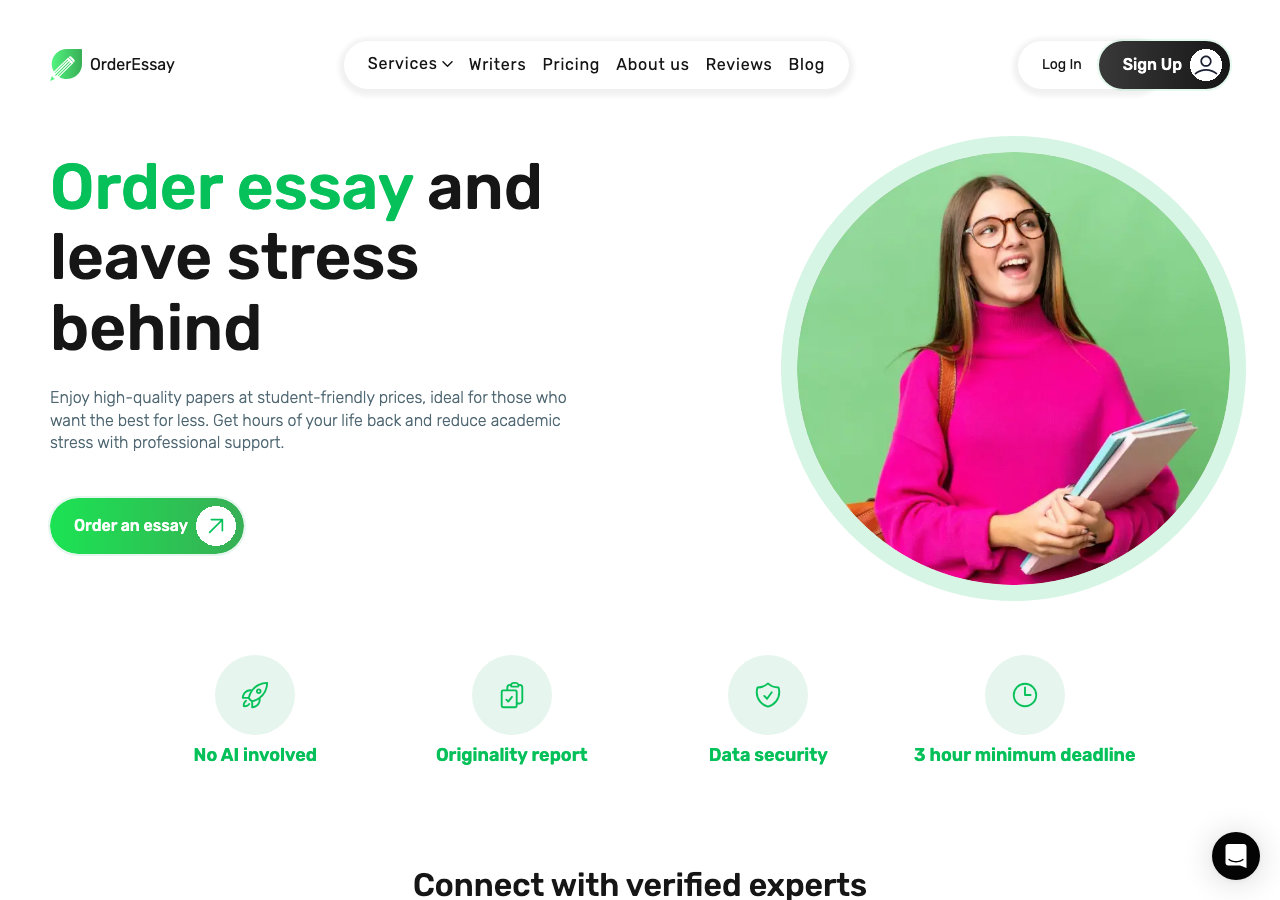
OrderEssay is the simplest checkout flow in our budget-tier shortlist — short order form, transparent calculator, single-screen payment. That positioning competes head-to-head with GetEssay at $11/page and EssayDot at the same minimalist UX cluster. Where it differs is the AI-risk score: 3.8/10 is a step worse than the 3.6 mid-band, which on rush orders means more ChatGPT-shape paragraphs and fewer human transitions in the public complaint themes.
Volume in our snapshot is 4,440 combined Trustpilot and Sitejabber signals — Trustpilot 4.3/5 across about 2,700 reviews and Sitejabber 4.2/5 across about 1,740. Blended 4.3/5 is workable but not class-leading; it is the third-tier band where star averages alone are unreliable, and recent-themes reading matters more than the headline number.
OrderEssay is not a verified Best Essay Services partner, so cashback and protection on tracked links do not apply. The platform’s own dispute path is the only escalation route, and the discipline it demands — checkout screenshot, rubric attached as a file, numbered revision tickets — is the same discipline every brand outside the partner cluster demands. Plan accordingly.
‘One-click ordering’ is the brand’s deliberate identity, and it is the right way to evaluate the catalog. Students who reach OrderEssay want the path from topic to payment to be short. That is the entire feature set on a low-stakes essay, and the design center matches: there is no marketplace, no writer profile gallery, no boutique editing layer. The platform takes the order, matches a writer, and delivers in the chosen deadline tier.
The cost of that simplicity shows up in two places. First, you cannot pre-vet the writer the way you can on EssayPro — you trust the matching layer. Second, the AI-risk score (3.8) sits on the wrong side of the mid-band, which means rush drafts are more likely to read like template prose than the same-priced GetEssay or EssayDot orders. On a graded paper, that risk lands on your edit pass.
Volume of about 4,440 combined signals is enough to confirm OrderEssay is real and recurring. It is not enough to filter Trustpilot by your specific subject and pull a thirty-review cluster confidently. Read the most recent thirty stories and look for repeated complaints about the same operational symptom — slow assignment, ignored rubric, ChatGPT-shape draft — rather than chasing the average.
The closest neighbours inside the index are GetEssay at $11/page on the budget axis and EssayDot at the same minimalist UX cluster with marginally better quality-risk. OrderEssay’s edge is the clean one-click flow; its disadvantage is the AI-risk gap. Pick by which trade-off matches your assignment.
Pricing policy
Indexed entry is $12 per page, which sits between GetEssay ($11) and EssayState ($13). The base rate assumes the longest deadline at the lowest academic level — quote your real assignment in the calculator before celebrating the homepage figure. The cart screen behaves transparently; most surcharges appear before the payment step rather than after.
Six-hour rush economics are where the brand’s metric profile bites. The multiplier on a same-day order is steep enough that a longer deadline at a slightly higher writer tier produces a better paper for the same dollar amount. If your only flexibility is one day in either direction, push the deadline outward, not the budget upward.
Add-ons — top writer, plagiarism scan, abstract, premium editing — sit one click below the cart total. None of them are scams. None of them are mandatory unless the rubric demands them. Decline noise; buy depth where it matches the assignment. Screenshot the itemized cart so any future dispute references actual line items, not memory.
Refund discipline on third-tier brands works on revision-and-partial-credit logic. Full refunds are rare when the SLA was met. The most reliable cost-saver is a longer deadline with a tighter brief in message one — not haggling after delivery on a six-hour rush. The leverage is highest before the writer starts and effectively zero after the deadline passes.
Customer support
Live chat is the channel that matters in the first ten minutes after payment. Confirm writer assignment, restate citation manual, and lock source rules — peer-reviewed-only, year cutoff, minimum count. Agents on this tier route best when the question is concrete; vague ‘please check on my order’ messages return scripts rather than action.
Revision tickets succeed when they read like rubric annotations. ‘Section 2 missing counter-argument per rubric line 4, add 80–120 words’ gets writer time. ‘Sounds AI, rewrite’ does not. Two clean revision rounds will fix more than four sloppy ones; the leverage is precision in round one.
Negative themes in third-party reviews cluster on add-on disputes (resolved with cart screenshots) and ChatGPT-shape rush drafts (the AI-risk profile expressed as student frustration). Both are predictable from the metric profile; both are mostly preventable with deadline discipline and an explicit human-writer-tier upgrade when the platform offers one.
Because OrderEssay is not on our partner protection list, escalation runs through the platform’s own policies. That is a reason to over-document — numbered tickets, rubric attachments, timestamped chat logs — rather than to walk away. The discipline transfers cleanly to verified-partner brands when stakes warrant the upgrade.
Features & differentiators
OrderEssay is differentiated on time-to-cart. The order form is short, the calculator updates in real time, and the payment step is one screen. For a panic order on a low-stakes essay, that is the entire feature set, and it is enough.
Work-type coverage in our catalog includes essay, research, coursework, and homework — generalist undergraduate stack. Admission essays, scholarship statements, dissertation chapters, and law-school memos are technically possible at checkout but do not match the metric profile. Take those to EssayBox, StudyDriver, or DissertationGuru instead.
The six-hour minimum defines the rush ceiling. Compare PaperHelp or WritePaper when the deadline is measured in hours rather than days; OrderEssay can sometimes deliver faster than its floor on simple essays, but the AI-risk profile makes that an expensive bet on a graded paper.
Domain hygiene matters in this band. Type orderessay.com directly or arrive through a known referral link rather than a sponsored search result; budget-tier keywords attract typosquats and mirror sites that look identical until the payment step.
On the comparison axis, OrderEssay reads sensibly against GetEssay (cheaper, similar trust, slightly better AI-risk), EssayDot (similar minimalist UX, marginally better quality-risk), and EssayHave (deeper review base, slightly higher entry). The case for OrderEssay specifically is the cleanest one-click flow when speed of decision matters more than configuration depth.
Pros and cons
Pro one: shortest checkout in the budget tier — useful for panic orders on low-stakes assignments.
Pro two: $12/page entry with declined add-ons stays competitive against same-tier neighbours on long-deadline orders.
Pro three: blended 4.3/5 across about 4,440 reviews — enough volume to confirm operational reality, not enough for subject filtering.
Con one: AI-risk 3.8/10 — elevated relative to the same-priced GetEssay (3.6) and EssayDot. Rush drafts read more like template prose.
Con two: trust 6.4/10 — third-tier band; not the catalog to bet a final-grade-weighted assignment on.
Con three: no partner protection or cashback on tracked links — documentation discipline replaces mediation.
Bottom line
OrderEssay earns consideration when the assignment is short, the deadline is at least six hours, and the grade weight is small enough that a template-flavoured draft is recoverable with a thirty-minute edit. The 6.4/10 trust score does not mean unreliable; it means mid-band, and mid-band rewards careful instructions far more than premium catalogs do.
Skip the brand for thesis chapters, admission packages, and any assignment where originality detection is the dominant grading axis. The 3.8/10 AI-risk number says the obvious thing about template cadence — believe it on graded work.
Run our match tool with your real deadline and page count before assuming OrderEssay is the cheapest option. GetEssay and EssayDot sit close enough on price that the AI-risk gap rarely justifies the dollar saving on assignments that count.
Bookmark orderessay.com after the first successful order so future panic ordering does not start from a sponsored search result. That single habit fixes most of the typosquat risk students report on the budget tier.
On any future order where the deadline allows it, push the SLA out by one tier and re-run the calculator before paying. Six-hour rush converts to twelve-hour for a meaningful price drop, and twelve-hour to twenty-four-hour for a larger one — and the AI-risk profile improves materially as the writer pool widens at longer SLAs. Students who form the habit of comparing two deadline tiers before payment routinely come out ahead on both grade outcomes and total spend, which is the only number that matters at the end of the semester.
If you find yourself returning to OrderEssay because the one-click flow is genuinely the right shape for how you order, accept the AI-risk profile as a fixed cost and budget edit time accordingly. A thirty-minute pass to rewrite the introduction, the conclusion, and one body paragraph in your own voice fixes most of what students dislike about template-flavoured drafts on this band. The brand is not pretending to be something it is not; the metric profile says exactly what to expect, and your edit pass is the part of the workflow that converts the order from acceptable to submission-ready.
What reviewers say
Curated themes from Trustpilot & Sitejabber — paraphrased with attribution. Read live reviews
“Delivery quality varies by deadline — read recent themes before rush orders.”
Trustpilot · Trustpilot · aggregated
“Confirm final price at checkout; homepage quotes may exclude add-ons.”
Sitejabber · Sitejabber · aggregated
“Revision and refund terms frequently discussed — review policy first.”
Trustpilot · Trustpilot · policy
Pros
- Native English writers
- Strong Trustpilot trend
Cons
- Limited weekend support
Pricing
- Starting rate $12/page from catalog data — confirm at checkout; totals scale with pages and deadline tier.
- Mid-to-premium pricing band — you are paying for review stability and stronger quality signals vs budget brands.
Deadlines
Minimum deadline 6h — suitable for urgent undergraduate essays. For thesis chapters, prefer 48h+ windows.
Compare alternatives
Who it's for
- Urgent deadlines (3–6h tiers)
- Native English writers
- Strong Trustpilot trend
Who should compare alternatives
- Limited weekend support
Student reviews
Loading student reviews…