
Independent review · 2026
EduBirdie Review
EduBirdie is the recognizable writer-auction platform — choose your bidder, set a three-hour floor, and pay entry rates near $13 per page — but our index treats it as a high-variance choice: trust 7.9/10 and quality-risk 4.5/10, the weakest AI-risk score in this batch. The auction model can deliver bargains and strong writers; it can also deliver mismatches. Use EduBirdie when you will spend time vetting profiles and accept revision work, not when you need thesis-grade consistency on the first draft.
edubirdie.com · #87 in TOP 100
Writer auction model
Our verdict
EduBirdie is the recognizable writer-auction platform — choose your bidder, set a three-hour floor, and pay entry rates near $13 per page — but our index treats it as a high-variance choice: trust 7.9/10 and quality-risk 4.5/10, the weakest AI-risk score in this batch. The auction model can deliver bargains and strong writers; it can also deliver mismatches. Use EduBirdie when you will spend time vetting profiles and accept revision work, not when you need thesis-grade consistency on the first draft.
Overview
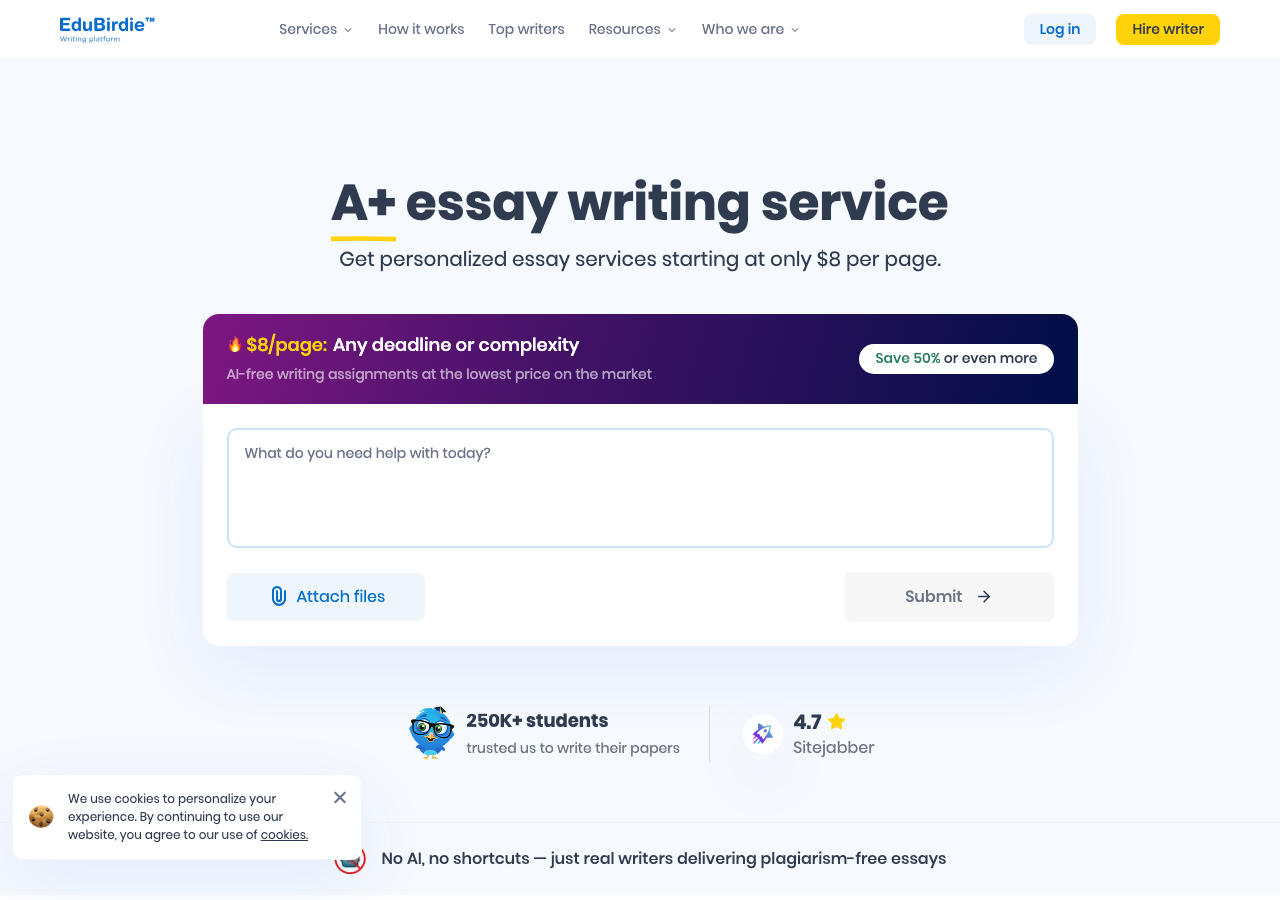
EduBirdie’s brand is synonymous with “pick your writer” in student search behavior — YouTube sponsorships, Reddit debates, and campus word-of-mouth keep the name visible even as trust metrics lag quality-first alternatives. Our index tracks nearly 8,900 combined Trustpilot and Sitejabber signals with a blended score around 4.0/5 — substantial volume, but the trust index at 7.9/10 sits below every major partner in our rush and quality tiers.
The auction model is the story and the risk. Catalog pros cite writer choice and plagiarism checks; catalog cons cite quality variance — both appear constantly in public reviews. Quality-risk at 4.5/10 is the highest among the five brands in this assignment, meaning AI-complaint themes and shallow-draft stories appear more often proportionally than on WritePaper (3.5) or StudyDriver (2.8). EduBirdie is a verified partner with cashback and protection, but our editorial stance is conditional: vet writers, avoid cheapest bids on Turnitin-sensitive work, and budget revision time.
Minimum advertised turnaround is three hours, matching PaperHelp and WritePaper on SLA while undercutting WritePaper on entry price ($13 vs $16). That combination attracts panic orders — exactly when auction variance hurts most. Treat EduBirdie as a marketplace tool, not a default recommendation for uninformed first-time buyers.
EduBirdie occupies the high-visibility, high-variance tier of our TOP 100. It is not trying to be the trust leader or the thesis monastery. It wants to be the platform where students post a job, watch bids arrive, and select a writer based on profile, price, and ratings — with a three-hour minimum deadline for true emergencies. That model is legally and commercially mature; our trust index at 7.9/10 confirms EduBirdie is not a fly-by-night banner. But 7.9 is the lowest score among the five brands covered here, and quality-risk at 4.5/10 demands informed ordering.
The writer auction is EduBirdie’s signature feature and its primary failure mode. Power users who compare five profiles and read recent reviews can outperform fixed-pool assignment; first-timers who choose the lowest bid often learn why “quality variance” tops our catalog cons. Human-first marketing is part of EduBirdie’s public story, yet complaint mining shows disproportionate AI-filler and template-structure themes relative to StudyDriver or CustomWritings — consistent with a 4.5 quality-risk score.
Students discover EduBirdie through influencer content and comparison pages against EssayPro — another marketplace, but one with higher trust (8.7) and lower quality-risk (3.2). The services feel similar at checkout; they diverge in complaint density and refund behavior (EduBirdie 7.0 vs EssayPro 7.8). If you want auction mechanics with stronger indices, Studybay offers flexible bidding with comparable trust (8.0) and lower quality-risk (3.9) at a $9 entry floor — different trade-offs, not a strict upgrade.
In our editorial framework EduBirdie appears in comparisons and geo content because name recognition drives search demand — not because it tops our quality rankings. Recommend it with conditions: writer vetting, revision budget, and avoidance of cheapest bids on high-stakes papers.
Pricing policy
EduBirdie’s indexed starting rate is $13 per page, which places the brand between PaperHelp ($12) and EssayPro ($14) on headline economics while offering auction discounts below that floor when writers underbid. Live pricing sync confirms the entry point, but final totals depend on which bid you accept — a $10 bid from a new writer is not the same product as a $18 bid from a veteran with subject tags. The homepage rate is a anchor, not a contract.
Auction dynamics cut both ways. Flexible bidding can beat fixed-pool brands on total order value when you have time to compare profiles — catalog pros reflect real savings stories on Sitejabber. Rush orders at 3h compress bidding time and push students toward expensive emergency bids or weak cheap bids, both bad outcomes. Our guidance: if the deadline is three hours, consider fixed-pool rush specialists (PaperHelp, WritePaper) where assignment is faster and trust indices are higher.
Plagiarism check upsells appear at checkout and in writer profiles. They can signal seriousness on high-stakes papers but do not replace your own originality review — especially on a platform where quality-risk is 4.5/10. Screenshot accepted bid terms, promised delivery time, and writer ID before payment; disputes without that metadata fare worse in support.
Refund behavior at 7.0/10 is below category leaders. EduBirdie resolves many conflicts with revisions or partial credits; full refunds cluster on documented non-delivery or blatant plagiarism when students file promptly. Expect procedural support scripts — polite but standardized. For partner orders through Best Essay Services, start with EduBirdie support before mediation, but document everything from bid acceptance forward.
Customer support
Support on auction platforms must mediate between students and independent writers — EduBirdie’s chat handles deadline extensions, revision authorization, and bid disputes daily. Response times are adequate on volume nights, though stories about slow escalation exist in Trustpilot samples proportional to nearly 8,900 review signals. Use chat immediately after accepting a bid to confirm the writer saw your files — not only when delivery fails.
Revision policy depends partly on writer cooperation and partly on platform rules. EduBirdie can authorize revisions when complaints cite rubric violations; writers who ghost after delivery trigger support reassignment paths that take time — painful on 3h orders. Budget an extra hour after delivery for review on any EduBirdie order, longer on research papers.
Negative support themes cluster around writer no-shows, bids that looked cheap but delivered filler, and refund denials when delivery technically happened on time. Preventive steps beat reactive fights: reject bids without subject keywords, avoid writers with thin histories, and pay modest premiums for proven completion rates. The catalog pro “Choose writer” only helps if you actually choose carefully.
Partner protection adds mediation for tracked orders, but EduBirdie support must see your bid acceptance timestamp and instruction upload time first. Agents dismiss vague “bad quality” claims; they respond to missing pages, wrong formats, and copied text with specifics.
Features & differentiators
Writer auction with profile browsing is EduBirdie’s headline differentiator against fixed-pool rush shops. You see ratings, bid prices, and sometimes subject tags — power-user tooling that first-timers ignore at their peril. Compared to EssayPro’s marketplace (8.7 trust), EduBirdie offers similar mechanics with weaker aggregate metrics — choose EssayPro when indices matter more than brand nostalgia.
Three-hour minimum deadline is real and attracts panic traffic. EduBirdie shares that floor with PaperHelp and WritePaper but loses on trust (7.9 vs 8.4 and 8.5) and quality-risk (4.5 vs 3.8 and 3.5). For emergencies, fixed-pool rush brands are our default; EduBirdie’s 3h tier is for students who already trust a specific writer on the platform.
Plagiarism check tooling appears in marketing and checkout — a catalog pro reflected in positive reviews when reports matched student expectations. On 4.5 quality-risk platforms, treat included checks as supplementary; run Turnitin or your institution’s tool before submission on graded work.
Work-type coverage includes essays, research, and coursework in our index — broad enough for undergraduate volume, not specialized enough for thesis chapters. StudyDriver and CustomWritings beat EduBirdie on dissertation metrics by wide margins. Admission essays are possible but high-variance; vet writers with prior admission tags or use a higher-trust admission-focused brand.
EduBirdie competes with Studybay in the flexible-bidding cluster. Studybay offers set-your-price auctions with trust 8.0 and quality-risk 3.9 at a $9 entry floor — often better indices for patient bidders. EduBirdie wins on brand recognition and writer pool visibility in English-language markets, not on our trust rankings.
Pros and cons
Pro one: choose-your-writer auction with plagiarism check options — genuine control for students who invest five to ten minutes comparing bids.
Pro two: $13 entry rate and 3h minimum SLA — competitive economics for informed rush orders when you reject suspiciously cheap bids.
Pro three: massive public review footprint near 8,900 signals — extensive narrative to research before accepting any bid.
Con one: quality variance — the catalog con and the defining risk. Quality-risk at 4.5/10 is the highest in this batch; expect editing and revision cycles.
Con two: trust index 7.9/10 — below our preferred 8.0+ threshold for uninformed first orders on Turnitin-sensitive courses.
Con three: refund behavior at 7.0/10 — disputes can be procedural; document bids and files meticulously.
Bottom line
EduBirdie belongs in our TOP 100 because students search for it by name — but our recommendation is conditional. The auction model rewards careful writer selection and punishes cheapest-bid panic buying.
Avoid EduBirdie for thesis chapters and originality-maximum work; use StudyDriver or CustomWritings. Avoid cheapest bids on 3h orders; compare PaperHelp or WritePaper when trust indices matter more than bidding flexibility.
Order via our tracked link for cashback and protection when you proceed — and spend real time on profiles before you accept a bid.
If you want marketplace mechanics with stronger trust, run EssayPro or Studybay in our match tool before defaulting to EduBirdie sponsorship memory.
What reviewers say
Curated themes from Trustpilot & Sitejabber — paraphrased with attribution. Read live reviews
“Delivery quality varies by deadline — read recent themes before rush orders.”
Trustpilot · Trustpilot · aggregated
“Confirm final price at checkout; homepage quotes may exclude add-ons.”
Sitejabber · Sitejabber · aggregated
“Revision and refund terms frequently discussed — review policy first.”
Trustpilot · Trustpilot · policy
Pros
- Choose writer
- Plagiarism check
Cons
- Quality variance
Pricing
- Starting rate $13/page from catalog data — confirm at checkout; totals scale with pages and deadline tier.
- Mid-to-premium pricing band — you are paying for review stability and stronger quality signals vs budget brands.
Deadlines
EduBirdie advertises 3h minimum deadlines — among the fastest in our index. Rush orders carry higher variance in review complaints; allow buffer time for revisions.
Compare alternatives
Who it's for
- Students who want human-first positioning
- Urgent deadlines (3–6h tiers)
- Choose writer
- Plagiarism check
Who should compare alternatives
- Quality variance
Student reviews
Loading student reviews…