
Student guides
Rush Orders 3h/6h/12h: What Outcomes Are Actually Realistic
Rush marketing promises miracles; writer pools deliver distributions. Set expectations before you pay urgency fees.
Updated June 2026
What rush actually buys
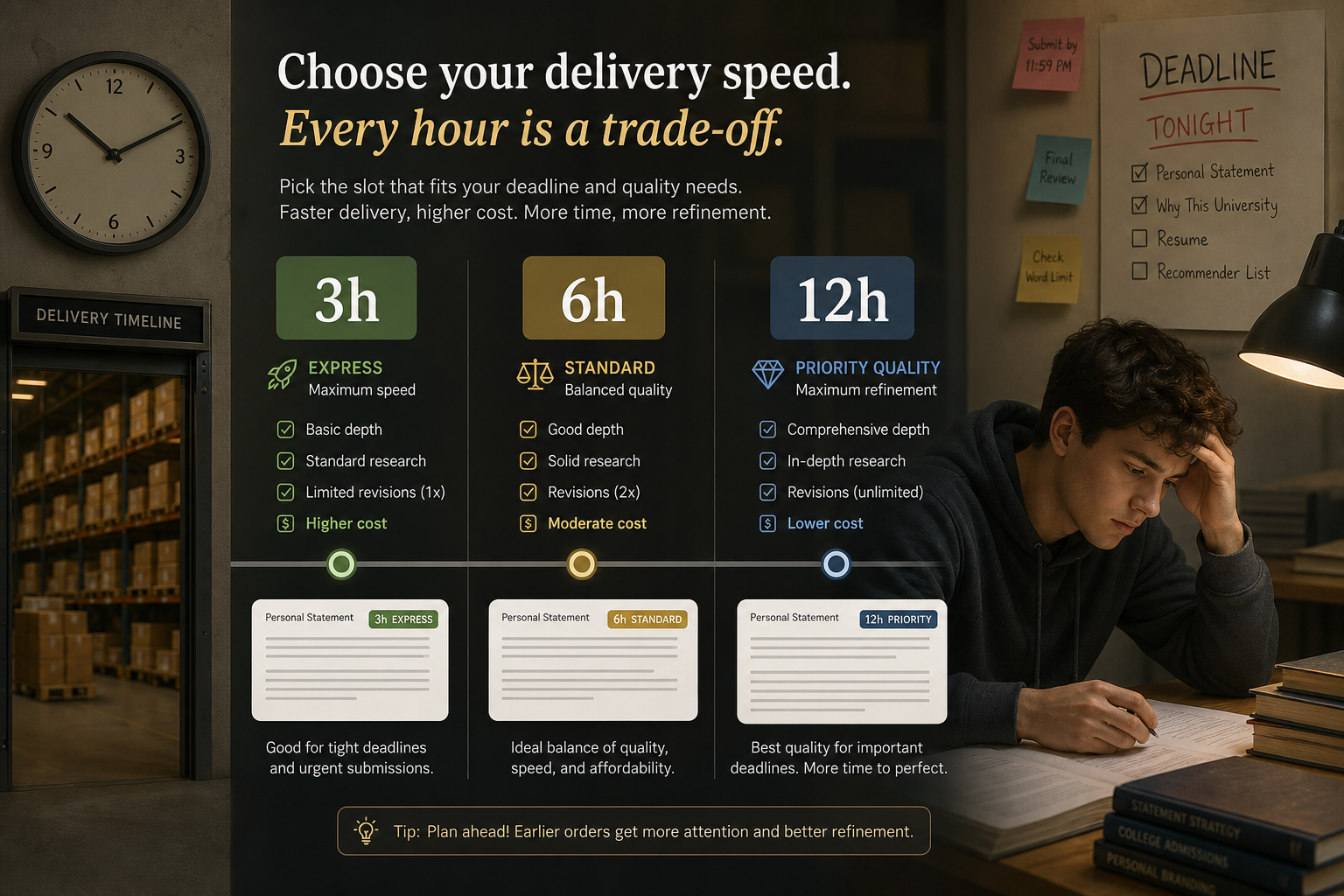
Rush fees purchase queue priority, not guaranteed quality. When you select a three-hour, six-hour, or twelve-hour delivery tier, your order moves to the front of the assignment pool and draws from writers who are online and available immediately. That is the entire mechanical benefit. The writer who picks up your rush order is not necessarily more skilled than the writer who would have taken it at the standard seven-day tier — they are simply awake, available, and willing to work under compressed time. Quality and speed are independent variables that marketing pages conflate on purpose. Rush surcharges buy queue position in a shared pool — ask whether they also buy a different writer tier.
Urgency pricing follows supply and demand logic. At midnight before a morning deadline, rush demand spikes and writer availability thins. The platform charges a premium because the matching problem is harder, not because it has unlocked a secret tier of elite writers. Some services do maintain dedicated rush teams with higher qualification floors, but many simply reprice the same pool. Ask support whether rush orders route to a different writer tier or the same pool at a higher rate. The answer tells you whether the surcharge buys capability or just speed in a shared queue. Peak-night rush demand thins writer supply; premiums reflect matching difficulty, not guaranteed excellence.
Rush also compresses your revision window. If a draft arrives three hours before your course deadline and it misses rubric requirements, you may have time for one quick fix pass — not a full revision cycle. Rush buys delivery speed at the cost of post-delivery flexibility. Factor that trade-off before paying: a rush order that arrives on time but wrong is worse than a standard order that arrived yesterday with room for two revision rounds. The invoice shows a successful rush; your grade shows a failed paper. Compressed delivery compresses revision time — on-time arrival with wrong scope still fails the course deadline.
Quality bands by SLA tier
Three-hour tiers produce the widest quality variance. Realistic outcomes for a three-hour order: a rough draft with basic structure, generic analysis, and sources that may not meet your faculty's credibility standards. Unrealistic expectations: polished argumentation, specialized subject expertise, perfect citation formatting, and rubric-complete coverage. Three-hour orders work as emergency scaffolding — something to rewrite heavily — not as submission-ready work for graded research papers. Treat three-hour delivery as a starting point for your own editing sprint, not as a finished product. Three-hour tiers produce scaffolding, not submission-ready research writing — plan a heavy rewrite pass.
Six-hour and twelve-hour tiers add enough time for one research pass and a structured outline, which improves average quality noticeably. Realistic outcomes: a draft that hits main rubric rows with uneven depth, citations that need manual verification, and voice that requires a substantial editing pass before submission. These tiers suit shorter assignments — three to five pages with familiar topics — more than complex research papers requiring ten or more scholarly sources. Expect to spend one to two hours after delivery on verification and voice editing even when the rush draft is "on time.". Six- and twelve-hour windows allow one research pass; depth will be uneven even when delivery is punctual.
Compare quality bands by reading rush-specific reviews on third-party platforms. Filter for reviewers who mention their deadline tier: "ordered six-hour rush, got draft on time but sources were mostly web pages" is more useful than "fast delivery, great service." Quality at rush tiers follows a distribution, not a guarantee. Your brief quality, subject complexity, and page count determine where you land on that distribution more than the rush label on the invoice. Reviews from rush customers are the closest thing to an expected outcome forecast you will get. Rush reviews filtered by SLA tier beat generic praise that hides subject-specific misses.
Subject and length limits
Not every assignment can be rushed responsibly. A three-page reflection essay on a novel you have read is a plausible rush candidate. A fifteen-page nursing care plan with peer-reviewed sources and APA formatting is not — regardless of what the pricing calculator allows you to select. Platforms often permit rush orders at lengths and complexity levels their writer pool cannot serve well, because the checkout form does not gatekeep — it just adds a surcharge. The calculator's willingness to accept your order is not a quality assessment. Checkout forms accept orders the writer pool cannot responsibly complete — sales logic is not quality logic.
STEM and clinical subjects carry higher rush risk than humanities summaries. Lab reports, statistical analyses, and problem sets require accuracy that compression undermines. A writer who completes a six-hour economics essay may produce acceptable prose; a writer who completes a six-hour organic chemistry mechanism set in the same window is more likely to produce errors that cost you grade points and learning gaps. Subject matter sets the floor on minimum viable turnaround, and that floor is often higher than the platform's shortest SLA option suggests. STEM accuracy degrades faster than humanities prose under extreme compression — price accordingly.
Length limits for rush orders are practical, not published. As a rule: under five pages with fewer than five sources, twelve-hour rush is sometimes viable. Under three pages with no research requirement, six-hour rush may work with heavy editing. Three-hour rush is viable only for short, low-stakes writing with minimal sourcing — and even then, plan a full rewrite pass before submission. If the platform accepts your rush order without flagging complexity, that acceptance is a sales decision, not a quality assessment from someone who read your brief. Practical length ceilings for rush are lower than calculators imply — treat long rush orders as high risk.
Partner rush vs budget rush
Premium services with named rush tiers often route orders to writers with verified credentials and track records on short deadlines. Budget marketplaces apply the same rush surcharge but draw from a broader, less vetted pool. The price difference between premium rush and budget rush is not just branding — it often reflects different assignment logic, quality review steps, and revision support availability after delivery. Premium rush sometimes includes a human QA pass; budget rush typically does not. Premium rush sometimes includes QA delay that budget rush skips — those minutes matter on twelve-hour timelines.
Partner rush services may include a post-delivery quality check before the draft reaches you — an extra thirty to sixty minutes that budget services skip. That check catches obvious formatting errors, missing sections, and plagiarism flags before you lose revision time reviewing them yourself. Budget rush delivers the writer's output directly to your inbox. On a twelve-hour timeline, that quality check can be the difference between a fixable draft and a submission that fails basic requirements you no longer have time to repair. Budget rush late delivery may trigger no refund while premium partial credit policies are more enforceable.
When comparing rush options, ask the same pre-payment questions at both price points: writer tier, revision SLA after rush delivery, and refund terms for late rush orders. A budget rush that arrives two hours late on a six-hour SLA may offer no refund because the policy excludes "partial delay." A premium rush with the same delay may trigger automatic partial credit. The rush surcharge at premium tiers sometimes buys enforceable guarantees, not just faster assignment — verify which before choosing based on price alone. Stakes assessment comes first: rush is a gamble on editing time you may not have after delivery.
A rush-order decision tree
Start with stakes. Low-stakes, short, familiar topic, and you have two hours to edit after delivery? Rush may be worth the surcharge. High-stakes, research-heavy, unfamiliar topic, or no post-delivery editing time? Do not rush — negotiate an extension with your instructor or reduce scope and write it yourself. Rush is a tool for time compression, not a substitute for preparation. Using rush on a paper worth thirty percent of your grade because you procrastinated is a gamble, not a strategy. Deadline arithmetic exposes impossible timelines before you pay urgency fees for false hope.
Next, check remaining time arithmetic. Subtract delivery SLA, minimum one-hour review, and at least one revision cycle from your course deadline. If the math goes negative before you order, rush cannot save you — the structural timeline is already broken. Example: six-hour deadline, six-hour rush tier, zero revision buffer equals accept whatever arrives or miss the deadline. Only proceed if you have buffer beyond the SLA. Students who skip this arithmetic pay rush premiums and still miss deadlines because they had no room for the revision the first draft inevitably requires. Pre-set walk-away criteria prevent panic acceptance of drafts that miss core rubric rows.
Finally, set your acceptance criteria before paying. Write down the minimum rubric rows the draft must hit to be worth editing rather than abandoning. If the draft arrives and misses those rows, invoke revision immediately — do not spend your remaining hours trying to salvage a fundamentally wrong paper. Rush orders fail more often on scope misses than on late delivery. Knowing your walk-away criteria before payment keeps panic from turning a bad rush into a submitted disaster you cannot explain in office hours. Rush works best as emergency structure for low-stakes short assignments — not as thesis rescue.
Compare services with real review data
Use our match tool or read ranked reviews before you order — human writers, tracked cashback on partners, and quality index scores side by side.
Related reading
More in blog
Ranking guides