
Student guides
Revision Policy Decoded: What Actually Matters Before You Pay
Revision policy language is where disputes are won or lost. Learn which clauses matter and how to lock scope before money moves.
Updated June 2026
Free revisions vs paid rewrites
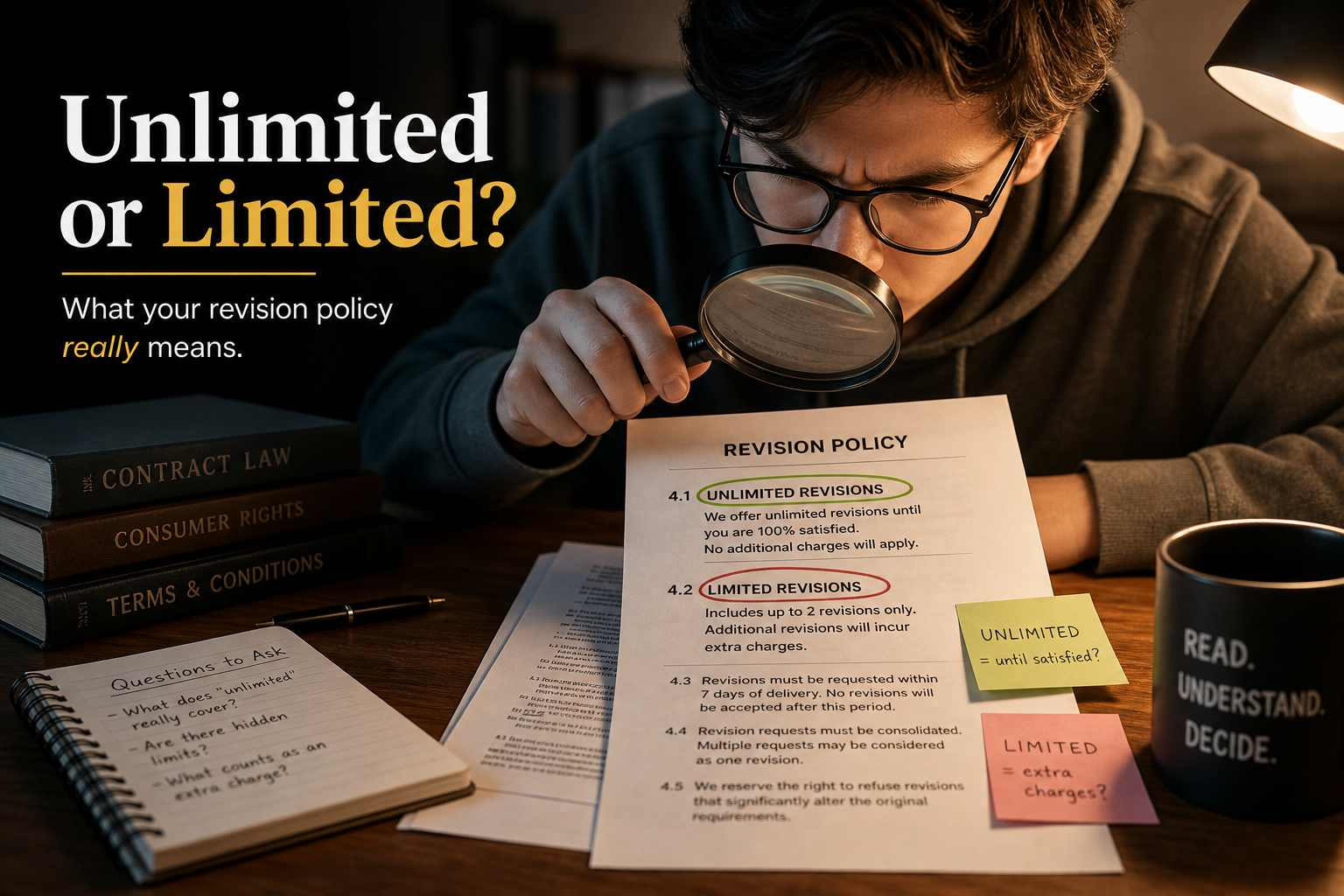
Most essay services advertise "free unlimited revisions," but the word "unlimited" rarely means what you expect. Free revision clauses almost always come with scope restrictions: revisions address deviations from your original instructions, not new directions you thought of after reading the draft. Change your thesis after delivery? That is often classified as a new order. Ask for three additional sources not mentioned in your brief? Same classification. The revision policy defines what counts as a fix versus what counts as an expansion — and companies classify expansions as billable whenever possible. Marketing teams love the word unlimited; dispute teams love narrow definitions of what counts as a valid revision.
Paid rewrites enter the picture when you exhaust free revision rounds or when support decides your request falls outside policy scope. Some platforms offer a paid rewrite at a discount; others require a full new order at standard pricing. The gap between free and paid is where most student frustration concentrates. You believed you were buying a paper that matched your rubric; the company believes it delivered what your brief requested and your revision requests are scope creep. Both sides have a case, which is why the brief and the policy matter more than the marketing headline on the pricing page. The free-versus-paid boundary is where support training focuses — because that is where margin is protected.
Before paying, ask support to define the boundary in writing: "If the draft misses a rubric row I included in my brief, is that a free revision or a paid rewrite?" Screenshot the answer. Also confirm how many revision rounds are included and whether "unlimited" resets on a timer — some policies allow unlimited revisions for fourteen days, then close the window entirely. Free revision marketing is a starting point for negotiation, not a guarantee. Decode the clause before you need it, because post-delivery support will interpret ambiguity in the direction that limits their labor cost. Valid tickets read like defect reports with page numbers; invalid tickets read like disappointment diaries.
Scope: what counts as a valid ticket
A valid revision ticket references a specific gap between your brief and the delivered draft. "The paper does not address rubric row three on methodological limitations" is valid. "I do not like the tone" is vague. "Add two more pages of analysis on Topic X using sources Y and Z as specified in my original instructions" is valid. "Make it better" is not. Companies process tickets that read like defect reports; they defer or deny tickets that read like general dissatisfaction. The language you use in the ticket determines whether it enters the rewrite queue or the rejection pile. Scope locked in message one becomes the evidence support must address when writers miss rubric rows.
Scope disputes often hinge on what was in your original order form versus what you discussed in chat. If your brief said APA 7 and the draft uses APA 6, that is a clear valid ticket. If your brief said "APA" without specifying edition and the draft uses APA 7 but your instructor wanted APA 6, the company may argue you did not specify. This is why locking citation style, page limits, source count, and rubric rows in message one matters — those details become the scope boundary that determines whether your revision request gets actioned or rejected with a copy-paste policy quote. Structured ticket categories route your request to people empowered to assign rewrites instead of closing chats.
Some platforms require you to submit revision requests through a structured form with dropdown categories: formatting, content, sources, grammar. Use the category that matches your issue and attach a rubric map showing the miss. Tickets submitted through the correct channel with documented scope get faster responses than free-text complaints sent to general support. Learn the ticket format before you need it, ideally by asking support to walk you through the process during your pre-payment test chat. Format compliance is bureaucratic, but bureaucracies reward compliance. Timer triggers vary silently between vendors — confirm whether the clock starts at delivery or at your acceptance click.
Timers and escalation paths
Revision windows run on clocks, and those clocks start at different triggers depending on the policy. Some companies start the revision period at first delivery; others start it at your acceptance click. A few start it at the original deadline regardless of when the draft actually arrived. Read the timer trigger carefully. If your revision window is fourteen days from delivery but the company delivered three days late, you may have less effective revision time than you assumed — especially if your course deadline falls inside that window and you cannot wait for a second draft. Escalation packages with timestamps beat escalation emails that restart the story from zero each time.
Escalation paths exist for when frontline support denies your revision request. Typically the path runs: writer → support agent → senior support or quality team → refund review. Each level requires you to resubmit evidence rather than restate frustration. Keep a single document with your brief, the delivered draft, a rubric map highlighting misses, and every support response timestamped. When you escalate, forward the complete file — not a new complaint from scratch. Escalation teams action packages that look like cases, not messages that look like venting. Case files win; tone alone does not. Revision SLAs longer than your remaining course deadline make the policy useless regardless of draft quality.
Response time SLAs within the revision window vary widely. Some services promise revision turnaround in twenty-four hours; others say "up to seventy-two hours" without guarantee. If your course deadline is forty-eight hours after expected delivery, a seventy-two-hour revision SLA means the policy is structurally incompatible with your timeline — regardless of draft quality. Match revision timer and SLA to your actual deadline before paying, and build in at least one full revision cycle before your submission cutoff. Timer math is where revision policy meets real-world deadline pressure. Rubric maps turn subjective frustration into rows a quality team can verify without re-reading your syllabus.
Documenting rubric misses
A rubric map is the single most effective revision document you can submit. Take your instructor's rubric and create a three-column table: rubric criterion, what the brief requested, what the draft delivered. Fill in the third column honestly — acknowledge rows the draft hit correctly, because credibility matters. Highlight rows where the draft falls short with specific evidence: page numbers, missing sections, wrong source types, formatting errors. This format converts subjective disappointment into auditable claims that support teams can forward to writers without reinterpretation or scope arguments. Screenshots accelerate revision processing because they remove interpretation from support-to-writer handoffs.
Attach side-by-side screenshots when the miss is visual: wrong margin width, missing cover page, incorrect heading levels, bibliography formatted in the wrong style. Writers and support agents process images faster than paragraphs of description. Include your original brief as an attachment even if it is already in the order history — support staff often work from ticket systems that do not display order form details inline. Make it effortless for the person reading your ticket to confirm you are right without opening four different system tabs. Timeline documentation matters when support delay eats the revision window you thought you purchased.
Timestamp everything. Note when the draft was delivered, when you first reviewed it, when you submitted the revision request, and when you received the response. If the revision window is fourteen days and support takes five days to respond with a denial, you need that timeline documented to argue that their delay consumed your revision allowance. Documentation turns rubric misses from a he-said-she-said conversation into a record that escalation teams and payment processors actually read when you push beyond frontline support. Hidden policies and acceptance catch-22s are structural signals to choose a different vendor before paying.
Revision policy red flags
Red flag one: the policy does not appear on the website until after you create an account, or it lives in a PDF buried three clicks deep in the footer. Transparency before payment is a legitimacy signal; hidden policies suggest the company prefers you not to read the terms until you are committed. Red flag two: "all sales final" language with no revision clause at all. No reputable operator in this market survives without some revision mechanism — total finality means total risk transfer to you. Two red flags together usually predict revision denial patterns described in recent two-star reviews.
Red flag three: revision requests require you to accept the draft as "satisfactory" before requesting changes. This catch-22 closes your ticket channel the moment you acknowledge receipt. Red flag four: support redefines your rubric-based revision request as "subjective feedback" in every response without engaging with the specific misses you documented. Pattern denial is a strategy — it wears you down until your deadline forces acceptance. Red flag five: the policy caps revisions at one round for orders over ten pages. Long papers need more revision cycles, not fewer. Reading revision terms before checkout is cheaper than learning them during a missed-deadline panic.
If you encounter two or more of these red flags, treat the revision policy as unenforceable regardless of what the marketing page promises. Either choose a different vendor or adjust your order strategy: shorter scope, earlier deadline, lower stakes, and a plan to finish the rewrite yourself if the first draft misses. Revision policy is not fine print — it is the contract clause that determines whether you get what you paid for or eat the loss. Read it before checkout, test it in pre-payment chat, and walk away when the flags stack up.
Compare services with real review data
Use our match tool or read ranked reviews before you order — human writers, tracked cashback on partners, and quality index scores side by side.
Related reading
More in blog
Service reviews
Ranking guides