
Student guides
Refund Disputes in Essay Services: How to Win With Evidence
Refund chats go nowhere without evidence. Build a dispute file the way support teams actually read tickets.
Updated June 2026
What platforms classify as refundable
Refund eligibility starts with the published policy, not with your disappointment. Most essay services classify these scenarios as refundable: complete non-delivery past the deadline, plagiarism above their stated threshold, or failure to follow core brief requirements after revision attempts are exhausted. Partial delivery — a draft that arrived late but exists — usually triggers partial credit rather than full refund. Subjective quality complaints ("I do not like the writing style") almost never qualify unless you can map the issue to a specific brief requirement the writer ignored. Refund rules reward cases that fit categories, not students who sound the most distressed in chat.
Policies also distinguish between refund and revision rights. A company may agree your draft missed the source count but offer a free rewrite instead of money back. You can accept the rewrite, reject it and push for refund, or accept it while documenting that the first delivery failed — preserving your refund option if the rewrite also misses. Know which path you are on before you click "accept delivery," because some platforms treat acceptance as waiver of refund claims for that delivery. Acceptance clicks have legal weight in dispute threads even when you clicked under deadline panic. Acceptance clicks can waive refund rights — know what you clicked when the draft first arrived.
Pre-payment chat promises can expand refundable scope if you documented them. If support confirmed "full refund if the draft does not follow APA 7 as specified" and the draft uses MLA, that screenshot overrides generic policy language in your favor. Platforms hate this, which is exactly why you capture promises before paying. Refund classification is a rules engine — your job is to show that your case matches a rule, not to argue that you deserve sympathy because the deadline was stressful and the grade mattered to your GPA. Pre-payment screenshots become enforceable promises when generic policies are ambiguous after delivery.
Building a timestamped evidence file
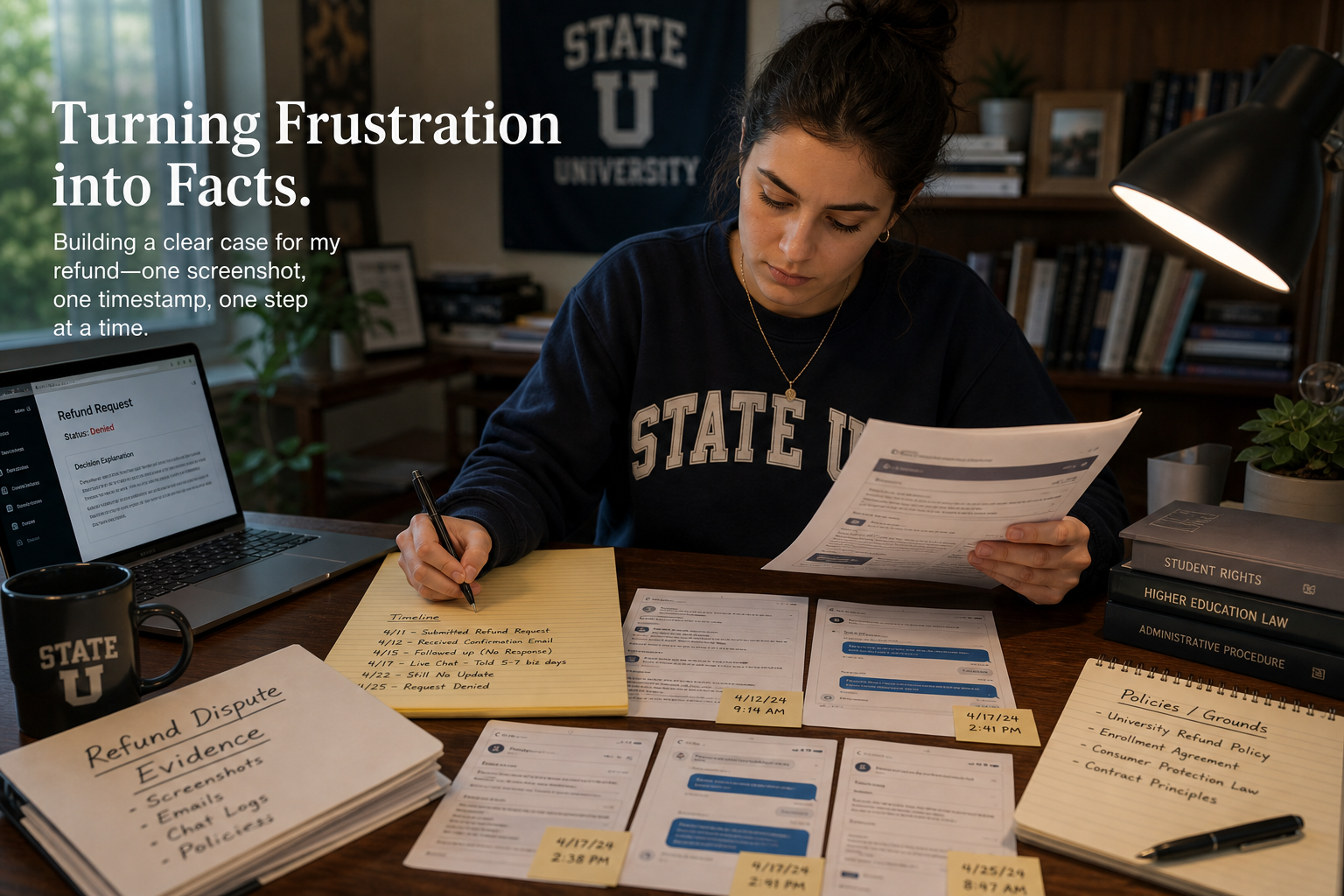
Start your evidence file the moment you place the order, not when something goes wrong. Create a folder with subfolders: brief, payment, delivery, revisions, support. Save your order confirmation with itemized pricing. Screenshot your brief as submitted. Log every support interaction with date, time, agent name, and full text. When the draft arrives, note the delivery timestamp against your deadline and save the file immediately — before any edits — as "delivery_v1_original." That pristine copy becomes the baseline for every later claim about what changed and when. Evidence folders started at order placement beat folders assembled after support denies your first request.
The core dispute document is a one-page timeline. Row format: date/time, event, evidence file name. Example: "2026-03-14 22:03 — Draft delivered, 18 hours past deadline — delivery_v1_original.docx." "2026-03-15 09:15 — Revision ticket submitted citing rubric rows 2 and 4 — ticket_4471_screenshot.png." "2026-03-17 14:00 — Support denied revision, classified as subjective — ticket_4471_denial.png." Timelines turn a folder of screenshots into a narrative that refund reviewers can process in under five minutes without reconstructing chronology themselves. Timelines let refund reviewers decide in minutes instead of asking you to re-tell the story twice.
Add a rubric map and a brief comparison table to the file. Three columns: requirement, brief specification, delivery reality. Attach the plagiarism report if their report shows issues, or your independent check if theirs does not. Include the pre-payment chat screenshot where support made any promise relevant to your claim. Evidence files win disputes because they remove interpretation from the conversation. Support can argue with your feelings; they struggle to argue with a timestamped folder that matches their own ticket system records line by line. Rubric maps and brief tables remove adjectives from refund claims — support prefers nouns and page numbers.
Writing tickets support will action
Open refund or escalation tickets with a subject line that states the claim category, not the emotion: "Refund request — non-delivery past deadline" or "Refund request — brief requirements not met after revision denied." First paragraph: order number, date, amount paid. Second paragraph: the specific policy clause or pre-payment promise your case satisfies. Third paragraph: bullet list of evidence attachments with file names. Fourth paragraph: the resolution you are requesting (full refund, partial credit, re-assignment). Close with your availability for follow-up. Total length: under two hundred words. Brevity respects the reviewer's queue and keeps your claim focused. Subject lines that name claim categories route tickets to refund queues instead of general chat agents.
Do not lead with threats of chargebacks, social media posts, or legal action in your first ticket. These statements trigger defensive responses and sometimes route your ticket to a slower queue. Lead with evidence. Mention chargebacks only if the ticket is denied after escalation and your timeline shows good-faith attempts to resolve internally. Support teams action tickets that look like standard refund reviews; they defer tickets that look like extortion attempts — even when the underlying claim is valid and the student is simply frustrated. Threat-first emails slow resolution; evidence-first emails get forwarded to people with refund authority.
Use the company's own vocabulary. If their policy says "quality assurance review," request a quality assurance review — do not invent your own process name. If their ticket form has a "refund" category, use it rather than sending a general chat message that may not enter the refund workflow. Match their system and their language. Tickets that fit the workflow get processed; tickets that bypass it get lost in general support queues where agents lack refund authority and default to closing conversations without resolution. Partial credits can be reasonable or traps depending on waiver language — read before you accept.
Partial credits vs full refunds
Partial credit offers appear when the company acknowledges some failure but argues you received partial value. Late delivery with a usable draft? Partial credit. Draft hit eight of ten rubric rows? Partial credit. One revision round completed before you requested refund? Partial credit. Evaluate partial offers against your actual loss: if the draft is unusable and you wrote the paper yourself anyway, partial credit does not compensate your time. If the draft needed heavy editing but saved you research hours, partial credit may be reasonable depending on the amount offered. Counter-evidence negotiations focus on documented hours lost, not on how unfair the situation feels.
Negotiate partial offers with counter-evidence, not counter-emotion. "Your offer of thirty percent credit does not account for the six hours I spent rewriting sections 3 and 4 to meet rubric rows the writer missed, documented in attachment E." This reframes the negotiation from "I am unhappy" to "your number does not match the documented damage." Some companies increase partial offers when faced with organized evidence; others hold firm. Know your walk-away point before entering the negotiation — usually the amount where accepting credit costs more than pursuing chargeback or writing off the loss and moving on. Chargebacks work when internal channels fail and your file shows good-faith resolution attempts.
Accept partial credit only with written confirmation of the amount, the credit expiration terms, and a waiver statement. Read the waiver carefully: some partial credit offers require you to close all dispute channels permanently, including chargeback rights. If the waiver language is broad, ask for narrower terms or decline the credit. A partial refund that closes your chargeback option is only a good deal if the credit amount genuinely compensates your loss and the company has a track record of honoring credits on future orders you actually plan to place. Issuer review favors whichever party submitted timestamps, rubric maps, and policy clause matches.
When card disputes make sense
Card disputes — chargebacks — are the escalation tool when internal refund channels fail. They make sense when you have documented non-delivery, documented plagiarism above policy thresholds, or documented brief violations that support denied after multiple escalation attempts. They do not make sense for subjective quality complaints without brief-mapped evidence, or when you accepted delivery and used the paper without raising issues within the revision window. Chargebacks require a paper trail that shows you tried to resolve internally first. Card network deadlines are hard stops — calendar them when you pay, not when you get angry.
Chargebacks require you to submit your evidence file to your bank or card issuer, not to the essay service. The issuer reviews your claim against the merchant's response, which typically includes delivery records, chat logs, and the company's refund policy. Your timestamped timeline and rubric map are decisive here because issuers process claims quickly and favor the party with clearer documentation. Incomplete evidence leads to denial, and repeated frivolous chargebacks can affect your account standing with your bank over time. Factual escalation notices sometimes unlock final review tiers that frontline chat cannot access.
Initiate chargebacks before the issuer's deadline — usually sixty to one hundred twenty days from the transaction, varying by card network and bank. Notify the company that you are escalating to your payment provider, not as a threat but as a factual update: "Internal refund request denied on [date]. I am filing a dispute with my card issuer. Order #[number], evidence attached." This message sometimes triggers a final review by someone with actual refund authority. If it does not, proceed with the chargeback using your evidence file. Disputes are won with records, not with rage. Records beat rage in every channel: support, quality teams, issuers, and conduct offices if it comes to that.
Compare services with real review data
Use our match tool or read ranked reviews before you order — human writers, tracked cashback on partners, and quality index scores side by side.
Related reading
More in blog
Service reviews
Ranking guides