
Student guides
Nursing and STEM Assignments: Why Generalist Services Fail
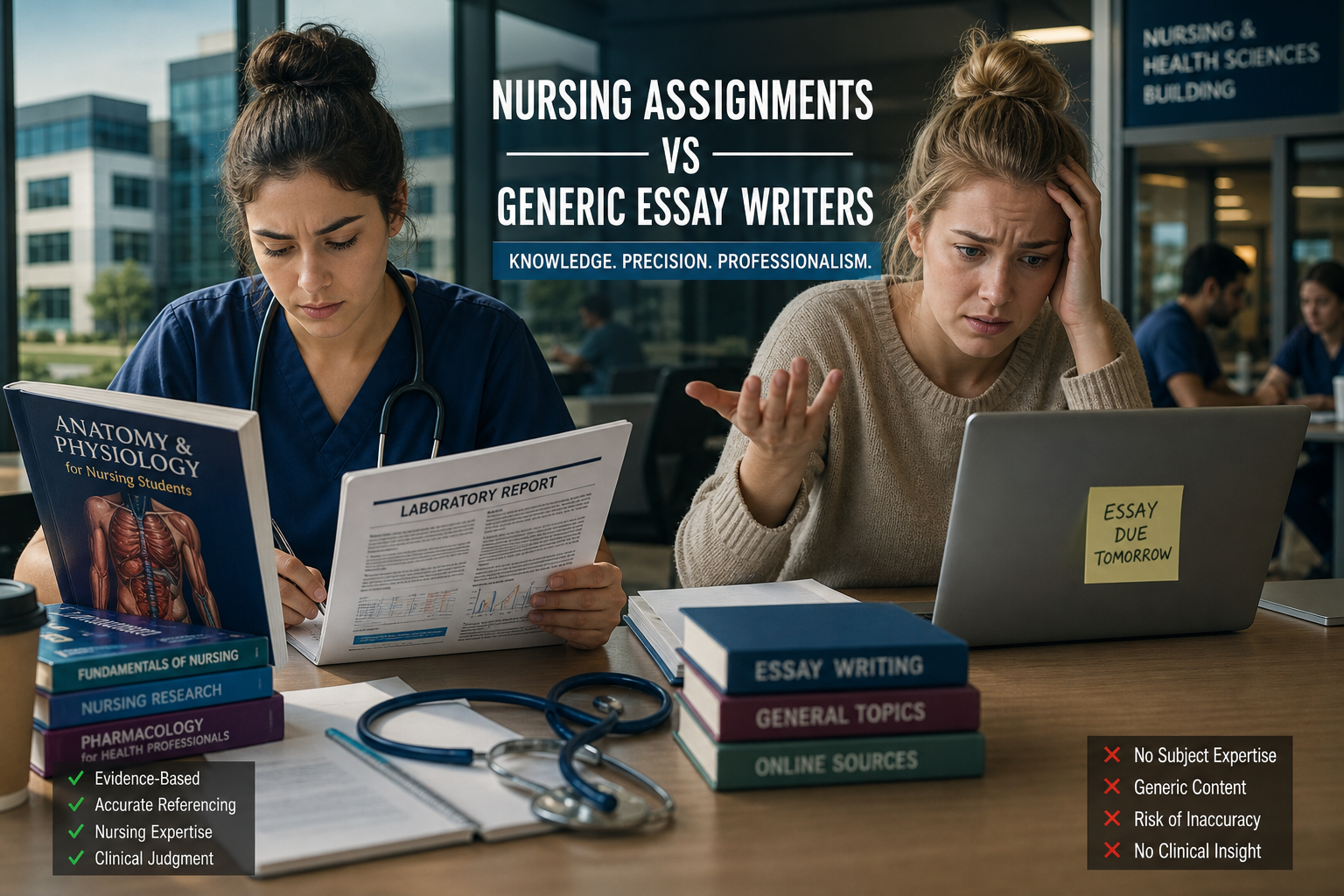
Humanities writers miss dosage tables and lab units. Specialist routing is not snobbery — it is rubric survival.
Updated June 2026
Rubric rows generalists skip
Nursing and STEM rubrics hide requirements in rows generalist writers never read: calculation show-work, unit consistency, care-plan linking to NANDA terminology, lab uncertainty reporting, figure captions with acceptable significant figures. A humanities writer delivering a fluent discussion section still fails the assignment when the methods table uses the wrong units or the care plan omits measurable outcomes that the rubric weights heavily enough to erase an otherwise readable narrative. Micro-orders reveal silent reassignment that wipes the portfolio signals you verified yesterday. Number rubric rows in your brief so support cannot claim technical criteria were invisible. Copy rubric weights beside row numbers so writers see which technical lines matter most.
Generalist marketplaces optimize for throughput. Writers rotate across history essays, marketing case studies, and biology lab reports in the same shift. They rely on templates — introduction, three body sections, conclusion — that map poorly to IMRaD reports, clinical reasoning grids, or structured SOAP notes. The prose sounds fine; the genre is wrong, and genre errors cost more points than awkward sentences in lab courses where the TA grades the table before reading your adjectives. Score specialist fit with a matrix instead of trusting universal expert claims on the homepage. Degree checkboxes do not prove clinical or lab competence — ask for subject tags and samples. Humanities templates fail SOAP grids even when the sentences sound compassionate.
Before ordering, copy every rubric row into your brief and ask support to confirm writer assignment by specialty, not just academic level. If they cannot name the documentation standard your program uses, assume the writer will guess. Guessing is how students lose points on rows worth thirty percent of the grade while earning praise from roommates for readable paragraphs that miss every technical criterion the instructor circled in red on the sample rubric. VIP labels without direct writer chat are faster queues, not verified nursing or STEM credentials. Simulation rubrics grade named protocols; empathy without taxonomy still loses weighted rows. UK and US documentation headings are not interchangeable without explicit briefing.
Nursing documentation norms
Nursing assignments punish vague empathy and reward structured clinical reasoning. Care plans must connect assessment findings to interventions with timelines and evaluation criteria. Reflective journals must tie ward observations to evidence-based practice, not generic feelings about caring. Generalist writers often produce compassionate essays that omit the taxonomy instructors grade — diagnosis labels, measurable goals, citation to current clinical guidelines your simulation instructor expects by name. Reject the assignment when the writer cannot discuss rubric rows in discipline vocabulary aloud. Name country and program in message one because documentation headings change by region. Simulation scenarios should appear in pre-order tests, not only in the final brief.
Documentation norms also vary by region. UK OSCE-style reflections differ from US APA care-plan formats. A writer who mastered one template may apply the wrong headings. Specialist nurses or nursing tutors recognize acuity language, contraindication checks, and when to cite NICE, CDC, or institutional protocols. Generalists cite whatever Google returns first and call it evidence-based without checking publication year or jurisdiction, which is how students fail patient-safety rows quietly. MasterPapers, OxEssays, and UKEssays differ by pool quality — verify tags, not logos, at checkout. A short terminology test beats retaking a clinical course over one wrong NANDA label. Error bars and unit propagation are often worth more points than fluent discussion.
Pre-order test: send a one-paragraph scenario from your rubric and ask the vendor to draft only the assessment and plan sections in two hundred words. Wrong terminology in the reply predicts a failed order. Right terminology saves you a rewrite night and protects patient-safety grades that treat precision as non-negotiable rather than stylistic preference. Keep the scenario realistic — vitals, allergies, and orders your rubric already names — so the test mirrors the real assignment rather than a generic wellness essay. Require one worked calculation sample before accepting a full lab report from a stranger. Oral lab checkoffs expose invented constants faster than any similarity report.
STEM figures and units
STEM instructors grade figures before they read prose. Axes labels, error bars, significant figures, and unit propagation through calculations are where generalist orders collapse. A writer who describes results narratively while your rubric demands a typed lab notebook format with sequential calculations will cost you marks even if the conclusion sounds scientific and confident enough to fool a roommate who never opened the lab manual. TAs often score figures before prose; missing error bars cap grades in the first pass. Specify software, manual style, and significant-figure rules in message one.
Unit errors are especially dangerous because they look like competence until a TA checks. Mixing milliliters and microliters, reporting torque in wrong dimensions, or copying constants without sources suggests you did not run the experiment — or your writer invented data. Either triggers integrity scrutiny in lab courses with strict authenticity rules and oral checkoffs where you must explain one calculation from memory without reading the submitted PDF. Oral checkoffs expose invented numbers faster than similarity dashboards students trust. Micro-orders reveal reassignment that wipes the specialist you thought you hired.
Specify deliverable format in obsessive detail: software for graphs, citation style for lab manuals, whether handwriting-style calculation scans are required, which uncertainty formula your department uses. Specialist STEM writers ask clarifying questions; generalists assume Excel and hope for the best. Your brief should read like a lab TA wrote it, not like a marketing page describing academic writing in general terms that never mention significant figures or propagation rules. List uncertainty rules explicitly because generalists rarely ask and rarely apply them. Matrix scoring beats homepage adjectives about universal expert coverage.
Pre-order specialist tests
Specialist routing is verifiable before payment. Ask for a writer ID with subject tags visible in the marketplace, not just top writer badges. Request a prior anonymized excerpt in your field — redacted care plan, lab report methods page, problem-set solution with work shown. Vendors who refuse samples hide variance you will pay for later when the delivered file cannot survive ten minutes with your instructor's rubric and the comments section fills with missing row complaints. Micro-orders reveal silent reassignment that wipes portfolio signals you verified yesterday. VIP tiers without nurse or engineer tags are queue upgrades, not specialty proof.
Run a paid micro-order if the stakes are high: one page, narrow scope, tight deadline. Evaluate whether the writer uses discipline jargon correctly, follows your rubric row order, and responds to technical revision requests without hand-waving. A failed micro-order is cheaper than a failed clinical course that delays licensure pathways and repeats tuition you already borrowed for. Micro-orders also reveal whether support reassigns writers without telling you, which erases every portfolio signal you verified. Score specialist fit with a matrix instead of trusting universal expert claims on homepages. Premium spend belongs on licensure-adjacent work, not on drill worksheets.
Compare two services with a scoring matrix: subject filter availability, writer messaging before acceptance, revision responsiveness on numeric corrections, and reviews mentioning nursing or engineering by name. Generalist sites score well on price and speed; specialist fit shows up only when you grade those categories explicitly instead of trusting homepage adjectives about expert writers who somehow cover every discipline equally well at the same per-page rate. VIP labels without direct writer chat are faster queues, not verified clinical credentials. Reject writers who cannot name the protocol your rubric already requires.
When to pay premium tiers
Premium tiers earn their cost when failure is expensive: capstone clinical courses, ABET-accredited lab sequences, licensure-adjacent assignments with zero tolerance for documentation error. Saving thirty dollars on a writer without verified specialty background is false economy when retaking a lab costs tuition and delays graduation by a semester you cannot afford to lose while clinical placements fill without you. Spend premium on capstone, ABET labs, and licensure-adjacent work — not routine drills. Patient-safety rows treat precision as mandatory, not as stylistic polish.
Premium should buy identifiable expertise, not just faster delivery. Confirm you can message the writer directly, reject mismatched assignments, and escalate to a subject lead. VIP labels without those mechanics are marketing. Pay more when the order includes data you collected, calculations that must match your notebook, or care scenarios tied to real simulation rubrics your instructor grades with a checklist rather than subjective praise for compassionate tone. Reject assignments when writers cannot discuss rubric rows in discipline vocabulary aloud. Genre errors cost more than awkward phrasing in most STEM lab rubrics.
Conversely, do not overpay for low-stakes STEM homework with single-right-answer problems unless your program treats every lab as high stakes. Route premium spend toward assignments where rubric rows reference professional standards, patient safety, or experimental integrity — the places generalists fail loudly and specialists fail rarely. MasterPapers, OxEssays, and UKEssays offer tiered access; the tier only matters when it maps to a verified specialist, not a faster queue that still assigns a historian to your pharmacology care plan. MasterPapers, OxEssays, and UKEssays differ by pool — verify tags, not logos, at checkout. MasterPapers, OxEssays, and UKEssays differ by pool — verify tags before pay.
Compare services with real review data
Use our match tool or read ranked reviews before you order — human writers, tracked cashback on partners, and quality index scores side by side.
Related reading
More in blog
Service reviews
Ranking guides