
Independent review · 2026
You.com Review
You.com is a search-and-chat hybrid that tries to occupy the territory between Perplexity's cited research mode and a standard AI chat assistant, offering access to multiple model backends including GPT-4o, Claude, and Gemini through a unified search-adjacent interface. Essay fit 6.8 reflects a genuinely useful tool for early-stage research discovery — finding angles, generating search terms, surfacing source candidates — that falls short of being a reliable full-draft engine. The hybrid nature is its unique selling point and its principal limitation: it does too many things adequately to do any of them with the consistency a high-stakes essay demands.
you.com · #25 in TOP 50
Search + citations
GPT · Claude · Gemini
Our verdict
You.com is a search-and-chat hybrid that tries to occupy the territory between Perplexity's cited research mode and a standard AI chat assistant, offering access to multiple model backends including GPT-4o, Claude, and Gemini through a unified search-adjacent interface. Essay fit 6.8 reflects a genuinely useful tool for early-stage research discovery — finding angles, generating search terms, surfacing source candidates — that falls short of being a reliable full-draft engine. The hybrid nature is its unique selling point and its principal limitation: it does too many things adequately to do any of them with the consistency a high-stakes essay demands.
Overview
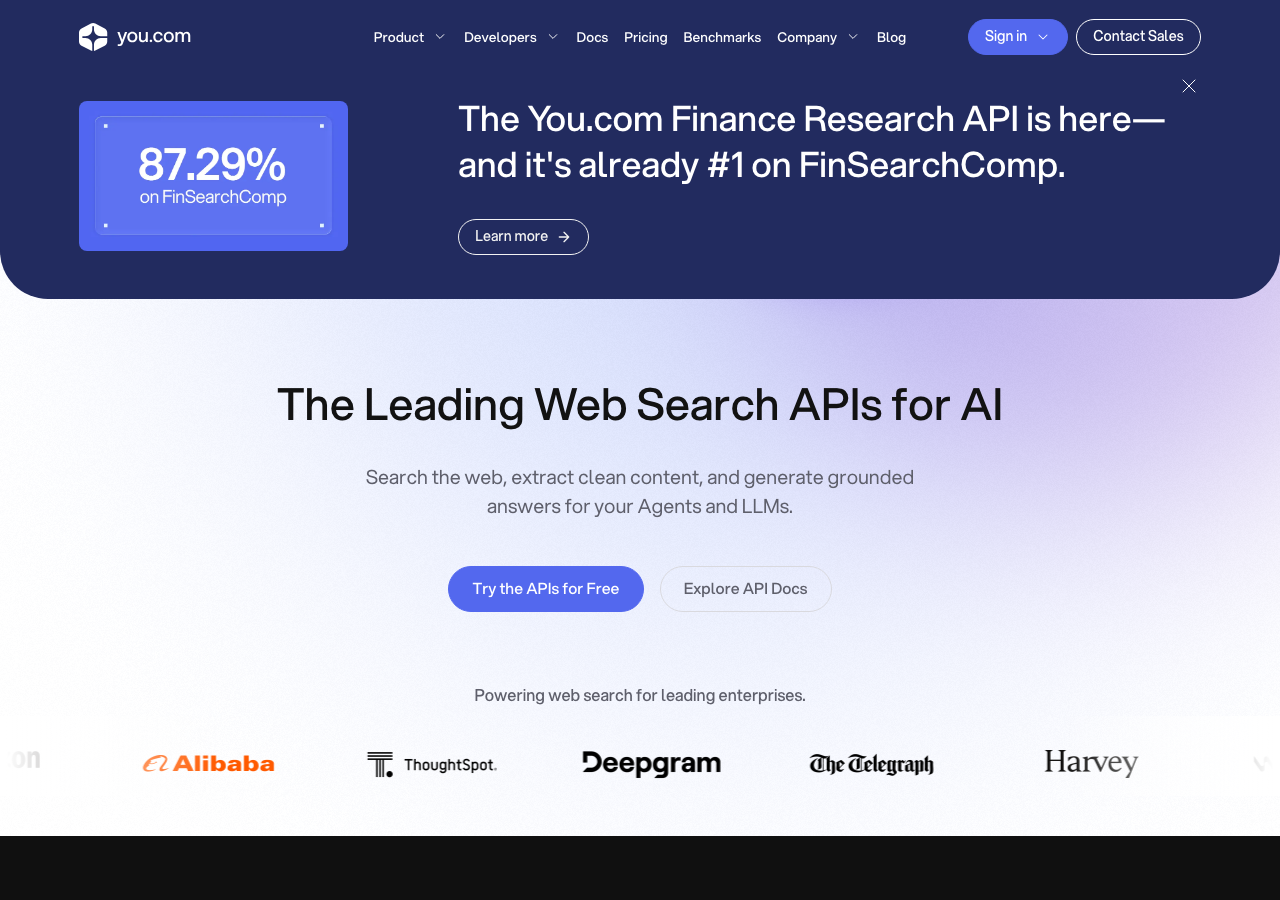
You.com launched as a privacy-conscious Google alternative and evolved into an AI-powered research platform. By 2025–2026 the product has settled into a mode where users can switch between a traditional web search interface, a chat mode powered by selectable LLM backends, and a research mode that attempts to combine web retrieval with AI synthesis. The free tier offers access to all three modes with usage limits, and a paid YouPro subscription removes most caps and unlocks additional model options.
For students, the appeal is intuitive: if you are researching a topic, you want both search results and explanatory prose at the same time. Perplexity Pro has built a strong subscription business on the same insight, but You.com offers a free alternative with a different feature emphasis. The critical question for essay writing is whether the chat and research modes produce output reliable enough to incorporate into academic work — and the honest answer is that they require more verification effort than Perplexity Pro and deliver less consistent quality than the frontier single-model chat interfaces.
Search-chat hybrid mechanics
You.com's research mode works by retrieving web results for your query, extracting relevant passages, and synthesizing them into a prose response with inline citations. In principle, this should produce more grounded output than an offline language model that confabulates sources from training memory. In practice, the quality of synthesis depends heavily on which sources the retrieval system surfaces, how accurately passages are extracted, and whether the underlying LLM correctly attributes claims to the right sources.
The citation quality in You.com's research mode is generally better than no-retrieval-at-all models, but it is not as carefully structured as Perplexity Pro's citation system. You.com will sometimes attribute a claim to a source that, when you follow the link, does not actually contain that claim — the retrieval found a relevant-looking page, the model generated a plausible sentence, and the two were associated without tight verification. This is a subtle failure mode that can slip past students who trust inline citations without clicking through.
Chat mode — purely conversational without web retrieval — follows the same patterns as the model you select. If you choose GPT-4o, you get GPT-4o quality with GPT-4o limitations. If you choose a Llama backend, you get the corresponding open-weight model quality. You.com does not enhance the model's underlying capabilities; it provides an access interface and, in research mode, a retrieval layer. This distinction matters because some students assume the platform adds polish or safety to the model's output beyond what the raw model produces.
The model switcher is a meaningful feature: the ability to run the same research query through GPT-4o and then through Claude Sonnet in the same interface, comparing how each frames the source material, is a genuine analytical advantage for students writing about contested topics. You.com makes this comparison more convenient than maintaining separate tabs on two different platforms.
Essay research and discovery workflows
The highest-value use case for You.com in academic workflows is initial topic exploration — what researchers call the 'literature landscaping' phase before formal database searches. A student who knows they want to write about urban heat islands and climate adaptation but does not know what the current research debates are can ask You.com's research mode to give an overview of recent scholarship and will typically receive a useful starting map: key authors, recent meta-analyses, ongoing debates between adaptation approaches, and policy implementation gaps.
This output is not citable in itself — it is synthesis over web sources, not a peer-reviewed summary — but it gives the student a vocabulary set, a list of names to search in Google Scholar, and a sense of which sub-questions are most contested. That is a legitimate research acceleration that does not require the student to submit AI-generated text as their own analysis. Think of it as a reference librarian who reads fast rather than a ghostwriter who writes clean.
For thesis statement brainstorming, You.com's chat mode with a frontier model backend performs comparably to using that same model in its native interface. Ask for five candidate thesis statements on your topic, evaluate each against your assignment criteria, and use the best as a starting point for your own refinement. The platform adds no extra capability here but also adds no friction compared with going directly to ChatGPT or Claude for the same task.
Bibliography bootstrapping is where You.com's hybrid nature shows its value most clearly. Ask the research mode to surface five to eight recent high-citation papers on a specific question, note the titles and authors, then verify each against Google Scholar or your university library system. You will often find that three of the eight are real and highly relevant, two are real but less relevant than the synthesis suggested, and two or three are fabricated or misattributed. The three that are real give you verified starting points for a proper database search. This is faster than starting a cold database search from scratch, but the verification step is non-negotiable.
Model backend selection and quality implications
You.com's free tier provides access to what the platform labels as 'Smart' mode — typically a mid-range model that varies by period but has included Claude Haiku, GPT-4o mini, and occasionally a Llama instruct variant. The YouPro subscription unlocks GPT-4o, Claude Sonnet, and Gemini 2.5 Pro as selectable backends. The quality gap between free and paid backends is significant for essay-quality analytical prose, though less important for search-aided research discovery.
On the free tier, 'Smart' mode is useful for short tasks — rewrite this paragraph, expand this bullet, check this argument for internal consistency — but shows its limitations on longer analytical tasks. A five-paragraph argument about postcolonial theory will get the structure right but will flatten the nuance in ways that a Claude Sonnet or GPT-4.1 response would not. Students who try You.com's free tier for substantive essay drafting and find it underwhelming are often comparing against a paid frontier model, not the free-tier equivalents — which are closer in quality than the comparison suggests.
The Genius mode (research-augmented) adds web retrieval to any backend, including the free-tier model. The retrieval layer improves factual grounding on current events and recent publications while simultaneously adding the citation verification burden described above. For topics where the training cutoff matters — anything in economics, technology, or current policy from late 2024 onward — the Genius mode is worth using even on the free backend, with the understanding that every citation requires a click-through.
Privacy implications of backend selection are worth noting: when you route your query through You.com to a GPT-4o backend, you are sending your text through You.com's infrastructure before it reaches OpenAI's API. You.com's privacy policy describes what data they retain and for what purposes; the answer is different from OpenAI's policy. Students with privacy concerns should read both policies before treating You.com as a privacy upgrade over direct ChatGPT use — it is not automatically more private simply because it is not called ChatGPT.
Honest limitations for academic essay work
You.com's essay fit score of 6.8 reflects several genuine limitations that students should understand before building workflows around the platform. First, the hybrid interface creates cognitive context-switching between research and drafting modes. Effective academic writing requires sustained focus on an argument; the You.com interface is designed for exploration and retrieval, not for the linear, focused drafting process that produces strong essays. The temptation to run another research query mid-paragraph interrupts the drafting rhythm in ways that single-mode tools do not.
Second, the synthesis quality in research mode varies substantially by topic domain. For topics with rich, clearly-written English web sources — mainstream science communication, public policy debates, technology business — the synthesis is useful. For topics with primary sources in non-English languages, technical scholarly literature, or historical archives poorly represented on the open web, the retrieval layer brings in thin or irrelevant material and the synthesis suffers accordingly. A student writing about contemporary Turkish political economy will find You.com's research mode less useful than a student writing about US climate policy.
Third, You.com's chat history and project management features are less developed than Claude's Projects or ChatGPT's memory features. If you are working on a multi-week paper and want the AI assistant to remember your thesis, your argument structure, and your style preferences across sessions, You.com requires manual re-seeding of context at the start of each session. This is a workflow friction cost that adds up over a long project.
Fourth, the platform's audience is broad — it includes general information seekers, students, developers, and business users — which means its system prompt tuning is not optimized for academic writing specifically. Claude.ai and ChatGPT have both invested in features and prompt defaults tuned for writing and analysis tasks; You.com's defaults are tuned for general-purpose search augmentation. Students need to supply more explicit framing in their prompts to get academically appropriate output.
Comparison with Perplexity
The most natural comparison for You.com is Perplexity, which has dominated the AI-search category in student adoption. Perplexity Pro consistently outperforms You.com's research mode on citation reliability, synthesis quality, and interface polish. Perplexity Free is a reasonable comparison with You.com's free tier, and the two are closer in quality, with Perplexity having an edge on structured citations and You.com having an edge on model-backend flexibility.
Where You.com differentiates is in the chat mode with selectable backends — Perplexity's chat is more search-focused and less flexible as a pure drafting assistant. A student who wants one tool for both research retrieval and general drafting might find You.com's model switcher more versatile than Perplexity's more unified experience. But versatility at the cost of quality polish is a tradeoff that favors power users over students who need reliable output quickly.
For students who have a YouPro subscription and are comparing with Perplexity Pro at the same price point, the decision comes down to workflow preference: Perplexity for research-first tasks where citation quality matters most, You.com for sessions where you want to switch between research and drafting modes without leaving the platform.
Bottom line
You.com earns essay fit 6.8 as a genuinely useful research-phase tool and a moderately capable drafting assistant, held back by citation reliability gaps and interface design that prioritizes breadth over the sustained focus that strong essay writing requires. It is a better research companion than a drafting engine.
The right student for You.com is someone doing early-stage literature exploration on a free budget, who wants to switch between search and chat without opening multiple tabs, and who understands that every citation and factual claim needs manual verification before it appears in a submitted document. The wrong student is someone expecting Perplexity Pro quality at Perplexity Free price points — the overlap is partial, not complete.
Compare Perplexity Free for cleaner citations on a zero budget; compare Perplexity Pro for the definitive paid research-AI product; compare Claude Free if drafting quality matters more than retrieval in your workflow.
Pros
- Hybrid search-chat interface useful for early-stage research discovery and topic landscaping.
- Model switcher allows GPT, Claude, and open-weight backend comparison in one platform.
- Research mode provides cited synthesis — better grounding than offline-only models.
- Free tier is usable for short tasks and bibliography bootstrapping.
Cons
- Citation reliability in research mode requires click-through verification — not as tight as Perplexity Pro.
- Free-tier backend quality is mid-range — analytical essay quality below frontier subscription tools.
- Hybrid interface creates context-switching friction that disrupts sustained drafting.
- Research mode weaker on non-English-language and specialized scholarly source domains.
- Platform privacy through model backends requires reading two privacy policies, not one.
- Session memory and project management less developed than Claude or ChatGPT.
Pricing
- You.com has a free tier or free product access — rate limits and model caps apply; paid upgrades may exist on you.com.
- Flagship stack: GPT · Claude · Gemini. Features and model names change; verify before you subscribe.
Models & access
GPT · Claude · Gemini. Availability, rate limits, and regional restrictions change — confirm on you.com before subscribing.
Compare alternatives
Who it's for
- Hybrid search-chat interface useful for early-stage research discovery and topic landscaping.
- Model switcher allows GPT, Claude, and open-weight backend comparison in one platform.
- Research mode provides cited synthesis — better grounding than offline-only models.
- Free tier is usable for short tasks and bibliography bootstrapping.
Who should compare alternatives
- Citation reliability in research mode requires click-through verification — not as tight as Perplexity Pro.
- Free-tier backend quality is mid-range — analytical essay quality below frontier subscription tools.
- Hybrid interface creates context-switching friction that disrupts sustained drafting.
- Research mode weaker on non-English-language and specialized scholarly source domains.
Student experiences
Ratings from students who used You.com on real assignments — includes critical reviews.
Loading student reviews…
2,018 words · Updated 2026