
Independent review · 2026
Together AI Chat Review
Together AI Chat sits at the intersection of developer infrastructure and consumer AI interface — a hosted open-model platform where the same Llama, Qwen, and DeepSeek models powering production AI applications are accessible through a browser chat at chat.together.ai. Essay fit 6.2 is an honest score for the category: the models are capable, the selection is wide, and the interface is minimal enough that its value is entirely determined by whether you know which model to pick and how to prompt it effectively. For students who know what they are doing with open-weight models, Together AI Chat is a powerful free resource. For students who just want a clean drafting assistant, there are better-calibrated options with friendlier interfaces.
together.ai · #31 in TOP 50
Open-weight chat
Open-weight catalog
Our verdict
Together AI Chat sits at the intersection of developer infrastructure and consumer AI interface — a hosted open-model platform where the same Llama, Qwen, and DeepSeek models powering production AI applications are accessible through a browser chat at chat.together.ai. Essay fit 6.2 is an honest score for the category: the models are capable, the selection is wide, and the interface is minimal enough that its value is entirely determined by whether you know which model to pick and how to prompt it effectively. For students who know what they are doing with open-weight models, Together AI Chat is a powerful free resource. For students who just want a clean drafting assistant, there are better-calibrated options with friendlier interfaces.
Overview
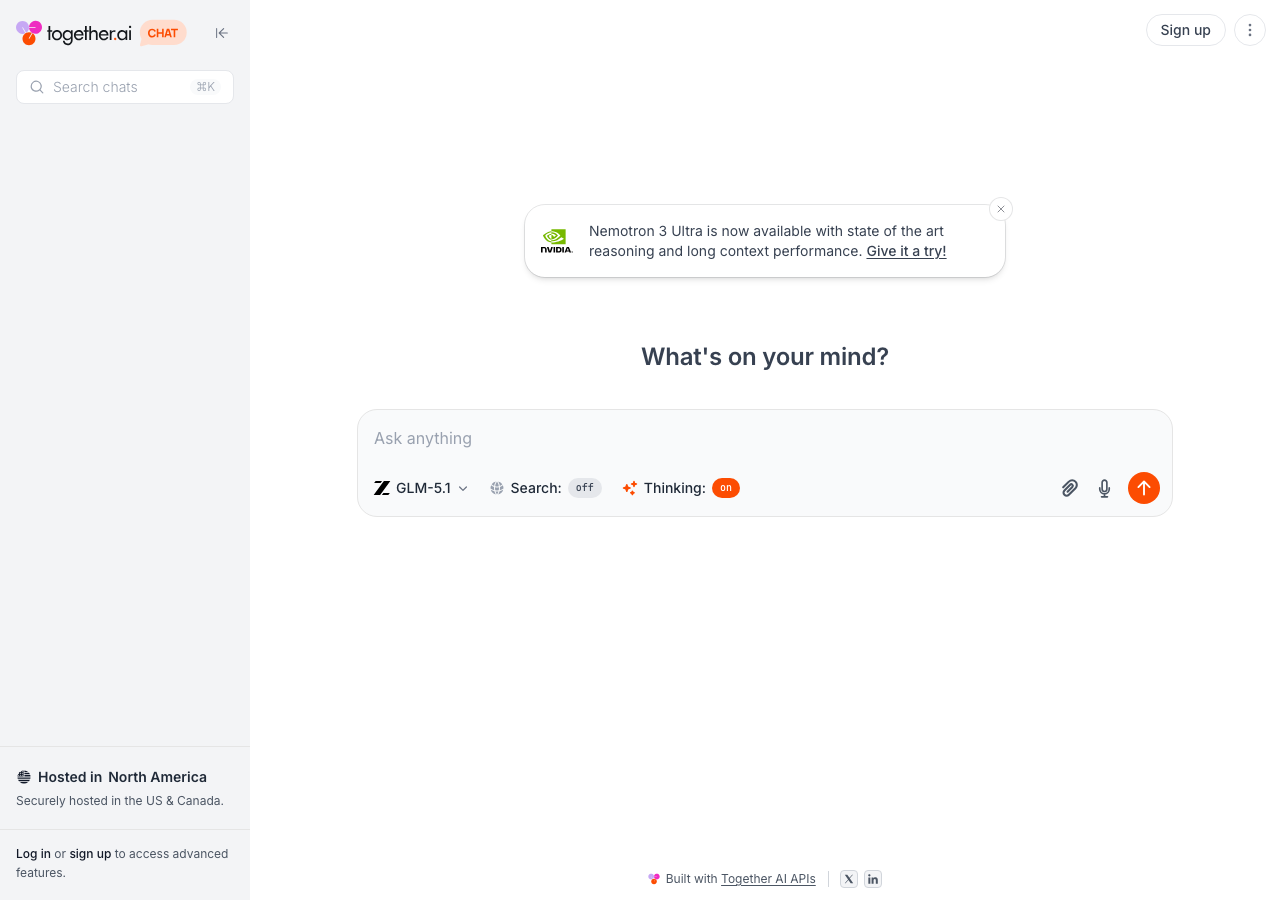
Together AI is a cloud infrastructure company that hosts and serves open-weight models at scale for developers and enterprises. Their API is a major route through which startups, research teams, and production applications access models like Llama 3.3 70B, Qwen 2.5 72B, DeepSeek V3, and dozens of other open-weight variants without managing their own GPU infrastructure. The chat interface at chat.together.ai is a consumer layer on top of that API — functional, free with daily credits, and populated with the same model catalog that enterprise customers use through the API.
The Together AI Chat model catalog is one of the most comprehensive open-weight rosters available through a single free interface. As of 2025–2026, it includes Llama 3.3 70B Instruct, Llama 3.1 405B Instruct (one of the largest openly accessible models), Qwen 2.5 72B Instruct, DeepSeek V3, Mistral 7B and Large variants, and several specialized fine-tunes for code, multilingual tasks, and instruction following. The breadth is impressive; navigating it usefully requires knowing what differentiates these models — a non-trivial knowledge investment for students who are not already embedded in the AI research community.
The open-weight catalog and what it offers
Together AI Chat's defining feature is model breadth. While Groq Chat runs three or four models well-chosen for speed, and HuggingChat rotates five or six community-featured models, Together AI's catalog contains dozens of models across multiple families and parameter scales. For a student with specific requirements — a very large model for complex reasoning, a multilingual model optimized for a specific language pair, a code-focused model for technical writing, a recent DeepSeek variant for its reasoning mode — Together AI Chat is the most likely free interface to have what they need.
Llama 3.1 405B Instruct deserves special mention: it is one of the largest open-weight models available for consumer access, and on Together AI's infrastructure it is accessible on the free daily credit allocation. For tasks requiring the maximum reasoning depth available from open-weight models — complex logical argument construction, multi-step analysis, nuanced philosophical reasoning — 405B provides a ceiling that genuinely approaches some frontier commercial models, at zero monetary cost to the student. The trade-off is speed (405B is slower than 70B models) and daily token allocation (the 405B model consumes more credits per query).
DeepSeek V3 on Together AI Chat is another high-value option. DeepSeek V3 is a frontier-quality Chinese open-weight model that produces English essay output comparable to or exceeding GPT-4o mini, with particularly strong performance on analytical and reasoning-heavy tasks. Accessing DeepSeek V3 through Together AI Chat is one route for students who want DeepSeek's quality without a direct account at deepseek.com — relevant for students in institutional contexts where direct Chinese AI platform access may raise concerns about data residency.
Qwen 2.5 72B Instruct, developed by Alibaba, is the strongest free multilingual option for Asian-language academic writing accessible through Together AI. Students writing academic work in Chinese, Japanese, Korean, or other Asian languages will find Qwen 2.5 significantly better calibrated for those languages than any of the Meta Llama variants, which were trained with a stronger English bias. Together AI Chat makes Qwen accessible without requiring a direct Alibaba-owned platform account.
Interface and student experience
The Together AI Chat interface is functional and fast but oriented toward developers and researchers rather than students who want a polished writing assistant. The model selection is presented as a full dropdown with dozens of entries, each identified by its technical name and parameter count but without guidance on which is best for essay writing. A student opening Together AI Chat for the first time will see 'meta-llama/Llama-3.3-70B-Instruct-Turbo' rather than 'Llama 3.3 70B (recommended for essays)' — a small but real barrier to the useful models that requires either prior knowledge or a few minutes of external research.
The default model selection if you do not choose is typically a mid-range option based on cost efficiency for Together AI's infrastructure, not optimized for essay quality. Starting a session without deliberately selecting a model is one of the most common beginner mistakes on Together AI Chat — you may run a mediocre 7B model and conclude the platform is weak, when the actual weakness is that the useful model (Llama 3.3 70B or Qwen 2.5 72B) was one dropdown selection away.
Session management is minimal: conversations exist while your browser tab is open and may or may not persist depending on whether you have created a free Together AI account. Account creation requires an email address; the free daily credit allocation is available with or without an account, but persistent history requires one. The daily credit system works on token counts — most essay-length sessions fall within the free allocation on 70B models, with more rapid depletion if you access the 405B model frequently.
Mobile experience is better than OpenRouter but below the consumer-optimized products. The model selector is navigable on mobile with some patience, and the chat interface works adequately for short tasks. For sustained essay drafting on a phone, Together AI Chat is workable but not comfortable. For desktop sessions, the interface is lean enough to be unobtrusive rather than frustrating.
Essay quality and model selection guidance
Essay fit 6.2 is the realistic average across the typical Together AI Chat session without deliberate model selection. With deliberate selection of the appropriate model, the realistic quality range is 6.8–8.0 depending on the model and task type. The gap between those numbers is entirely determined by the student's model selection literacy — a knowledge investment that takes fifteen to thirty minutes to acquire and pays off across every subsequent session.
For general English academic essays (humanities, social sciences, policy), the recommended model hierarchy is: DeepSeek V3 for analytical reasoning depth, Llama 3.3 70B Instruct Turbo for balanced speed and quality, and Llama 3.1 405B Instruct for maximum depth on complex analytical tasks where speed is not the priority. These three models cover the essay quality range on Together AI Chat and are available on the free daily allocation.
For multilingual essays, Qwen 2.5 72B Instruct is the strongest option for Asian languages; Mistral Large for European languages (French, Spanish, German, Italian). Neither outperforms the recommended English models on English tasks, but both represent meaningful quality improvements on their respective language domains compared with Llama-based alternatives.
For code and technical documentation, Together AI Chat's catalog includes Llama 3.1 8B Instruct Turbo and Code Llama variants specifically fine-tuned for code contexts. These are more appropriate than a 70B general model for generating code comments, algorithm explanations, and technical report sections that reference specific code constructs. Using a code-tuned model for code-adjacent essay content, and a general-purpose model for analytical prose, is a model-switching strategy that pays dividends on mixed technical-analytical papers.
Open-weight transparency and academic relevance
Together AI Chat provides access to models whose weights, architectures, and training methodologies are publicly documented. Llama 3.3's Meta technical report, DeepSeek V3's published paper, Qwen 2.5's technical documentation, and Mistral's architecture papers are all available for citation in academic work. This transparency level is unavailable for ChatGPT, Claude, or Gemini, which makes Together AI Chat — like Groq Chat and HuggingChat — a methodologically more defensible choice for students whose coursework involves studying AI systems.
For AI ethics, technology policy, and digital humanities coursework, the ability to cite the actual technical documentation of the model you used as an AI assistant is a meaningful methodological choice. Saying 'I used a language model with the following documented training characteristics' is a more intellectually honest attribution than 'I used a proprietary black-box model from a large commercial provider.' The open-weight models accessible through Together AI Chat make the former possible.
Together AI's infrastructure business also makes it a useful contact point for students interested in AI deployment research. The company has published technical content about model serving efficiency, fine-tuning pipelines, and the economics of open-model hosting that are directly relevant to AI infrastructure coursework. Students in computer science, operations research, or engineering programs studying AI systems can treat Together AI's technical blog and documentation as useful primary sources alongside the platform's chat interface.
Data privacy on Together AI Chat follows enterprise service norms: account creation ties your chat history to an email, the company retains data under its standard privacy policy, and there is no advertising business creating secondary incentives for data use. For students concerned about privacy, Together AI is a neutral option — not as explicitly privacy-architected as DuckDuckGo AI Chat, but not subject to the data-richness incentives of Google, Meta, or Microsoft. Reading the current privacy policy before using the service for sensitive content is appropriate.
Comparison with Groq Chat and HuggingChat
The natural comparisons for Together AI Chat are Groq Chat (fast, narrow model roster, free) and HuggingChat (community open-weight rotation, free, wider than Groq). Together AI Chat splits the difference on model selection breadth — more than Groq, similar to HuggingChat but with more stable model availability and a stronger enterprise backing that means featured models are less likely to be rotated out without notice.
Speed on Together AI Chat is fast but not at Groq's exceptional level. Together AI runs on GPU infrastructure optimized for throughput at scale, not specifically for single-session latency in the way Groq's LPU architecture is. For rapid iteration sessions where speed is the priority, Groq Chat is the better choice. For sessions where model selection flexibility matters more than speed — accessing Qwen, DeepSeek, or the 405B model — Together AI Chat has the advantage.
HuggingChat's model rotation is community-driven and can change faster than Together AI's catalog, which follows a more deliberate model addition process tied to enterprise demand. This makes Together AI Chat slightly more stable for students who want to build consistent workflows around specific models without worrying about those models disappearing between sessions.
OpenRouter offers a broader catalog than Together AI Chat and more configuration options, but it charges per-token for most frontier models and requires credit-card setup for paid access. Together AI Chat's free daily credit allocation covers most essay writing needs without payment, which makes it more accessible for students on tight budgets who want open-weight model breadth without the credit-card barrier that OpenRouter imposes for some access tiers.
Who Together AI Chat is for
Together AI Chat is the right tool for students who are willing to invest fifteen minutes learning which models in the catalog suit their specific writing tasks, want access to the widest free open-weight model selection in a single interface, and need specific capabilities — Qwen multilingual, DeepSeek reasoning, 405B depth — that more curated interfaces do not offer. This is a small but genuine student segment: AI-literate students in CS, data science, AI ethics, and research methods programs who are already familiar with the open-weight model landscape.
It is the wrong tool for students who want to open a clean interface, start typing, and get good results without model selection overhead. For those students, Claude Free, ChatGPT Free, or Le Chat Free provide more reliable default quality with far less setup investment.
The middle ground — students who are curious about open-weight models, willing to read a brief model guide, and have specific multilingual or analytical requirements that default model selections do not meet — is Together AI Chat's natural home. The fifteen-minute investment in learning the model catalog pays for itself within a single productive writing session.
Bottom line
Together AI Chat earns essay fit 6.2 as a realistic average that masks significant variance by model selection. With deliberate model choice — DeepSeek V3 or Llama 3.3 70B for English analysis, Qwen 2.5 72B for Asian-language work, Llama 3.1 405B for maximum analytical depth — the effective score is meaningfully higher. The platform rewards informed users and underserves uninformed ones more than almost any other tool on this list.
It is the right primary free tool for AI-literate students who need model breadth and transparency, and a valuable backup for students who hit capability ceilings on more curated platforms and need access to a specific open-weight model without paying for an API account. For everyone else, the model selection overhead makes it a specialized resource rather than a general-purpose drafting assistant.
Compare Groq Chat for open-weight speed without the selection complexity; compare HuggingChat for community-driven model rotation in a slightly more student-friendly interface; compare OpenRouter for the widest possible catalog including commercial models at a per-token cost.
Pros
- Broadest free open-weight model catalog — Llama, Qwen, DeepSeek, Mistral, and specialized fine-tunes.
- Access to Llama 3.1 405B on free credits — one of the largest openly accessible models for essay depth.
- DeepSeek V3 access without a direct Chinese platform account — useful for institutional data-residency concerns.
- Strong multilingual options (Qwen for Asian languages, Mistral for European) in one interface.
- Transparent open-weight models with published technical reports for academic citation.
Cons
- Model selection overhead — dozens of models without consumer-facing quality guidance for essays.
- Default model selection may not be optimized for essay writing — requires deliberate selection.
- Interface designed for developers, not students — sparse onboarding and no writing-specific features.
- Not as fast as Groq Chat — GPU infrastructure lacks LPU-level latency optimization.
- No file uploads or academic workflow features; text-only interface.
- Privacy is adequate but not architected — review current policy before sensitive academic use.
Pricing
- Together AI Chat has a free tier or free product access — rate limits and model caps apply; paid upgrades may exist on together.ai.
- Flagship stack: Open-weight catalog. Features and model names change; verify before you subscribe.
Models & access
Open-weight catalog. Availability, rate limits, and regional restrictions change — confirm on together.ai before subscribing.
Compare alternatives
Who it's for
- Broadest free open-weight model catalog — Llama, Qwen, DeepSeek, Mistral, and specialized fine-tunes.
- Access to Llama 3.1 405B on free credits — one of the largest openly accessible models for essay depth.
- DeepSeek V3 access without a direct Chinese platform account — useful for institutional data-residency concerns.
- Strong multilingual options (Qwen for Asian languages, Mistral for European) in one interface.
Who should compare alternatives
- Model selection overhead — dozens of models without consumer-facing quality guidance for essays.
- Default model selection may not be optimized for essay writing — requires deliberate selection.
- Interface designed for developers, not students — sparse onboarding and no writing-specific features.
- Not as fast as Groq Chat — GPU infrastructure lacks LPU-level latency optimization.
Student experiences
Ratings from students who used Together AI Chat on real assignments — includes critical reviews.
Loading student reviews…
2,303 words · Updated 2026