
Independent review · 2026
Poe Review
Poe scores 7.8 for essay fit — a reasonable aggregate for an aggregator platform that gives you ChatGPT, Claude, Gemini, Llama, and others inside one subscription, but the score reflects the awkward truth that an aggregator rarely lets you squeeze full value from any individual model, the per-query credit system punishes heavy users, and students who know exactly which engine works best for their task are better served going there directly.
poe.com · #15 in TOP 50
Multi-model hub
Multi-model hub
Our verdict
Poe scores 7.8 for essay fit — a reasonable aggregate for an aggregator platform that gives you ChatGPT, Claude, Gemini, Llama, and others inside one subscription, but the score reflects the awkward truth that an aggregator rarely lets you squeeze full value from any individual model, the per-query credit system punishes heavy users, and students who know exactly which engine works best for their task are better served going there directly.
Overview
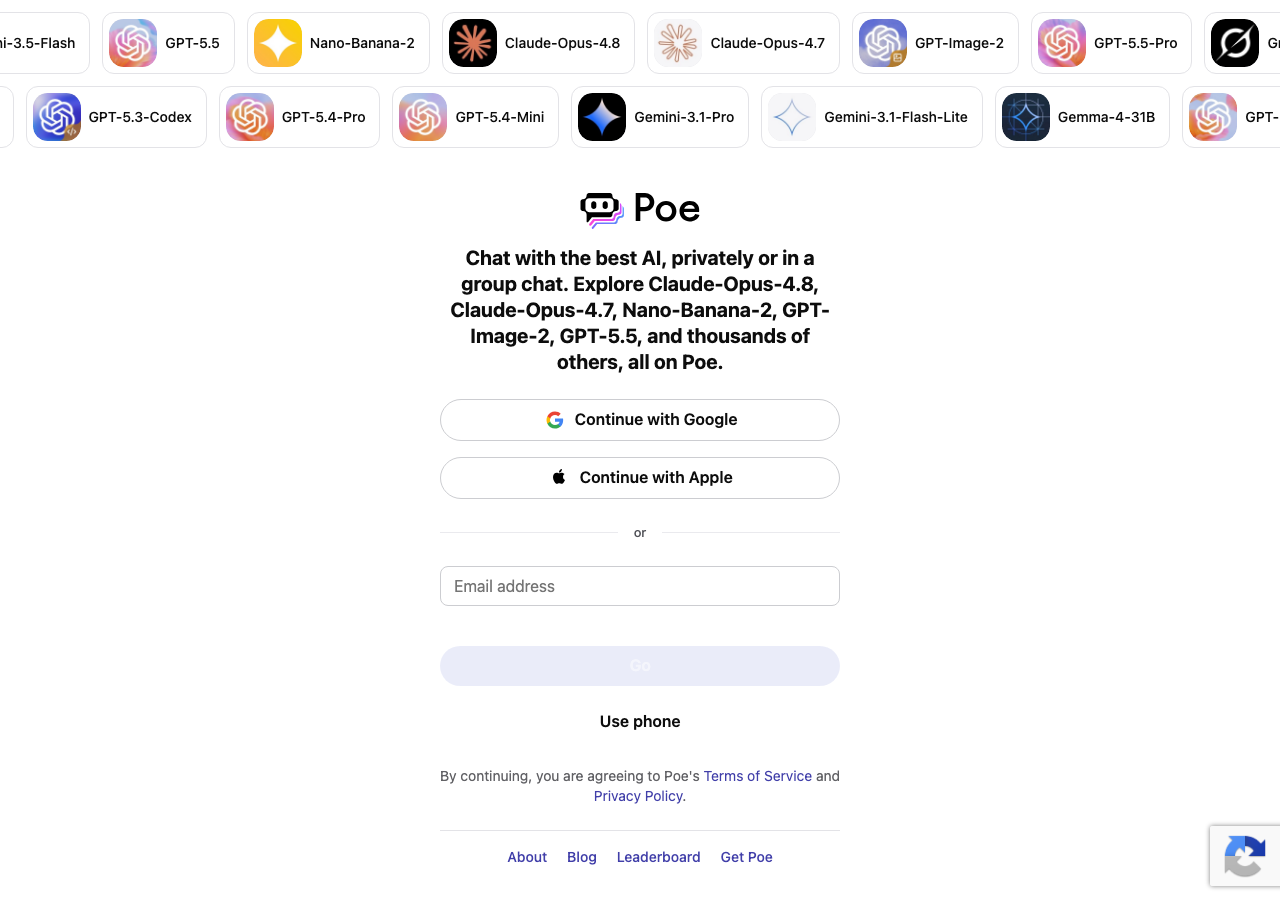
Quora's Poe launched as an answer to a real student frustration: frontier AI models were scattered across different subscriptions, each with different interfaces, different pricing, and different capabilities. Poe bundled them under a single $20/month plan and let users switch between GPT-4 class models, Claude, Gemini, Llama, and various community bots from one interface. For a student who was genuinely unsure which model to use for which task, or who wanted the flexibility to compare outputs side by side, Poe solved a real problem.
The aggregator model has inherent structural limits, though. Poe does not own the underlying models — it pays OpenAI, Anthropic, and others for API access, which gets passed to users as per-message credits that vary by model. Using Claude Opus 4 or GPT-4.1 on Poe consumes credits faster than using smaller models, and heavy users of frontier models can exhaust a month's allocation before the billing cycle resets. Students who treat Poe as an unlimited Claude subscription discover this the hard way during finals week.
The platform's value proposition is clearest for students in a specific phase: exploring which AI engine actually fits their workflow. Trying Claude's long-context rewrites alongside GPT's outline generation alongside Perplexity's cited answers within the same interface is genuinely useful for developing AI literacy. Once you know your preferred tool, though, the efficiency argument for maintaining a Poe subscription alongside direct model subscriptions becomes harder to sustain, and many students eventually drop Poe in favor of a direct relationship with their two or three preferred engines.
Poe's current model roster includes GPT-4.1 class models from OpenAI, Claude Sonnet and Opus variants from Anthropic, Gemini models from Google, Meta's Llama series, Mistral models, and a catalog of community-created bots that specialize in specific tasks. From a single interface, a student can prompt Claude for a long-form essay draft, ask GPT for a citation check, run the same paragraph through Gemini for a tone audit, and compare the results. This model-hopping workflow is Poe's strongest use case.
The subscription tier at $20/month grants a credit allocation that resets monthly. The credit cost per query varies by model: smaller models like GPT-4.1 mini and Llama consume minimal credits, while frontier models like Claude Opus 4 or GPT-4.1 full consume significantly more per query. Poe publishes credit costs per model in the interface, and understanding this table before committing to a workflow is important. Students who plan to use primarily smaller models may find good value; students who need frontier-tier quality for complex tasks will hit credit limits faster than they expect.
Essay fit at 7.8 reflects the platform-level experience rather than the maximum capability of any single model. When you access GPT-4.1 through Poe, you get GPT-4.1 — the model quality is the same. What changes is the interface context (no file upload in all cases, fewer custom system prompts available, less workflow tooling than native interfaces) and the credit economics. The platform does not add capability; it packages existing capability into a switching interface.
For students who have used Poe through 2025–2026: the interface has matured. Conversation history is more reliable, the mobile app is functional for on-the-go editing queries, and the bot marketplace includes some genuinely useful academic bots that have been fine-tuned on citation management or essay outlining tasks. Not all community bots are high quality — many are thin wrappers around basic prompts — but filtering for the high-rated academic bots does surface useful tools.
Credit economics and real-world cost
The credit system is Poe's most discussed friction point among student users. A $20/month subscription provides a fixed monthly credit allocation, but the credit cost varies dramatically between model tiers. A conversation with Claude Opus 4 on a complex 3,000-word essay prompt could consume the equivalent of dozens of conversations with GPT-4.1 mini. Students who discover Poe through its budget framing — 'one subscription for everything' — and then spend their credits on two or three frontier-model conversations per day before midterms will be disappointed.
Practical credit management for essay workflows: use smaller models (Llama 3.3, GPT-4.1 mini) for iterative editing tasks that require multiple back-and-forth exchanges, and save frontier-model credits (Claude, GPT-4.1 full) for the high-value tasks where model quality makes a measurable difference — initial outline generation, complex argument analysis, final-pass tone editing. This tiered approach extends a monthly allocation meaningfully for students who plan it deliberately.
Compare this to direct subscriptions: $20/month directly to Anthropic gives unlimited Claude Sonnet access with high daily limits on Opus. $20/month directly to OpenAI gives GPT-4.1 with generous daily limits. Poe's $20 gives a credit pool across models that may be sufficient for light use but constrains heavy frontier-model use. The value proposition reverses: Poe is better value for exploration and lighter use, direct subscriptions are better for students who know their preferred model and use it intensively.
A free Poe tier exists with very limited daily messages across a subset of models. It provides enough access to evaluate the platform but not enough for substantive essay work. Students using Poe for actual coursework should budget for the paid tier and plan credit consumption by model tier as described above.
Model comparison workflows
The legitimate best use case for Poe is systematic model comparison during the early stages of an essay project. Write your thesis statement and ask three different models for counterarguments. Compare which model produces the most substantive opposition arguments — this tells you both which model to use for the rest of the paper and surfaces counterarguments you may not have considered. This kind of parallel evaluation is cumbersome when switching between separate browser tabs with different subscriptions; Poe makes it genuinely efficient.
Another productive comparison workflow: ask different models to outline the same assignment, then synthesize the best structural ideas from each. Claude often produces more granular section differentiation; GPT tends toward cleaner overall architecture; Gemini sometimes identifies angle gaps in the argument structure. Combining their structural suggestions before writing produces better outlines than any single model alone. This is meta-level prompt engineering — using the platform's switching capability as a deliberate creative tool rather than treating it as simple access arbitrage.
Community bots in the academic category on Poe range from useful to redundant. A few specialized bots trained on citation styles (APA, MLA, Chicago) are genuinely helpful for formatting passes without burning frontier credits. Bots trained on specific disciplines — legal writing, nursing documentation, engineering report structure — vary in quality and are worth testing before relying on them for assessed work. Approach them as useful if they prove out and replaceable if they do not.
Interface and workflow limitations
Poe's interface is clean and the model switching is fast, but several capabilities available in native model interfaces are absent or constrained. File upload is available for some models but not all; the implementation is less polished than ChatGPT's native file handling. Custom system prompts — setting a persistent instruction that applies throughout a conversation — are possible but require familiarity with the interface. The Projects-style persistent memory available in Claude's native interface does not transfer to Poe's API access.
Conversation persistence and history works reliably across sessions, which is an improvement over earlier versions of the platform. You can return to a previous essay conversation and continue it, though very long conversation histories can slow response generation. For multi-week projects, starting a new conversation and re-pasting context is often more efficient than extending a very long thread.
The mobile Poe app is functional for quick editing queries but less suitable for sustained writing sessions. The keyboard-app workflow — alternating between a notes app or document and the Poe chat interface — works on phones but requires deliberate session management. Tablet users report a better experience; the larger screen makes side-by-side workflows feasible.
Who should use Poe
The student profile that genuinely benefits from Poe is one in transition: early in their AI use, not yet settled on a preferred engine, working across different assignment types that may benefit from different models, and willing to invest time in understanding which tool works for which task. For this student, Poe's variety is a feature rather than a consolation prize, and the credit allocation is sufficient for the exploratory use pattern.
Students who have done that exploration and know their workflow are less well served by Poe. If you know you want Claude for long essays and Perplexity for source discovery, paying $20 each directly gives you more of each than Poe's credit-managed pool provides. The exception is students who need occasional access to models they do not subscribe to directly — Poe as a backup for overflow Claude usage when hitting direct subscription limits, for example.
Students in programs with highly variable assignment types — one week a 1,000-word analytical essay, the next a lab report, the next a case study — may find Poe's model variety practically useful because different format demands genuinely benefit from different models. The switching cost between models on Poe is low enough to justify this use pattern without feeling like you are constantly fighting the interface.
Bottom line
Poe's 7.8 essay fit score reflects a platform that delivers real value for its target use case — model exploration and flexible access — while falling short of the efficiency you get from a direct subscription when you have identified your preferred engine. The credit economics require active management, and the interface limitations compared to native model platforms are real.
Use Poe during the AI-exploration phase of your academic year: test models, build preference knowledge, experiment with comparison workflows. Then evaluate whether the variety remains worth the credit constraints once you know what you actually need. For many students, the honest conclusion is a direct Claude or ChatGPT subscription that delivers more of the model they use most.
If you stay on Poe, treat it as a credit budget to manage: frontier models for high-value tasks, smaller models for iterative edits, and the bot marketplace for specialized formatting tasks. That tiered approach stretches the monthly allocation and captures the genuine value in Poe's aggregation model.
Pricing
- Listed from $20/mo for Poe — student discounts and annual billing change the total.
- Flagship stack: Multi-model hub. Features and model names change; verify before you subscribe.
Models & access
Multi-model hub. Availability, rate limits, and regional restrictions change — confirm on poe.com before subscribing.
Compare alternatives
Who it's for
- Track credit costs per model before writing your workflow — Claude Opus and GPT-4.1 full consume credits much faster than mini-tier models, and hitting zero before finals is a real risk
- Use Poe's model-switching for deliberate comparison early in a project: ask three models for counterarguments to your thesis and synthesize the best opposition points from each
- Reserve frontier-model credits for high-value tasks (outline generation, argument analysis, final tone pass) and use smaller models (GPT-4.1 mini, Llama) for iterative editing rounds
Student experiences
Ratings from students who used Poe on real assignments — includes critical reviews.
Loading student reviews…
1,735 words · Updated 2026