
Independent review · 2026
Pi Review
Pi is a therapeutic conversational assistant that asks how you are doing before it asks what you want to write — which tells you everything you need to know about its essay-use ceiling. Essay fit 5.8/10 is not a failing grade; it reflects a product that genuinely excels at sustained back-and-forth brainstorming, argument pressure-testing, and the kind of patient Socratic dialogue that helps students who think out loud. It fails where academic writing demands: Pi will not draft a ten-page research paper to APA specification, will not maintain structural coherence across long documents, and its model — Inflection 3.0 — is deliberately restrained in raw output volume. For students who arrive with ideas but struggle to organize them into an argumentative through-line, Pi is a surprisingly useful thinking partner. For students who want polished paragraphs quickly, it is the wrong app.
pi.ai · #32 in TOP 50
Frontier subscription
Inflection 3.0
Our verdict
Pi is a therapeutic conversational assistant that asks how you are doing before it asks what you want to write — which tells you everything you need to know about its essay-use ceiling. Essay fit 5.8/10 is not a failing grade; it reflects a product that genuinely excels at sustained back-and-forth brainstorming, argument pressure-testing, and the kind of patient Socratic dialogue that helps students who think out loud. It fails where academic writing demands: Pi will not draft a ten-page research paper to APA specification, will not maintain structural coherence across long documents, and its model — Inflection 3.0 — is deliberately restrained in raw output volume. For students who arrive with ideas but struggle to organize them into an argumentative through-line, Pi is a surprisingly useful thinking partner. For students who want polished paragraphs quickly, it is the wrong app.
Overview
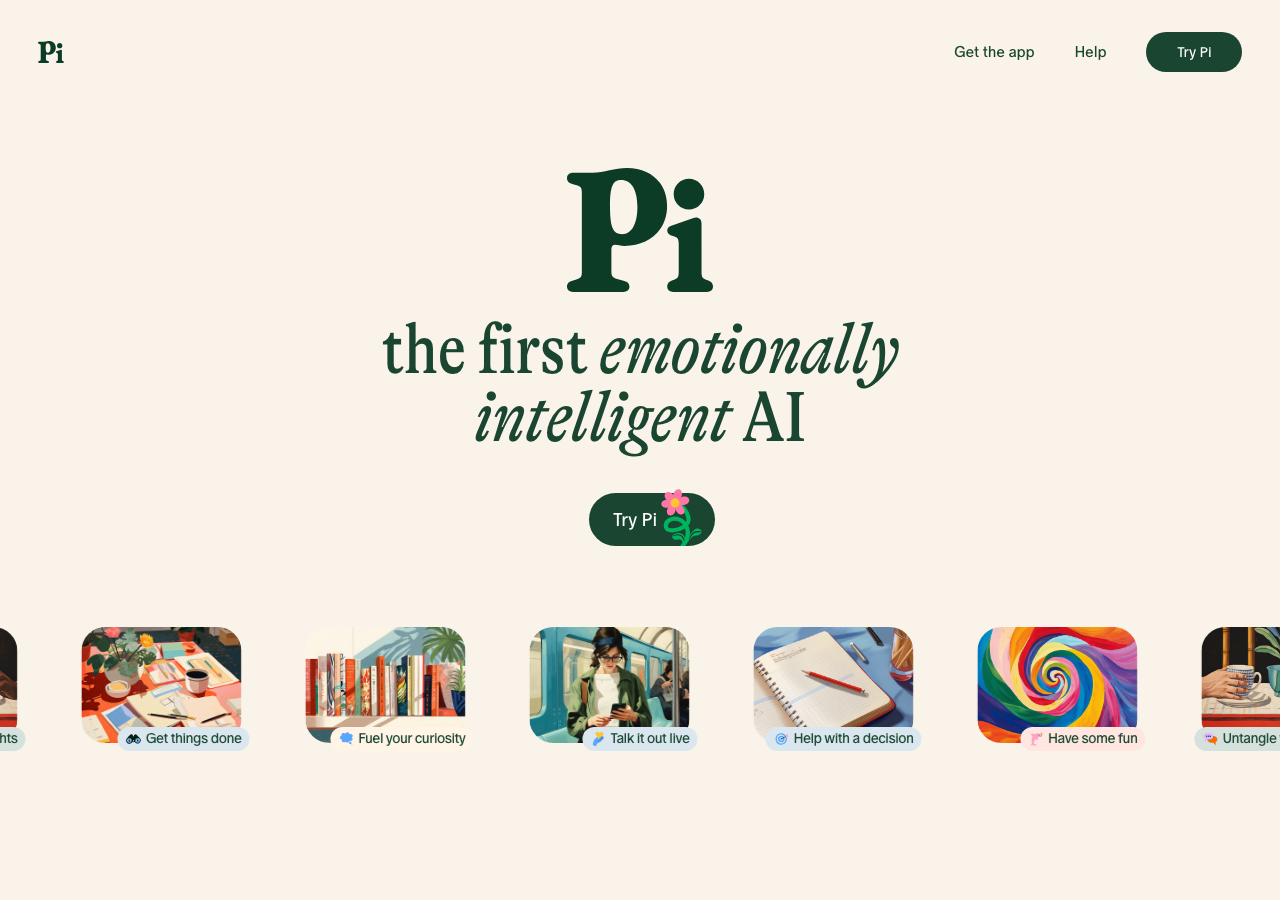
Inflection AI positioned Pi as an emotionally intelligent companion rather than a productivity engine, and that design philosophy shows up everywhere: in the warm greeting on first load, in the way responses loop back with clarifying questions instead of just completing your sentence, and in the deliberate refusal to generate large blocks of prose on demand. When Pi launched, the AI chat landscape was crowded with tools optimizing for output volume; Inflection went the other direction, betting that users would value quality of conversation over quantity of text.
That bet works beautifully in personal productivity and decision-support contexts and lands awkwardly in the essay-writing context this catalog evaluates. Students who have spent time with Pi report a meaningful experience that helps them understand what they actually think about a topic before they write about it — an underrated input into better academic work. However, the transition from 'Pi helped me understand my thesis' to 'Pi wrote my draft' is one Pi resists by design. Knowing that distinction upfront saves frustration.
Pi is free at the consumer tier, which means access friction is near zero. The practical constraint is that Inflection 3.0 is not publicly benchmarked against GPT-4.1 or Claude Sonnet 4 in writing tasks, and the output character is noticeably different — more measured, shorter per turn, less willing to dump a five-paragraph essay on you without prompting. Whether that is a limitation or a feature depends entirely on how you approach it.
Pi sits at rank thirty-four in our AI engines catalog, and its essay fit score of 5.8/10 places it firmly in the 'situational use' band — below the frontier engines that carry scores above 8.5, above the novelty chatbots that score in the threes. The situational use frame matters: Pi is not a bad product; it is an accurately positioned one. Inflection built a conversational AI optimized for reflective dialogue, and the essay experience is collateral — it works when you treat Pi as a thinking collaborator rather than a writing machine.
The underlying model, Inflection 3.0, represents Inflection's pivot after the company's restructuring period in 2024. The technical specifics of the model are less publicly documented than competing frontier models, but the behavioral profile is consistent: slower, more deliberate replies; frequent pauses to check comprehension; a tendency to rephrase your question back to you before answering. These conversational habits are ideal for therapy apps, coaching tools, and reflective journaling. In an essay context, they can feel like friction when you want three body paragraphs on environmental regulation immediately.
International and multilingual students sometimes find Pi's patient, repetition-tolerant style useful for ESL clarity conversations — explaining an idea multiple times in different ways to identify the clearest formulation. That use case is genuine and distinct from what ChatGPT Plus or Claude Pro offer. Pi does not speed through clarifications; it stays with your language until the meaning sharpens. For non-native English writers working through argument structure, that patience has real value.
The product interface is minimal: a single chat window, a thoughtful design that avoids dashboard clutter, and no file uploads. No PDF rubric ingestion, no voice-to-text essay mode, no history export for integrity documentation. These absences are consistent with Pi's positioning as a casual companion, not an academic workflow tool.
What Pi does well for students
Brainstorming sessions are where Pi earns its 5.8 rather than a lower score. Present Pi with a vague essay topic — something like 'I need to write about how social media affects democracy' — and it will not immediately produce a five-point outline. Instead, it will ask which aspect interests you most, probe whether you lean toward platform design arguments or political-economy ones, and eventually reflect your own thinking back in a more organized form. By the end of a twenty-minute Pi conversation, many students find they have a genuine argument they own rather than a generic frame they borrowed.
Argument stress-testing is a related strength. If you tell Pi your thesis and ask it to push back, it will engage seriously — asking for the assumptions you are making, flagging places where your reasoning jumps, and suggesting alternative interpretations of your evidence. This is valuable in the early stage of paper development when your position is still porous. Pi will not rewrite your argument for you, but it will tell you where it leaks.
For shorter writing tasks — reflection journals, discussion board posts, weekly response papers — Pi's output ceiling is less of a problem. A two-hundred-word reflection that Pi helped shape is a reasonable workflow. The student still writes the final text, but Pi's questions helped them know what to say. Those are the success stories that appear in productivity communities that have discovered Pi.
Mental clarity for writing-anxious students is an overlooked genuine use. Pi handles 'I have no idea how to start this paper' in a different register than ChatGPT does. ChatGPT will give you an outline immediately. Pi will ask what you find confusing about the assignment and why. For a student in an anxiety spiral who needs to feel heard before they can think, Pi's mode is sometimes genuinely better — even if it produces no text.
Where Pi falls short for academic work
Volume is the first wall you hit. Ask Pi for a full essay draft and it will produce a much shorter result than similarly instructed models — often under four hundred words where a prompt to GPT-4.1 yields twelve hundred. The gap is not laziness or quality filtering; it is architectural intention. Inflection built Pi to keep conversation moving rather than to produce monologues. For a ten-page research paper due at midnight, that architecture is a misfit.
Long-form coherence is the second wall. Even when Pi generates multi-paragraph responses, they tend to stand alone rather than build on each other across a long exchange. Academic essays require that section three remembers the argument established in section one; Pi's session memory and structural ambition do not reliably sustain that through-line. The effect is a collection of interesting paragraphs rather than a unified argument — a useful sketch, not a submittable draft.
Citation support is essentially absent. Pi will not look up sources, will not format a bibliography, and will not check whether the authors you name wrote what you claim they wrote. Compared with Perplexity Pro or even ChatGPT Plus with browsing, Pi has no foothold in the research stage of essay writing. If your assignment requires five peer-reviewed sources, Pi cannot help you find or verify them.
File uploads and rubric ingestion are not features Pi offers. This means you cannot drop an assignment sheet into Pi the way you can with ChatGPT Plus or Claude Pro. You have to summarize the rubric manually — a small friction for a short assignment, a meaningful handicap for a complex one with grading criteria across multiple dimensions.
Academic integrity documentation is also a gap. Pi does not export conversation history in formats that timestamp or authenticate your process. If you use Pi in your writing process and need to demonstrate that your work developed iteratively, Pi is not the tool that helps you build that paper trail.
Comparison with adjacent engines
The most useful comparison for Pi is Claude Pro's conversational mode, which also engages reflectively and asks clarifying questions — but then follows up with long-form drafts when requested. Claude Pro charges $20 per month and delivers both the dialogue Pi excels at and the drafting volume Pi withholds. For students who value the thinking-partner style but eventually need output, Claude Pro is the natural upgrade path from Pi.
Character.AI occupies a lower essay-fit score (4.5) and a different purpose — roleplay and persona simulation — but student audiences overlap. Students who discovered AI through Character.AI sometimes migrate to Pi when they want more realistic conversation without the fiction overlay. Pi is the more academically honest of the two: it does not pretend to be a historical figure and it will not help you craft a story that misrepresents facts.
DeepSeek and Qwen Chat both offer free access with stronger raw essay output than Pi. If cost is the constraint and you need a free tool that actually drafts, DeepSeek V3 dramatically outperforms Pi on essay length and coherence while maintaining acceptable quality. Pi's advantage is narrowly in the brainstorming and emotional support register, not in output performance.
Grok Premium (8.0 essay fit) offers real-time X-platform context and more aggressive generation — at the opposite personality extreme from Pi. Students who find Pi too slow or too gentle often gravitate toward Grok's faster, more opinionated style. The choice is partly personality preference: Pi is warm and measured; Grok is quick and candid.
Pricing and access
Pi is free at the consumer tier, which removes the cost objection immediately. There is no subscription to cancel, no usage limit that triggers mid-session for most students, and no paywall for the core conversational experience. Access friction is minimal: create an account or use a phone number, and the app is available on iOS, Android, and web.
The free tier is generous because the product is not trying to extract maximum throughput from users — it is designed to sustain a relationship. That model means Pi is unlikely to gate brainstorming sessions or impose word quotas the way ChatGPT Free throttles during high-demand periods. For students who have experienced the frustration of a free ChatGPT session cutting off mid-draft during finals, Pi's consistency is a quiet advantage.
The tradeoff is that Inflection does not publish premium tier roadmaps in the same way OpenAI or Anthropic do. Advanced capabilities, larger context windows, or research-mode features may not arrive on a student-friendly timeline. Pi's value proposition rests on the current free tier experience; planning around future feature parity with frontier engines is speculative.
Bottom line
Pi earns its place in our catalog not as a drafting engine but as a thinking tool — a category that is undersupplied and genuinely useful at the front end of the writing process. Students who arrive at an essay assignment without a clear argument, who write better when someone asks them questions, or who need to articulate their ideas before they can commit them to text will find Pi more useful than the essay-fit score of 5.8 suggests. The score reflects production capacity; the actual value is in what happens before production starts.
The practical workflow recommendation is to use Pi for the first twenty minutes of a difficult assignment — explore the topic conversationally, let Pi push back on your initial instincts, and then export the clarity gained into a stronger engine (ChatGPT Plus, Claude Pro, or DeepSeek) for actual drafting. That two-tool workflow exploits what Pi does well without asking it to do what it was not designed for.
Do not use Pi as your primary engine if you are writing research papers longer than five pages, if your assignment requires documented sources, or if you need to produce submittable text on a tight deadline. In those scenarios, Pi is the right warm-up and the wrong finish line.
Pros
- exceptional brainstorming dialogue — best free engine for argument development through conversation rather than generation.
- patient ESL-friendly style that stays with unclear ideas until they sharpen rather than racing past them.
- free with consistent availability — no usage throttling that disrupts a thinking session.
- honest and measured in responses — less likely to confidently hallucinate citations than output-hungry frontier models.
Cons
- low essay output volume — you will not get a full first draft from a single Pi session.
- no file uploads, no rubric ingestion, no bibliography support — missing core academic workflow tools.
- no citation lookup or source verification — cannot fill the research stage of any assignment that requires documented evidence.
- no exportable conversation history for integrity documentation — unsuitable for building a process paper trail.
- long-form structural coherence is weak across multi-section essays — produces paragraphs, not unified arguments.
Pricing
- Pi has a free tier or free product access — rate limits and model caps apply; paid upgrades may exist on pi.ai.
- Flagship stack: Inflection 3.0. Features and model names change; verify before you subscribe.
Models & access
Inflection 3.0. Availability, rate limits, and regional restrictions change — confirm on pi.ai before subscribing.
Compare alternatives
Who it's for
- exceptional brainstorming dialogue — best free engine for argument development through conversation rather than generation.
- patient ESL-friendly style that stays with unclear ideas until they sharpen rather than racing past them.
- free with consistent availability — no usage throttling that disrupts a thinking session.
- honest and measured in responses — less likely to confidently hallucinate citations than output-hungry frontier models.
Who should compare alternatives
- low essay output volume — you will not get a full first draft from a single Pi session.
- no file uploads, no rubric ingestion, no bibliography support — missing core academic workflow tools.
- no citation lookup or source verification — cannot fill the research stage of any assignment that requires documented evidence.
- no exportable conversation history for integrity documentation — unsuitable for building a process paper trail.
Student experiences
Ratings from students who used Pi on real assignments — includes critical reviews.
Loading student reviews…
2,119 words · Updated 2026