
Independent review · 2026
OpenRouter Review
OpenRouter is an API aggregator with a consumer chat interface that gives access to over a hundred models — GPT-4.1, Claude Sonnet, Gemini, Llama, Mistral, DeepSeek, and dozens of specialist fine-tunes — through a single login and pay-per-token billing. Essay fit 7.5 reflects the ceiling of what the best models on its roster can achieve, not the floor, which is much lower. For students, OpenRouter is most valuable as a comparison laboratory and a low-cost backup route to frontier models, but navigating a hundred-model dropdown to write a literature review is a workflow that actively discourages focus. It rewards technical curiosity and punishes impatience.
openrouter.ai · #23 in TOP 50
Multi-model hub
100+ models
Our verdict
OpenRouter is an API aggregator with a consumer chat interface that gives access to over a hundred models — GPT-4.1, Claude Sonnet, Gemini, Llama, Mistral, DeepSeek, and dozens of specialist fine-tunes — through a single login and pay-per-token billing. Essay fit 7.5 reflects the ceiling of what the best models on its roster can achieve, not the floor, which is much lower. For students, OpenRouter is most valuable as a comparison laboratory and a low-cost backup route to frontier models, but navigating a hundred-model dropdown to write a literature review is a workflow that actively discourages focus. It rewards technical curiosity and punishes impatience.
Overview
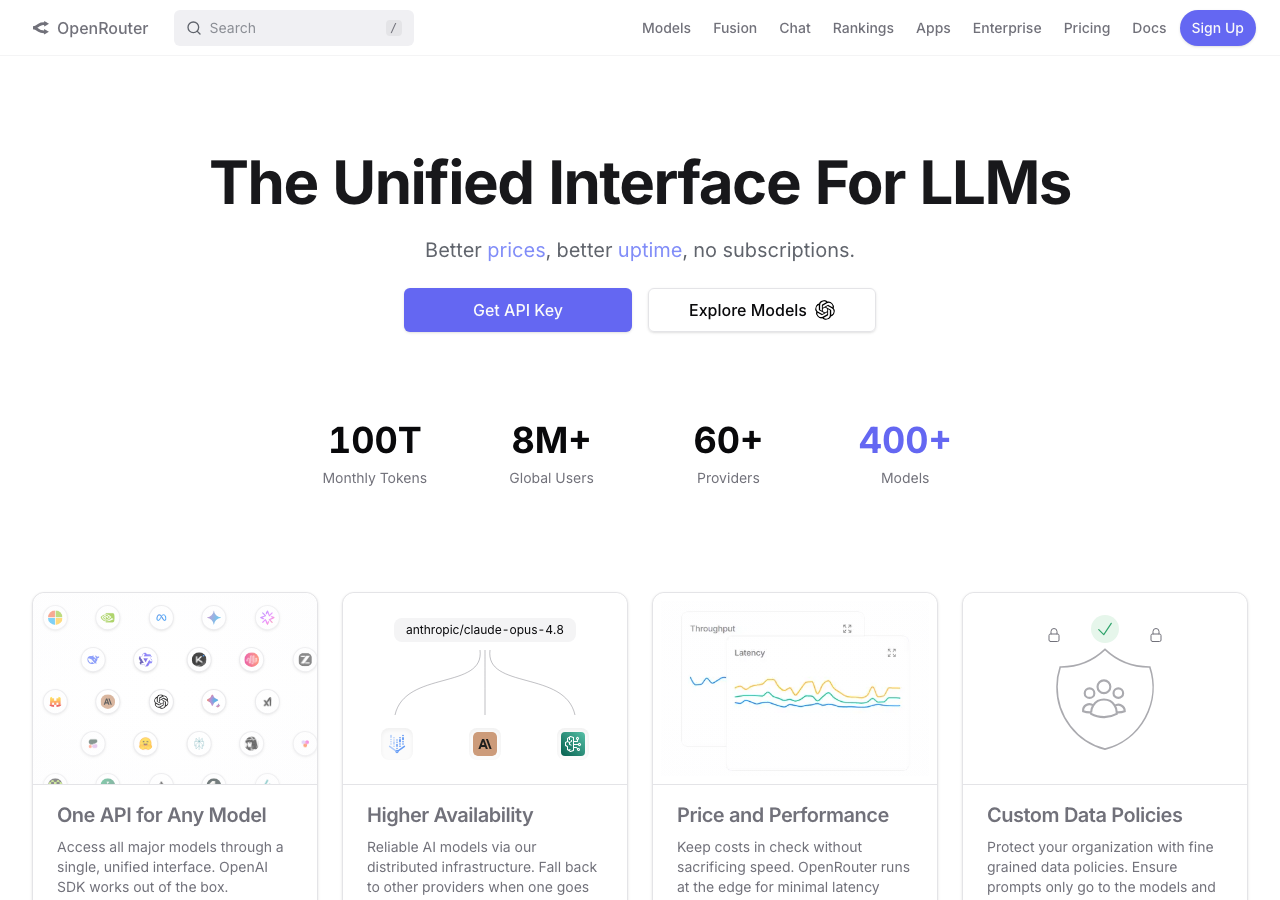
OpenRouter occupies a category of its own: it is neither a model provider nor a standalone AI assistant. It is infrastructure — a routing layer that normalizes API calls across providers and exposes them through a web chat interface anyone can access. The business model is transparent: OpenRouter marks up per-token costs slightly over the underlying provider rates and offers free daily allocations on several models including a capped version of GPT-4o mini and various Llama variants. Students who want Claude Sonnet 4 access without a $20 Claude Pro subscription can, at least in theory, pay for individual sessions through OpenRouter's micro-billing system.
The practical student experience is more complicated than that pitch suggests. The chat UI at openrouter.ai/chat is functional but stripped-down compared with ChatGPT, Claude.ai, or Gemini. No file uploads on most model routes, no voice mode, no persistent projects, no polished system prompts. What you get is a raw conversation interface attached to a model selector. For a student who has already formed habits around a consumer AI product, switching to OpenRouter feels like trading a car for access to a bus depot — technically more destinations, fewer creature comforts.
What OpenRouter actually is
OpenRouter was founded to solve a developer problem: maintaining integrations with a dozen AI providers is expensive and brittle when each provider has its own API format, authentication system, rate limits, and deprecation schedule. By normalizing all of them behind a single OpenAI-compatible API endpoint, OpenRouter lets developers write one integration and swap models by changing a parameter. The consumer chat interface is a side product of that infrastructure — useful for testing, but not designed as a primary writing assistant.
The model catalog in 2025–2026 includes flagship commercial models (GPT-4.1, Claude Sonnet 4, Gemini 2.5 Pro), open-weight leaders (Llama 3.3 70B, Mistral Large, DeepSeek V3), research-adjacent fine-tunes (various instruction-tuned Qwen variants), and dozens of smaller models that vary widely in quality. The model list is not curated from a student writing perspective — it includes models trained for code completion, function calling, image generation descriptors, and other tasks that do not help with humanities essays. Navigating it requires either technical knowledge or time-consuming experimentation.
Pricing works on credits: you fund an account and burn credits per token. Most students will find that a few dollars of credits cover weeks of moderate use on mid-tier models. The catch is that the cheapest capable models — Llama 3.3 70B, Mistral Small, DeepSeek V3 — are either free-capped or very cheap, but the frontier models that actually justify the essay fit score are not dramatically cheaper through OpenRouter than through native subscriptions, especially when you factor in the feature gap.
Free-tier access on OpenRouter includes daily token allocations on models like Llama 3.1 8B and occasionally larger models during promotional periods. The allocations reset daily and are usually enough for a short essay task or a set of paragraph revisions, but not for a full research session. Students who discover OpenRouter through a Reddit recommendation often approach it expecting a free gateway to GPT-4-class models; the reality is that meaningful Claude or GPT-4.1 usage still costs money, just billed per session rather than per month.
Aggregator tradeoffs for essay writing
The core tradeoff of using an aggregator for academic writing is model selection overhead versus theoretical flexibility. When you open ChatGPT, you make one choice: which mode to use (standard chat, canvas, deep research). When you open OpenRouter chat, you choose from over a hundred models before you type a word. For a student who has done their research and specifically wants DeepSeek R1 for a logic-heavy philosophy paper or Claude Sonnet 4 for a long-context literature review, this is a feature. For a student who wants to start writing a sociology paper in thirty seconds, it is friction.
Model quality on OpenRouter is wildly uneven. Running the same essay-drafting prompt through five different models on the platform will produce five outputs ranging from excellent — indistinguishable from Claude Pro output — to actively problematic, where smaller fine-tuned models confabulate sources, lose structural coherence on multi-paragraph tasks, or produce prose with subtle grammatical errors that a native speaker would not make. The aggregator does not rank or curate models by writing quality, so the burden of quality control falls entirely on the user.
For comparison workflows — genuinely useful for advanced students writing research methodology sections or anyone trying to understand how different models handle a contested topic — OpenRouter is actually superior to any single provider. You can ask the same analytical question to GPT-4.1, Claude Sonnet, Mistral Large, and DeepSeek V3 in rapid succession, compare how each frames the argument, and triangulate toward a more nuanced understanding than any single model would provide. This is not a feature marketed to students, but it is probably the highest-value use case for academic work.
Another legitimate aggregator advantage is cost arbitrage on specific tasks. If you need to generate five alternative phrasings for a conclusion paragraph, running that through a cheap but capable model like Mistral Small via OpenRouter costs fractions of a cent and avoids eating into a monthly Claude or ChatGPT subscription. Students who use AI assistants heavily across multiple papers in a semester can potentially reduce their total AI spend by routing low-stakes micro-tasks through OpenRouter's cheaper models while reserving subscription engines for complex analytical work.
Which models are worth using for essays
From the OpenRouter catalog, the models most relevant to essay writing fall into three tiers. Tier one — genuinely frontier quality — includes Claude Sonnet 4, GPT-4.1, and Gemini 2.5 Pro. These are available on OpenRouter but cost money and lack the polished features their native interfaces provide. Using Claude Sonnet 4 through OpenRouter's raw chat interface means losing Claude.ai's Projects, Artifacts, document uploads, and formatting context. You pay a similar per-token rate for an inferior experience. Tier one models on OpenRouter make sense for developers testing prompts, not for students writing papers.
Tier two — capable open-weight models — is where OpenRouter delivers genuine value. Llama 3.3 70B, DeepSeek V3, Mistral Large, and Qwen 2.5 72B all perform at essay fit levels of 7.5–8.5 on our evaluation tasks, are substantially cheaper than frontier models, and are sometimes available on free daily allocations. A student willing to experiment with model selection can get near-frontier writing quality at near-zero cost by choosing wisely from this tier. The workflow requires knowing that Llama 3.3 70B is a serious model, not a toy — which most students do not know without research.
Tier three — smaller fine-tuned models under 13B parameters — should be avoided for essay tasks. They produce grammatically correct prose on easy prompts but break down on complex analytical tasks, multi-paragraph coherence, and nuanced argumentation. The OpenRouter catalog contains many of these because they are cheap to host and useful for certain developer applications; they are not useful for undergraduate-level academic writing.
The practical recommendation is to bookmark three or four models from tier two, ignore the rest, and treat OpenRouter as a multi-model dashboard rather than a search-and-discover platform. Creating a free account and setting those four models as favorites takes about ten minutes and turns OpenRouter from an overwhelming dropdown into a focused comparison tool.
Setup friction and the student experience
Creating an OpenRouter account requires an email address and, for paid model access, a credit card or crypto payment. The credit-card barrier is meaningful for younger students without independent payment methods. Some students work around this using prepaid cards or by sticking exclusively to the free daily allocations, which limits access to tier one models but keeps tier two open-weight models accessible.
The chat interface at openrouter.ai/chat lacks the onboarding polish of consumer AI products. There is no tutorial, no suggested prompt library for students, no context about which models are good for which tasks. First-time users frequently report frustration when they try an essay task on a small free model, get mediocre output, and conclude that OpenRouter is not useful — when the actual issue is model selection, not the platform.
System prompt configuration is available but requires knowing what a system prompt is and how to write one. For students who want to configure a consistent writing-assistant persona across all their sessions — 'you are a careful academic writing tutor, always ask for sources before making factual claims' — OpenRouter allows this through its Playground interface in a way that most consumer products do not. This is a genuine power-user feature, but it requires ten minutes of learning investment before it becomes useful.
Mobile experience is significantly worse than ChatGPT, Claude, or Gemini. The openrouter.ai site is responsive but not optimized for mobile writing sessions. Students who draft on their phones will find the model selector unwieldy, the context management awkward, and the formatting options absent. OpenRouter is effectively a desktop tool.
Academic integrity and the aggregator risk
From an integrity standpoint, OpenRouter introduces a specific risk that single-provider products do not: model provenance ambiguity. If your campus AI policy specifies which models are approved for AI-assisted work — increasingly common at research universities — running your essay through a fine-tuned variant of an approved base model via a third-party aggregator may or may not be in compliance, depending on how the policy is written. Some policies cover model families; some cover specific access points; some are silent on aggregators entirely. Read your policy carefully before using OpenRouter for graded work.
Detection-wise, frontier models accessed via OpenRouter produce output statistically identical to the same models accessed via their native interfaces. There is no aggregator effect that makes AI text more or less detectable. Students who believe OpenRouter provides some kind of detection advantage are mistaken; the model's statistical fingerprint is the same regardless of how the API call was routed.
The comparison-workflow use case described above — querying multiple models for the same question — does not create any new integrity exposure beyond standard AI use. If anything, the process of reading multiple model outputs critically and synthesizing toward your own position is closer to a literature review methodology than to copy-pasting a single model's paragraph, and it leaves a more defensible paper trail of active engagement with the material.
Bottom line
OpenRouter earns essay fit 7.5 because the best models accessible through it are genuinely excellent — but that score represents a ceiling that requires informed model selection to reach, not a consistent baseline. The platform rewards technical students, comparison-minded researchers, and budget-conscious users who are willing to spend thirty minutes learning the catalog. It punishes students who need a clean, guided drafting experience.
Use OpenRouter as a supplement to a primary subscription engine, not as a replacement. Set up three or four bookmarked models from the tier-two open-weight catalog, use the comparison workflow when you genuinely need multiple perspectives on a contested question, and use the cheap-model arbitrage for low-stakes tasks. Avoid using it as your primary interface for deadline-critical writing if you are not already comfortable navigating model quality differences.
Compare Poe if you want a more polished multi-model interface at a subscription price; compare HuggingChat if you want open-model experimentation with a cleaner UI; compare the native providers directly if the feature gap on frontier models is a bottleneck.
Pros
- Access to frontier and open-weight models through one interface — useful for comparison.
- Pay-per-token billing can be cheaper than subscriptions for moderate, targeted use.
- Free daily allocations on capable open-weight models including Llama and Mistral variants.
- System prompt configuration allows consistent writing-assistant persona across sessions.
- Strong arbitrage value — route cheap tasks to cheap models, reserve budget for complex analysis.
Cons
- Model selection overhead — hundred-model dropdown is workflow friction for most students.
- Raw chat interface lacks file uploads, formatting tools, and consumer-grade onboarding.
- Tier-one models via OpenRouter cost similarly to native subscriptions with fewer features.
- Small models in the catalog deliver poor essay quality — requires informed model selection.
- No mobile-optimized experience; effectively desktop-only.
- Credit card requirement for paid models excludes some younger students.
Pricing
- OpenRouter has a free tier or free product access — rate limits and model caps apply; paid upgrades may exist on openrouter.ai.
- Flagship stack: 100+ models. Features and model names change; verify before you subscribe.
Models & access
100+ models. Availability, rate limits, and regional restrictions change — confirm on openrouter.ai before subscribing.
Compare alternatives
Who it's for
- Access to frontier and open-weight models through one interface — useful for comparison.
- Pay-per-token billing can be cheaper than subscriptions for moderate, targeted use.
- Free daily allocations on capable open-weight models including Llama and Mistral variants.
- System prompt configuration allows consistent writing-assistant persona across sessions.
Who should compare alternatives
- Model selection overhead — hundred-model dropdown is workflow friction for most students.
- Raw chat interface lacks file uploads, formatting tools, and consumer-grade onboarding.
- Tier-one models via OpenRouter cost similarly to native subscriptions with fewer features.
- Small models in the catalog deliver poor essay quality — requires informed model selection.
Student experiences
Ratings from students who used OpenRouter on real assignments — includes critical reviews.
Loading student reviews…
2,088 words · Updated 2026