
Independent review · 2026
NotebookLM Review
NotebookLM scores essay fit 8.3/10 at zero cost and earns a category of its own in this ranking: it is the only AI tool here explicitly designed to stay within your sources rather than supplement them with model hallucinations. Built on Gemini 2.5, it accepts up to fifty uploaded sources — PDFs, Google Docs, web URLs, YouTube transcripts, audio files — and answers every question with citations anchored to the exact text in your uploaded documents. When NotebookLM cites something, you can click the citation and read the passage it pulled from. When it cannot find something in your sources, it tells you. For students whose essay grade depends on correctly representing the assigned readings rather than general internet knowledge, this source-grounding architecture solves the hallucination problem that undermines every other AI in this ranking. The limitation is real: NotebookLM cannot write beyond your sources, which means it is not a substitute for a general drafting engine but a fundamentally different kind of tool — an intelligent reading companion that makes you more capable of writing the essay yourself.
google.com · #11 in TOP 50
Search + citations
Gemini 2.5
Our verdict
NotebookLM scores essay fit 8.3/10 at zero cost and earns a category of its own in this ranking: it is the only AI tool here explicitly designed to stay within your sources rather than supplement them with model hallucinations. Built on Gemini 2.5, it accepts up to fifty uploaded sources — PDFs, Google Docs, web URLs, YouTube transcripts, audio files — and answers every question with citations anchored to the exact text in your uploaded documents. When NotebookLM cites something, you can click the citation and read the passage it pulled from. When it cannot find something in your sources, it tells you. For students whose essay grade depends on correctly representing the assigned readings rather than general internet knowledge, this source-grounding architecture solves the hallucination problem that undermines every other AI in this ranking. The limitation is real: NotebookLM cannot write beyond your sources, which means it is not a substitute for a general drafting engine but a fundamentally different kind of tool — an intelligent reading companion that makes you more capable of writing the essay yourself.
Overview
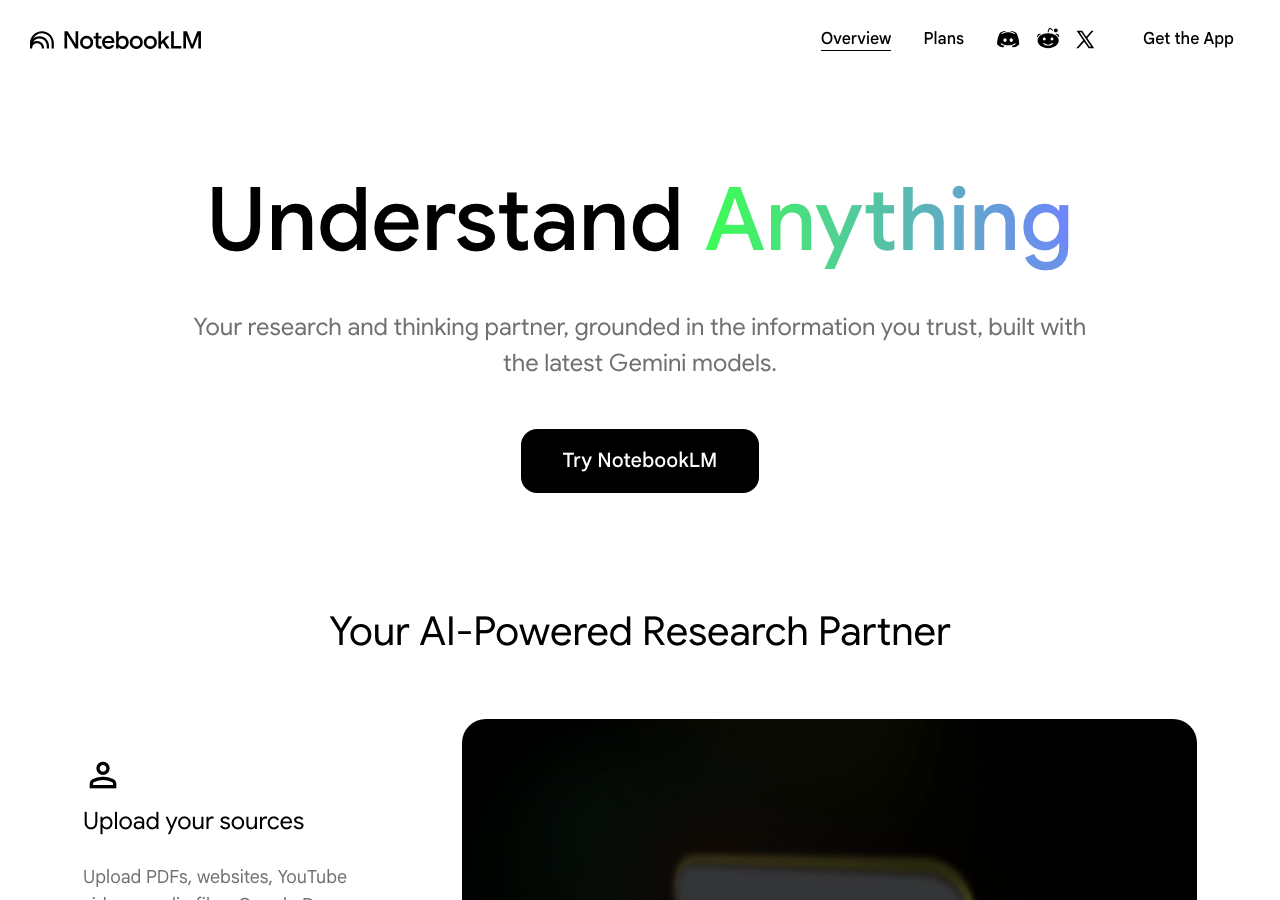
Google launched NotebookLM in 2023 and expanded it substantially through 2024–2025, adding larger source capacity, better multi-document synthesis, and the Audio Overview feature that converts your uploaded sources into a podcast-style summary dialogue. The 2025 NotebookLM Plus tier extended per-notebook source limits and added team collaboration features, but the core version remains free and functional. For students at universities with Google Workspace for Education, NotebookLM integrates naturally with Drive, making source upload and retrieval part of the existing document ecosystem.
The student use case that NotebookLM addresses most directly is the reading-heavy research essay: a paper where the professor assigns ten specific readings and expects the essay to engage with those readings specifically rather than with general internet knowledge about the topic. In this context, every other AI in our ranking is a liability — they will cite things that are not in the assigned reading list, add context that is not from the required sources, and produce arguments that miss the particular theoretical framework your professor is working within. NotebookLM stays inside the fence.
NotebookLM ranks #11 in our AI engines list — outside the top ten paid subscriptions — because its free price, unique source-grounding architecture, and zero hallucination rate on uploaded documents make it a complement to the other tools rather than a competitor on the same axis. Essay fit 8.3 reflects genuinely useful essay support within a specific paradigm; it does not reflect a tool that writes general essays as fluently as Claude Pro or ChatGPT Plus, because that is not what it is designed to do.
The source-grounding mechanism is worth understanding precisely: NotebookLM does not browse the internet and does not draw on Gemini 2.5's general model knowledge when answering questions. It reads your uploaded documents and answers using only what those documents contain. A question that your sources do not address returns a clear acknowledgment that the answer is not in the uploaded material. This is the opposite behavior from every other AI in this ranking, which will confidently answer questions from training data regardless of whether the question asks them to stay on-topic.
The implication for academic integrity is favorable in a specific way: NotebookLM-assisted writing is grounded in sources the student has actually uploaded and accessed, rather than in model hallucinations the student may not be able to verify. If you upload the ten PDFs assigned for your seminar paper and use NotebookLM to help you understand them and identify how they relate to your argument, your essay will be built on a foundation of actual source engagement. The AI assistance is pedagogically productive — it helps you read more efficiently, not think less.
The limitation cuts in the other direction: NotebookLM cannot help you find new sources, draft sections that go beyond what you have uploaded, or rewrite your prose with the fluency of a dedicated drafting engine. The tool is designed for source comprehension and synthesis, not open-ended generation. Students who upload their required readings and then ask NotebookLM to 'write my essay' will be disappointed — it will help you understand and structure ideas from the texts, but the argumentative synthesis and original contribution remain your work to do.
Source upload and interrogation workflows
The NotebookLM workflow that works best for a research essay begins before you open the tool: compile your reading list into a set of downloaded PDFs or links to accessible web pages, and organize them by relevance to your essay question. Upload all of them to a NotebookLM notebook. Once uploaded, the tool indexes the sources and makes them collectively queryable — you can ask 'what do these sources say about X' and receive a synthesis drawn from all uploaded texts with inline citations showing exactly which document and passage each claim comes from.
The citation format in NotebookLM responses uses superscript numbers that open a panel showing the exact quoted passage from your source, positioned precisely in the document. This is not Perplexity-style link-to-a-webpage citation — it is passage-level source attribution to the specific text you uploaded. For building your own bibliography from primary and secondary sources, the passage citations tell you exactly where to look in the original document, making bibliography construction faster and more accurate than a keyword search through an unread PDF.
The 'Guide' feature generates a structured overview of your uploaded sources — a study guide, FAQ, table of contents, or timeline depending on the content — that helps orient you in a reading set before you begin writing. For dense or unfamiliar theoretical material, this oriented reading is the difference between being lost in a text and being able to locate where your argument fits within it. History students working with primary documents, law students reading case files, philosophy students navigating dense theoretical texts all report this orientation function as the most time-saving feature.
Source limit management matters for large research projects: the free tier supports up to fifty sources per notebook and the sources can be large PDFs. For a dissertation chapter with a reading list of sixty or seventy papers, you will need to curate which sources to upload rather than uploading everything. Prioritize the papers your argument will directly engage rather than comprehensive coverage.
Audio Overview and study applications
NotebookLM's Audio Overview feature — which converts your uploaded sources into a generated podcast-style dialogue between two AI voices summarizing and discussing the material — attracted significant attention in 2024 and remains a distinctive feature in the 2025–2026 landscape. The audio format is useful for students who absorb material more effectively through listening than reading, for review sessions during commutes, and for orientation passes through unfamiliar reading lists before close reading.
The academic limitations of Audio Overview are important to state clearly: the dialogue is a generated synthesis, not a recording of the actual text. It simplifies, paraphrases, and occasionally misrepresents subtle arguments in ways that a close reading would catch. Treat Audio Overview as a first orientation that tells you what the sources are broadly about and where potential connections between them lie — not as a substitute for reading the sources before you write about them. An essay built on Audio Overview impressions without reading the sources will be caught by any professor who asks you to defend a specific textual claim.
The podcast format is also useful for accessibility: students with reading disabilities, visual impairments, or time constraints that prevent front-to-back reading of dense texts can use Audio Overview to extract the conceptual structure before engaging the difficult passages more directly. This is a genuinely inclusive feature with no close parallel in other consumer AI tools at any price.
Comparison with general AI engines for essay work
Understanding what NotebookLM is not helps clarify when to use it. It is not a prose drafting engine — it will not write polished essay paragraphs from scratch the way ChatGPT Plus or Claude Pro will. When you ask NotebookLM to 'write a paragraph arguing that X,' it will produce a passage drawing from your sources, but the prose quality and argumentative structure will be secondary to the source fidelity. The result reads more like a source-cited explanation than a polished essay paragraph. This is a feature, not a bug — it forces the student to do the actual writing synthesis — but it is a real expectation gap for students who encounter the tool expecting a drafting co-pilot.
The complementary workflow that students report most effective is: use NotebookLM with your required readings to understand the material, identify key arguments and evidence, and map how your sources relate to your thesis; then move to Claude Pro or ChatGPT Plus to draft essay paragraphs in your own voice, with the NotebookLM session still open as a reference for checking source claims before you write them into your draft. The two tools handle different stages of the essay process — source comprehension versus prose generation — and using them in sequence makes both functions available without conflating them.
Turnitin implications for NotebookLM are lighter than for other AI tools precisely because the primary output is oriented toward the student's own reading comprehension rather than prose generation. A student who uses NotebookLM for source interrogation and writes their own essay paragraphs is in a substantially better integrity position than one who uses ChatGPT Plus to generate finished paragraphs. The AI assistance is structural rather than textual, which is a category many campus policies treat more permissively — though students should verify their specific institution's stance.
Bottom line
NotebookLM earns essay fit 8.3 as the best tool for the source-comprehension stage of essay writing — the part that comes before you open a blank document and start drafting. For students whose papers depend on correctly engaging assigned readings, it is the most academically honest AI assistant in our entire ranking, and it is free.
The student who benefits most: you have twelve PDFs assigned for a seminar paper, you are overwhelmed by the volume, and you need to understand how they connect to each other and to your thesis before you can write. NotebookLM handles that problem better than anything else in this ranking, at zero cost.
The complementary stack for a research-heavy essay: NotebookLM for source comprehension and citation mapping, Perplexity Pro for additional source discovery, and Claude Pro or ChatGPT Plus for prose drafting. Each tool does one thing well; none of them should do all three.
Pros
- Zero hallucination on uploaded sources — every citation links to the exact passage in your actual document.
- Free tier is generous — up to fifty sources per notebook, no subscription required.
- Source-grounding architecture is the most academically defensible AI assistance mode in this ranking.
Cons
- Cannot draft polished essay prose — output is source-synthesis, not finished paragraphs.
- Requires you to upload your sources first — no live web browsing or external database access.
- Audio Overview simplifies complex arguments — not a substitute for close reading in source-dependent disciplines.
Pricing
- NotebookLM has a free tier or free product access — rate limits and model caps apply; paid upgrades may exist on google.com.
- Flagship stack: Gemini 2.5. Features and model names change; verify before you subscribe.
Models & access
Gemini 2.5. Availability, rate limits, and regional restrictions change — confirm on google.com before subscribing.
Compare alternatives
Who it's for
- Zero hallucination on uploaded sources — every citation links to the exact passage in your actual document.
- Free tier is generous — up to fifty sources per notebook, no subscription required.
- Source-grounding architecture is the most academically defensible AI assistance mode in this ranking.
Who should compare alternatives
- Cannot draft polished essay prose — output is source-synthesis, not finished paragraphs.
- Requires you to upload your sources first — no live web browsing or external database access.
- Audio Overview simplifies complex arguments — not a substitute for close reading in source-dependent disciplines.
Student experiences
Ratings from students who used NotebookLM on real assignments — includes critical reviews.
Loading student reviews…
1,822 words · Updated 2026