
Independent review · 2026
Le Chat Free Review
Le Chat Free is Mistral's consumer interface running on Mistral Small and Medium — a competent, free drafting assistant with a genuinely interesting European privacy story, decent multilingual range, and an essay fit score of 7.3 that reflects honest capability without frontier-level polish. It is not the first engine most students open, and it should not be. But for ESL writers who want a model built outside the US surveillance economy, for French or Spanish coursework where American vernacular bias shows, or for anyone who has maxed out ChatGPT's free-tier throttle and needs a clean fallback, Le Chat Free earns a real place in the rotation.
mistral.ai · #22 in TOP 50
Open-weight chat
Mistral Small · Medium
Our verdict
Le Chat Free is Mistral's consumer interface running on Mistral Small and Medium — a competent, free drafting assistant with a genuinely interesting European privacy story, decent multilingual range, and an essay fit score of 7.3 that reflects honest capability without frontier-level polish. It is not the first engine most students open, and it should not be. But for ESL writers who want a model built outside the US surveillance economy, for French or Spanish coursework where American vernacular bias shows, or for anyone who has maxed out ChatGPT's free-tier throttle and needs a clean fallback, Le Chat Free earns a real place in the rotation.
Overview
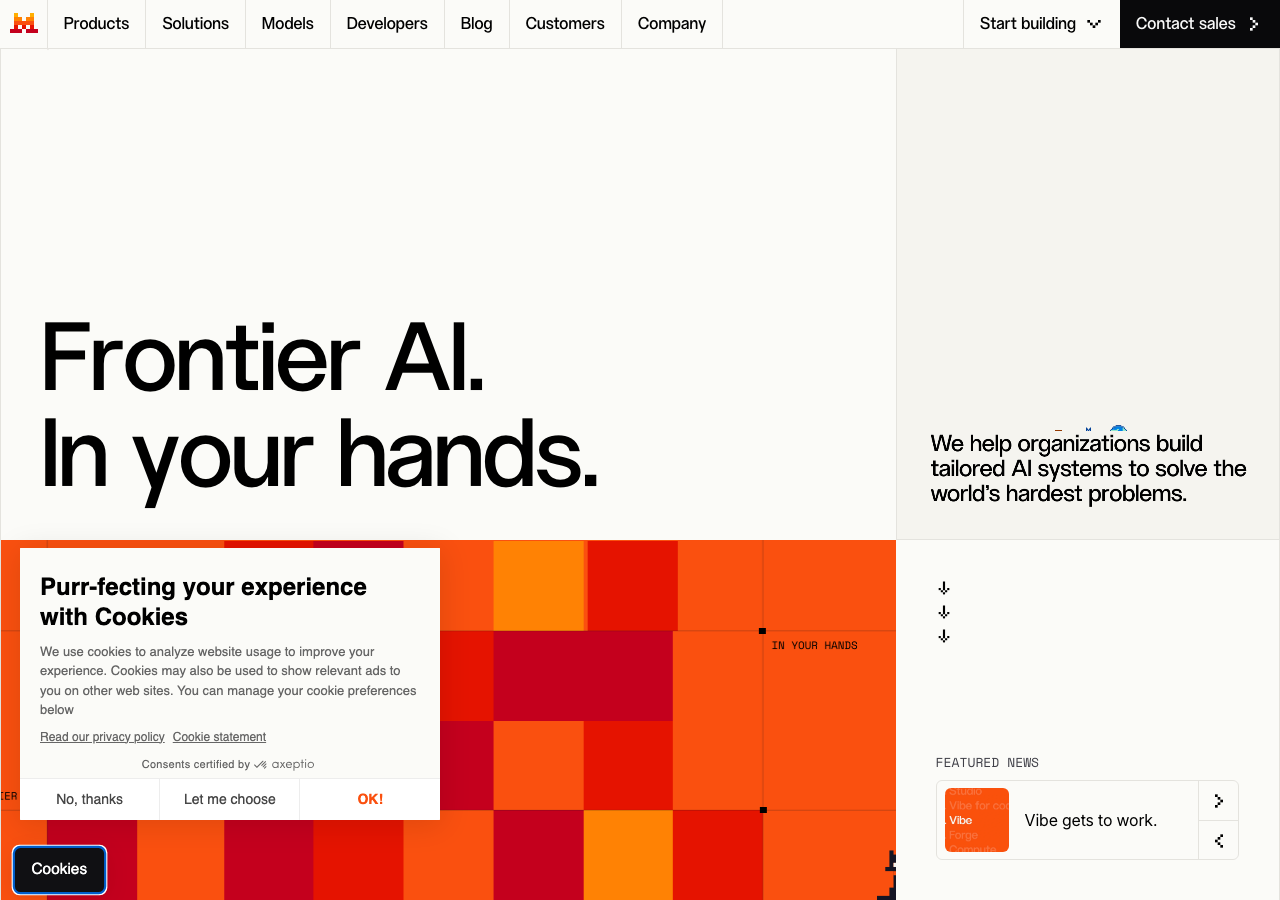
Mistral AI was founded in Paris in 2023 by alumni of DeepMind and Meta, and it raised European venture backing with an explicit mission to build competitive open-weight models that could be deployed inside the EU under GDPR constraints. Le Chat is the company's consumer-facing chat interface, and the free tier gives access to Mistral Small and occasionally Mistral Medium without requiring a credit card. That combination — no cost, EU data residency, open-weight lineage — is genuinely unusual in a market where the dominant products route traffic through US datacenters under terms that leave user data available for training by default.
For students, the practical upshot is moderate but real: Le Chat's underlying models are strong enough for thesis sentence rewriting, paragraph restructuring, and argument-gap spotting on humanities essays, while the EU infrastructure story makes it a legitimate choice for anyone studying privacy law, digital sovereignty, or tech ethics who wants to avoid the optics of sourcing AI help from the very companies they are critiquing. Essay fit 7.3 means it produces clean, grammatically correct paragraphs but occasionally drifts into generic phrasing on complex analytical tasks that GPT-4.1 or Claude Sonnet would handle with more specificity.
Le Chat Free operates in the mid-tier band of consumer AI engines — comfortably above basic chatbots, clearly below the frontier paid products. Mistral Small, the primary model served on the free tier, was trained on a multilingual corpus with particular depth in French, Spanish, German, and Italian, which gives it advantages on European-language academic tasks that English-first models handle with visible strain. A political science essay arguing from Habermasian deliberative democracy will read more naturally if you work iteratively with Le Chat than if you paste your thesis into a model that conceptualizes European governance through an anglophone lens.
The interface itself is clean, fast, and genuinely pleasant to use — lighter than ChatGPT's feature-dense UI, which can overwhelm students who only need a drafting partner, not a multi-modal research suite. Conversations reset with standard context windows, and there is no persistent memory on the free tier that would allow the model to learn your writing voice across sessions. That is both a privacy feature and a usability limitation depending on your workflow.
Rate limits on the free tier are generous by 2025–2026 standards. Unlike ChatGPT Free's hard throttle during peak hours, Le Chat rarely gates access behind a waiting room. Students in European time zones especially benefit because Mistral's server load is distributed differently from US-centric providers. The practical ceiling is essay length: very long documents exceeding fifteen or twenty pages of context will see quality degradation before you hit an explicit limit.
Essay fit 7.3 was calibrated against a set of undergraduate-level writing tasks: sociology arguments, close literary readings, policy analysis briefs, and STEM lab reports. Le Chat consistently produced coherent structure and correct grammar but struggled with the synthetic specificity that distinguishes a B+ from an A paper — the kind of insight-sentence that earns rubric points for original analysis rather than competent summary. Use it to draft, restructure, and polish; do not use it to generate original argumentation you will claim as your own intellectual contribution.
European privacy angle for students
Mistral's EU-first positioning is not just marketing. The company publishes data processing terms that commit to GDPR compliance, processes conversations on servers located in the European Economic Area, and does not sell user data to third parties for advertising. The contrast with OpenAI, Google, and Meta — all of which operate primarily under US jurisdiction with data practices that European regulators have repeatedly investigated — is substantive, not cosmetic.
Why does this matter for students? First, if you are writing a paper on digital rights, surveillance capitalism, or EU tech sovereignty, using Le Chat as your drafting assistant is consistent with the values your essay argues for. Submitting a paper criticizing Meta's data practices while having had Claude or ChatGPT draft your literature review is an irony worth avoiding if the topic is salient. Second, some universities in Germany, France, and the Netherlands have issued guidance suggesting that students should prefer EU-based AI tools when AI assistance is permitted — early compliance with that kind of institutional policy costs nothing when the free-tier tool is this capable.
Third, for students in regulated programs — law, medicine, public policy — whose coursework may brush against sensitive client scenarios or hypothetical case studies, the jurisdictional question around data residency is genuinely relevant. A mock legal brief should probably not be processed through servers in a jurisdiction your client's data would not legally go. Le Chat Free is not a substitute for professional-grade compliance tools, but it is a more defensible choice in that context than the default US alternatives.
Practically, the privacy advantage shows up most clearly in the absence of intrusive data-use notifications and in the minimal account requirements. You can create a Mistral account with an email address and no payment method, which reduces the identity-linking profile that frontier providers build. Students who have privacy-conscious parents, attend institutions with strict acceptable-use policies, or simply prefer not to have their academic drafts stored on US cloud infrastructure will find Le Chat Free's data posture more comfortable.
Multilingual and European-language performance
The strongest practical differentiator for Le Chat Free is multilingual capability on European languages. Mistral trained its models with substantially higher proportions of French, Spanish, Italian, German, and Portuguese text than comparable US-origin models. The result is perceptible: paragraphs generated in French do not read like translated English, idioms land correctly, and academic register — important for French lycée-level writing and university dissertations — is maintained without prompting. Spanish-speaking students report similar results: Le Chat handles subjunctive constructions, regional academic vocabulary, and citation integration in Spanish with fewer awkward anglicisms than ChatGPT.
For bilingual assignments — common in Canadian universities, Swiss institutions, and international programs — Le Chat handles register switching between languages within a single conversation more gracefully than most alternatives. A student drafting a French abstract for an English-language thesis can hand both sections to Le Chat without the jarring tonal mismatch that appears when English-first models attempt French academic prose.
The model is significantly weaker on non-European languages. Arabic, Chinese, Japanese, and Korean performance falls meaningfully behind Qwen Chat, Kimi, or even ChatGPT Free for academic writing in those languages. Students writing in East Asian or Middle Eastern scripts should not treat Le Chat as a multilingual solution — it is a European multilingual solution, which is a narrower category.
English academic writing sits in the 7.3 essay score territory — solid but not exceptional. The model produces well-structured paragraphs with appropriate hedging language for social science claims, handles British English spelling conventions reliably (an underrated advantage for UK university submissions), and does not over-americanize prose in ways that stand out to British or Australian readers. The weakness is in close literary analysis, where the model tends toward summary rather than interpretation, and in quantitative STEM writing, where it occasionally loses track of unit consistency across long problems.
Drafting workflows and honest limitations
Le Chat Free performs best in the middle stages of essay production: after you have a rough outline and a set of source notes, but before you are polishing final sentences. Feed it a bullet list of your argument structure, ask it to expand each point into a full paragraph, and then revise its output against your own understanding of the sources. This workflow produces essays that feel authored rather than generated because the structural skeleton is yours and the prose is a joint product you have actively edited.
Thesis statement generation is a genuine strength. Le Chat can take a broad topic description — 'write about the role of public intellectuals in Weimar Germany' — and produce three or four candidate thesis sentences with different argumentative angles. This is useful for students who know what period or phenomenon they want to write about but are stuck on the specific argumentative claim. Evaluate the candidates critically; do not simply pick the most confident-sounding one.
Limitations in essay contexts are real and should be stated plainly. Le Chat Free does not search the web; it cannot retrieve current sources, check DOIs, or verify that a journal article exists. Any citation it produces is confabulated from training data and must be manually verified before submission. The model's training cutoff means it will not know about publications, policy changes, or events from late 2024 onward with any reliability. For time-sensitive topics in economics, public health, or technology policy, this is a meaningful gap.
The context window on Mistral Small is shorter than GPT-4.1 or Claude Sonnet — practically, this means you cannot paste an entire fifteen-page draft and ask for a holistic revision pass. Work in sections: introduction, each body section, conclusion, and bibliography separately. This is actually good writing practice regardless of which AI engine you use, but it is enforced by the tool rather than chosen by the student.
The model does not always flag its own uncertainty, which is a subtle but important limitation. When Le Chat produces a confident-sounding paragraph on a contested empirical question in economics or history, it may not add the hedging language that would alert a careful reader that the claim needs source verification. Train yourself to be suspicious of fluent confidence in a domain where consensus is fragile.
Academic integrity considerations
Le Chat Free's output sits in the same detection landscape as any frontier AI: Turnitin's AI indicator, GPTZero, and instructor intuition can all flag paragraphs that were drafted by Mistral Small without subsequent revision. The model's European training corpus does produce stylistic patterns that differ somewhat from ChatGPT's characteristic prose — shorter average sentence length, slightly less frequent em-dash usage, different transitions — but these are statistical tendencies, not reliable detection avoidance. Do not choose Le Chat because you believe it evades detection; that claim has no rigorous basis.
The honest position is that AI-assisted drafting requires the same documentation discipline regardless of which engine you use. If your institution requires disclosure, disclose it. Keep timestamped version history in your Google Docs or equivalent. Show incremental edits that reflect your own thinking, not just a clean AI-generated final. The fact that Le Chat is European, open-weight-adjacent, and privacy-respecting does not make its output academically invisible — it makes the tool more ethically coherent as an assistant, but the submission is still your responsibility.
One underappreciated risk with Le Chat Free is the false sense of progress it can create. Because the interface is clean and responses come quickly, it is easy to accumulate several thousand words of apparently polished text without having thought through the argument in any depth. The words look like an essay; they have topic sentences, transitions, and appropriate vocabulary. But the argument may be circular, the evidence thin, and the conclusion a restatement of the introduction. This is not unique to Le Chat — it is a risk with any fast language model — but the lightweight UI removes friction in a way that makes it particularly easy to mistake output for thought.
Comparing Le Chat Free to alternatives
Against ChatGPT Free, Le Chat Free competes credibly on European-language tasks and edges ahead on data residency. ChatGPT Free has a larger model ecosystem, more integrations, and a larger community creating prompt advice, but its throttling during peak hours is a real usability problem. Le Chat Free's consistent availability is worth something when a deadline is two hours away.
Against Claude Free, Le Chat Free is weaker on long-context tasks and on nuanced analytical prose. Claude's free tier produces more carefully calibrated hedging and is less likely to assert contested empirical claims with false confidence. If you are writing a philosophy or ethics paper where intellectual precision matters more than quantity, Claude Free is the better unpaid option.
Against Gemini Free, Le Chat Free wins on non-Google-ecosystem independence — if you are already using Google Docs, Search, and Scholar, Gemini has better integration, but if you are trying to maintain some distance from a single big-tech stack, Le Chat is a cleaner choice.
Against Le Chat Plus (€15/month), the free tier trades access to Mistral Large and Mistral Medium for no cost. For essay-length tasks, Mistral Small is capable enough that the upgrade is optional — the quality gap is noticeable on long analytical arguments but not on paragraph-level drafting. Upgrade if you write regularly in French or Spanish at a level where Mistral Large's additional fluency is perceptible and worth the subscription.
Bottom line
Le Chat Free earns a 7.3 essay score and a recommendation as a secondary drafting tool — not a replacement for the engines at the top of our list, but a genuinely useful complement. It is the right default for European-language coursework, a principled choice for privacy-literate students, and a reliable overflow option when the main free tiers are throttled.
Treat it as a paragraph-level collaborator rather than a research oracle. Bring your own sources, verify every factual claim, and revise the output enough that the final argument is recognizably yours. Within those honest constraints, Le Chat Free delivers solid value at zero cost.
Compare Le Chat Plus if multilingual quality gaps are a bottleneck; compare Claude Free if you need more careful analytical hedging in English; compare HuggingChat if you want to experiment with rotating open-weight models beyond the Mistral family.
Pros
- EU data residency and GDPR compliance — a real differentiator for privacy-conscious students.
- Best free-tier multilingual coverage for European academic languages.
- Clean, fast interface with generous availability and minimal throttling.
- Open-weight model lineage means the underlying architecture is publicly documented.
Cons
- No web search — citation generation is confabulated and must be manually verified.
- Shorter context window limits whole-document revision passes.
- English analytical prose quality sits below Claude Free and ChatGPT Free on complex tasks.
- No persistent memory across sessions on the free tier.
- Limited community resources and prompt guides compared to OpenAI ecosystem.
Pricing
- Le Chat Free has a free tier or free product access — rate limits and model caps apply; paid upgrades may exist on mistral.ai.
- Flagship stack: Mistral Small · Medium. Features and model names change; verify before you subscribe.
Models & access
Mistral Small · Medium. Availability, rate limits, and regional restrictions change — confirm on mistral.ai before subscribing.
Compare alternatives
Who it's for
- EU data residency and GDPR compliance — a real differentiator for privacy-conscious students.
- Best free-tier multilingual coverage for European academic languages.
- Clean, fast interface with generous availability and minimal throttling.
- Open-weight model lineage means the underlying architecture is publicly documented.
Who should compare alternatives
- No web search — citation generation is confabulated and must be manually verified.
- Shorter context window limits whole-document revision passes.
- English analytical prose quality sits below Claude Free and ChatGPT Free on complex tasks.
- No persistent memory across sessions on the free tier.
Student experiences
Ratings from students who used Le Chat Free on real assignments — includes critical reviews.
Loading student reviews…
2,418 words · Updated 2026