
Independent review · 2026
Meta AI Review
Meta AI earns an essay fit score of 7.6 — solidly useful for free brainstorming and first-draft prose, but limited by occasional coherence drops on longer pieces, lack of persistent memory across sessions, and the awkward reality that it lives inside social apps most students associate with procrastination rather than scholarship.
meta.ai · #12 in TOP 50
Open-weight chat
Llama 4 · Llama 3.3
Our verdict
Meta AI earns an essay fit score of 7.6 — solidly useful for free brainstorming and first-draft prose, but limited by occasional coherence drops on longer pieces, lack of persistent memory across sessions, and the awkward reality that it lives inside social apps most students associate with procrastination rather than scholarship.
Overview
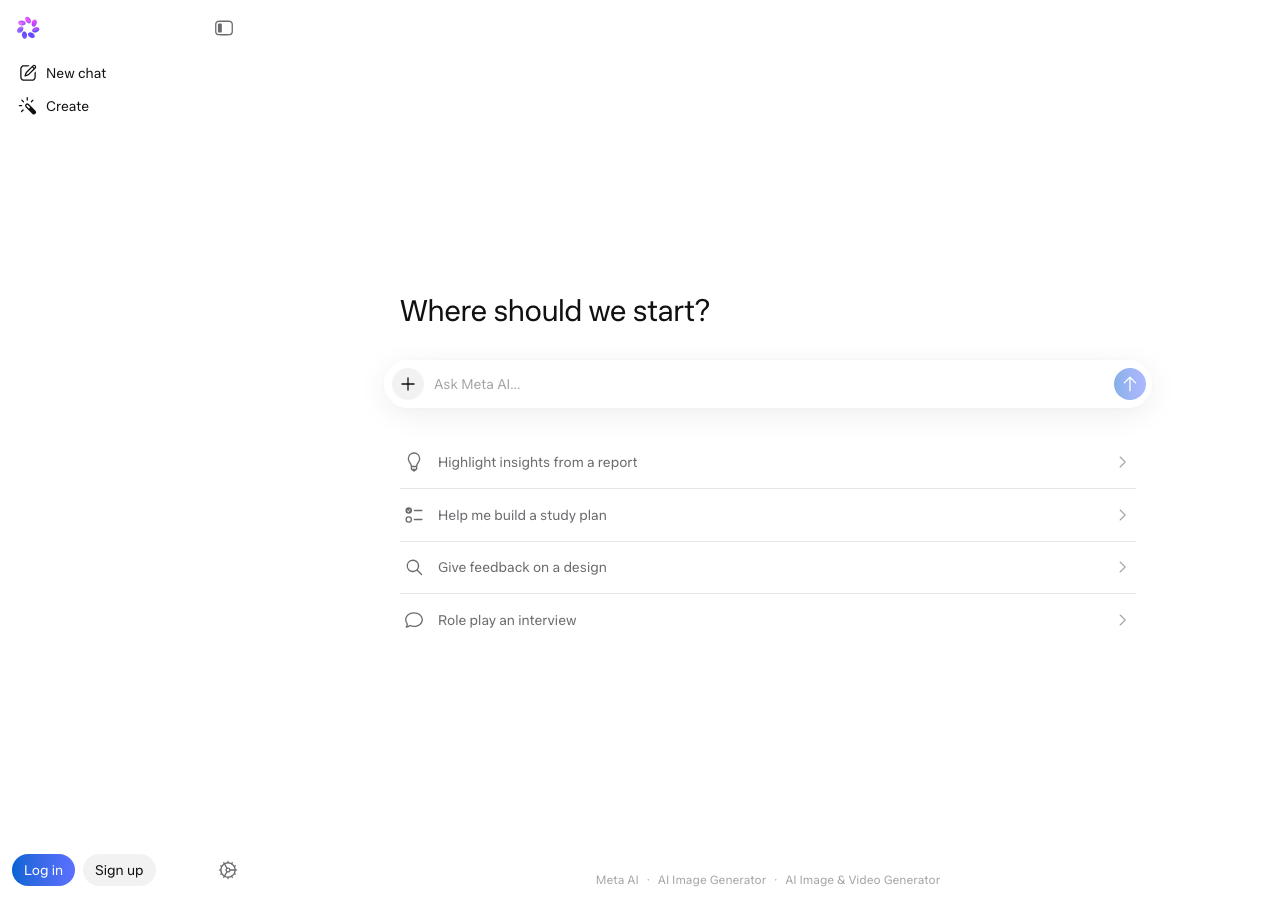
Meta AI entered the consumer market not through a dedicated chat portal but through the apps students already had on their phones: WhatsApp, Instagram, Messenger, and the standalone meta.ai web interface. That distribution strategy gave it an enormous install base overnight, which is both its strength and its strange limitation — the engine is genuinely capable on paragraph-length tasks, but the social-media context around it makes focused, multi-session essay work harder to maintain psychologically and practically.
The underlying models, Llama 4 and the previous Llama 3.3, are legitimate frontier-class architectures. Meta publishes weights openly, which means the academic community has stress-tested these systems in a way proprietary models cannot match. For students, that translates to reliable prose generation, decent argument structuring, and a free tier without obvious daily message caps that would interrupt a late-night drafting session. The limits show up elsewhere: context windows, nuanced editing on 20-page papers, and citation behaviors that remain weaker than search-native tools.
Student sentiment ranges from enthusiastic casual users who discovered the assistant through Instagram to skeptical heavy writers who tried it for a term paper and switched back to ChatGPT or Claude. Neither reaction captures the honest middle: Meta AI is a capable free co-pilot for focused, bounded tasks — outlines, rewriting short passages, explaining a concept before you write about it — but it requires deliberate workflow management to avoid the distraction spiral of checking it from an app where your friends' posts are one swipe away.
Meta AI runs on Llama 4 by default in 2026, with Llama 3.3 accessible in some regional deployments. The Llama 4 architecture introduced Scout and Maverick variants — Scout optimized for long-context processing and Maverick targeting more capable instruction-following — and Meta's blog posts describe these as multimodal-capable systems. For practical student use, the relevant tier is Llama 4 Maverick in the web interface: it handles 128k-token context windows, can read images you upload alongside text, and generally produces grammatically clean English across a range of academic registers.
The free access model is structurally different from ChatGPT Free or Claude Free. Meta does not appear to enforce hard daily message limits in the same way; many users report sustained sessions of dozens of exchanges without hitting a rate gate. The ceiling shows up instead in feature availability: advanced reasoning modes, persistent conversation memory, and the kind of tool integrations (search grounding, code execution) that paid tiers at other providers include are absent or inconsistently available. You get raw language generation, which is often exactly what a student drafting a history essay needs.
Comparing it to the other free options in our rankings: Meta AI produces prose that reads more naturally than Copilot Free in many test prompts, handles longer documents better than Grok Free's basic tier, and matches Claude Free on paragraph-level rewrites while falling behind on instruction-following precision for complex rubric-driven tasks. The essay fit score of 7.6 places it in a productive middle band — better than novelty tools, weaker than the paid frontier tiers it aspires to match.
For international students particularly, the Llama architecture's multilingual training data is a quiet advantage. While Meta does not market Llama 4 as a multilingual specialist the way Qwen or Kimi position themselves, the base model was trained on substantial non-English corpora, and responses in Spanish, Portuguese, and Arabic are noticeably more fluent here than on some competitors at the same price point (free). That said, students writing in Chinese or Japanese for English-language courses should manage expectations: the tone calibration for ESL writing assistance is better from Kimi or Qwen, which were tuned closer to those use cases.
Essay drafting and writing quality
Meta AI handles standard academic essay structures well: five-paragraph formats, comparative analysis frameworks, argument-counterargument-rebuttal patterns. Where it earns the 7.6 rather than a higher score is in sustained coherence across sections. Prompt it for a 2,000-word essay and the early sections tend to be stronger than the conclusion, which can drift toward rote summary language. Prompt it for an outline first, then fill sections individually, and the quality jumps noticeably — the engine performs better when scope is constrained per prompt.
Sentence-level quality is generally high. Meta AI avoids the over-em-dashed, excessively hedged prose that ChatGPT sometimes defaults to. The rhythm tends toward cleaner declarative sentences, which reads more naturally in academic prose and lowers the stylistic signature that some instructors flag. That said, it can slip into filler transitions — 'Furthermore, it is important to note that...' style connectives — particularly when asked to lengthen a draft. Editing prompts like 'remove all transition padding' or 'rewrite to prioritize concrete evidence over hedged claims' improve the output measurably.
One specific weakness: technical and highly specialized academic content. Prompting Meta AI for a detailed analysis of protein folding mechanisms or the finer points of constitutional law doctrine produces prose that sounds confident but occasionally misstates technical details. This is a known pattern with general-purpose LLMs and is not unique to Meta, but students in STEM or law courses should treat outputs as rough scaffolding and verify claims against lecture notes and primary sources. The error rate on technical facts is meaningfully higher here than on ChatGPT Plus with file upload, where attaching your lecture PDF grounds the responses.
Humanities and social science essays tend to play to Meta AI's strengths. Comparative literature prompts, sociological argument construction, historical essay structure — these tasks sit close to the center of what large language models trained on broad text corpora do well. First-pass drafts in these domains are often usable as structural templates after a rewrite pass, saving the hours-long blank-page problem without producing a final product that should be submitted as-is.
Platform context: social apps vs. the web interface
Using Meta AI inside WhatsApp or Instagram is a fundamentally different experience from using the standalone meta.ai web interface, and the distinction matters for student productivity. The in-app experience is optimized for conversational bursts — quick answers, brief replies, casual tone. For essay work, it introduces a real problem: the same notification stream that interrupts you with memes can interrupt a carefully building essay prompt chain. The web interface at meta.ai is cleaner, supports longer inputs more gracefully, and creates less cognitive friction between you and the task.
Conversation history in the web interface persists within sessions but does not carry over between browser sessions in the way that Claude's Projects or ChatGPT's memory features do. This means that for a multi-day essay project, you need to rebuild context each session — paste in your thesis and outline, explain the assignment, then continue. It is a mild overhead for a one-day sprint and a real workflow friction for a week-long research paper. Keeping a working notes document with the context you re-paste is the practical workaround, but it adds a step that paid tools have solved.
The mobile app at meta.ai is more functional than the in-app chatbot. It offers a focused interface, supports image uploads (relevant for diagram-based science coursework), and stores recent conversations. For students doing most of their work on phones rather than laptops — a larger share than desktop-centric developers assume — this mobile-first accessibility is a genuine differentiator among free tools.
Academic integrity and detection risk
The Llama architecture's open-weights status creates an unusual detection dynamic. Because Llama models are available for self-hosting and fine-tuning, AI detection tools have been trained on more diverse Llama output variations than on some proprietary models. The practical effect is that raw Meta AI output may generate higher AI scores on detection tools than similarly-worded output from some other free tier engines, even when the prose quality is equivalent. This is not a reason to avoid the tool — it is a reason to understand that the detector problem is about your revision habits, not your choice of engine.
The honest advice is the same here as for every other AI tool: use Meta AI to scaffold thinking you own. If the process starts with your notes, your observations, and your interpretation of sources, and the AI assists with prose construction, the academic integrity argument is much cleaner than if you opened a blank prompt and asked for a complete essay on a topic you have not yet engaged with. The distinction is practical too — essays built on your existing analysis tend to survive professor questions in office hours; essays generated cold tend not to.
Meta's data handling policies deserve a mention. Because Meta is a social media company with an advertising business model, its privacy practices differ from OpenAI or Anthropic. Student essays submitted as prompts may inform model training unless you opt out — the setting exists but requires active navigation. Students working on sensitive research topics, personal narratives, or papers that overlap with professional work should review Meta's data use terms before pasting anything they would not post publicly.
Pricing and comparison
Meta AI is free with no visible premium tier as of mid-2026. There are no subscription options, no usage credits to purchase, and no student discount program to track. That simplicity is appealing — you do not need to manage billing, watch for trial expirations, or evaluate whether a $20 subscription justifies this month's workload. You just use it.
Against ChatGPT Free, Meta AI's practical daily message availability tends to be higher; GPT-4o mini throttles more visibly during peak hours. Against Claude Free, Meta AI produces slightly more direct prose but loses on instruction-following nuance — Claude Free is better at complex multi-step editing instructions. Against Gemini Free, Meta AI has less integration with productivity tools but produces fewer awkward corporate-register sentences on humanities topics. Against Grok Free, Meta AI's context handling on longer documents is more reliable.
The zero-cost angle makes Meta AI a strong backup tool for students who primarily use a paid engine and want a fallback for overflow queries during a rate-limited session, or who want a second opinion on phrasing without consuming their paid credits on minor edits.
Bottom line
Meta AI sits in a useful tier for students who need competent free writing assistance without the churn of managing subscriptions. Its essay fit score of 7.6 reflects genuine capability on standard academic tasks — outlines, prose rewriting, concept explanation, argument construction — alongside real limits in sustained long-form coherence and citation reliability.
The practical recommendation: use meta.ai in the web interface rather than inside social apps, keep a context document to paste at session start for multi-day projects, and build editing prompts that strip filler language after first-draft generation. Compare with Claude Free if your editing instructions are complex, and compare with Perplexity Free when your assignment requires traceable sources.
The platform context cuts both ways — access is frictionless and session-length limits are generous, but the social media ecosystem around the in-app experience creates productivity risks that a focused student working in the web interface can sidestep. Know which version you are using and set your environment accordingly.
Pricing
- Meta AI has a free tier or free product access — rate limits and model caps apply; paid upgrades may exist on meta.ai.
- Flagship stack: Llama 4 · Llama 3.3. Features and model names change; verify before you subscribe.
Models & access
Llama 4 · Llama 3.3. Availability, rate limits, and regional restrictions change — confirm on meta.ai before subscribing.
Compare alternatives
Who it's for
- Use meta.ai in the dedicated web interface, not inside WhatsApp or Instagram — the focused UI improves output quality and removes distraction
- Paste your thesis, outline, and key argument points at the start of each session to rebuild context Meta AI does not carry between browser sessions
- Follow every first-draft request with a targeted edit prompt: ask to remove filler transitions, shorten sentences over 30 words, and replace hedged claims with evidence-backed assertions
Student experiences
Ratings from students who used Meta AI on real assignments — includes critical reviews.
Loading student reviews…
1,855 words · Updated 2026