
Independent review · 2026
Spark Review
iFlytek Spark earns a 6.5/10 essay fit score that, like ERNIE Bot and Hunyuan, reflects a regional specialist whose performance within Chinese educational contexts exceeds the aggregate score suggests. What distinguishes Spark from its Chinese-market peers is a deliberate and sustained focus on the educational vertical: iFlytek is not primarily a search company (like Baidu) or a social-media conglomerate (like Tencent), but a speech technology and education technology company that has oriented its AI products toward students, teachers, and the Chinese national education system. Spark 4.0 Ultra is the most education-specifically tuned Chinese LLM in our catalog — built with knowledge of Chinese national standards (课程标准), examination genre requirements (高考 and 中考 formats), essay tutoring workflows, and classroom translation tools. For mainland Chinese students navigating the Chinese educational examination pipeline, Spark offers niche advantages that ERNIE Bot and Hunyuan do not. For international students, English-medium work, or research requiring Western academic databases, the same limitations apply as for the other regional specialists.
iflytek.com · #38 in TOP 50
Regional engine
Spark 4.0 Ultra
Our verdict
iFlytek Spark earns a 6.5/10 essay fit score that, like ERNIE Bot and Hunyuan, reflects a regional specialist whose performance within Chinese educational contexts exceeds the aggregate score suggests. What distinguishes Spark from its Chinese-market peers is a deliberate and sustained focus on the educational vertical: iFlytek is not primarily a search company (like Baidu) or a social-media conglomerate (like Tencent), but a speech technology and education technology company that has oriented its AI products toward students, teachers, and the Chinese national education system. Spark 4.0 Ultra is the most education-specifically tuned Chinese LLM in our catalog — built with knowledge of Chinese national standards (课程标准), examination genre requirements (高考 and 中考 formats), essay tutoring workflows, and classroom translation tools. For mainland Chinese students navigating the Chinese educational examination pipeline, Spark offers niche advantages that ERNIE Bot and Hunyuan do not. For international students, English-medium work, or research requiring Western academic databases, the same limitations apply as for the other regional specialists.
Overview
iFlytek (科大讯飞) has occupied a unique position in Chinese technology for over two decades — a Hefei-based AI company whose primary commercial focus is speech recognition, natural language processing, and education technology, rather than the broad consumer platform plays of Baidu, Tencent, or Alibaba. The company's speech recognition technology is embedded in Chinese courtrooms, hospitals, schools, and government offices. Its education products — including intelligent scoring systems used in official examinations, classroom interaction tools, and student assessment platforms — are deployed across hundreds of thousands of Chinese schools.
That educational infrastructure position is the context for understanding Spark. When iFlytek trained its large language model on Chinese text, it did so with access to examination corpora, student essay samples, teacher feedback datasets, and educational curriculum documents that other Chinese AI companies do not hold to the same degree. The practical effect is a model that understands what Chinese composition graders look for, how Chinese examination essays are structured, and what constitutes an above-average argument in a 高考作文 (college entrance examination composition) with a specificity that more general-purpose models cannot match.
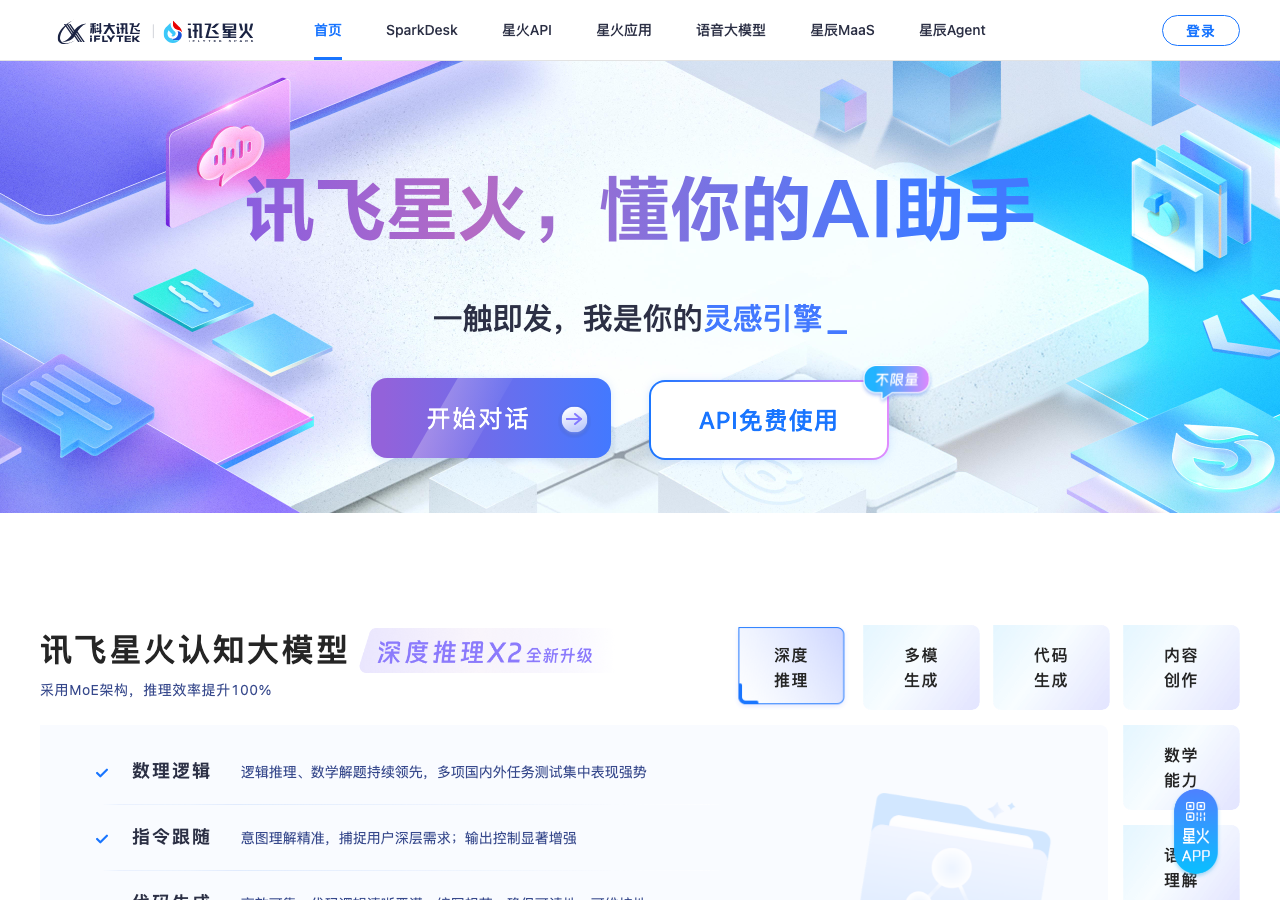
Spark 4.0 Ultra represents the current flagship model generation, with improved reasoning capability, longer context windows, and multimodal features including speech-to-text (leveraging iFlytek's core speech recognition competency). Access is available through the Xinghuo (星火) web interface at xinghuo.xfyun.cn, iFlytek's mobile apps, and integrated education platforms. Free access is available for basic functions; premium tiers unlock extended usage and advanced features.
Spark at rank forty-one in our catalog is the deepest education-vertical specialist among the Chinese regional AI products we review. The essay fit score of 6.5 reflects the same international-use-case drag that affects ERNIE Bot (7.0) and Hunyuan (6.6), with a slight additional discount reflecting Spark's narrower public profile and smaller international user base compared with Baidu's and Tencent's products. Within the Chinese educational context specifically — particularly the examination and tutoring contexts — Spark is arguably more specialized than its score suggests.
iFlytek's positioning of Spark has been explicitly educational from launch. Marketing materials, product feature descriptions, and integration partners all emphasize student use: the Spark-powered essay scorer tells students what score range their examination composition would likely receive; the Spark-powered translation tool supports Chinese students reading English academic sources; the Spark-powered tutoring interface provides step-by-step reasoning for mathematics, science, and language problems in the Chinese curriculum format. This is not incidental feature overlap with education — it is the designed primary use case.
The speech-to-text integration deserves specific mention because it is more deeply developed in Spark than in competing Chinese AI products. iFlytek's proprietary speech recognition technology, which has been deployed in professional settings for over fifteen years, powers Spark's voice input at a quality level that surpasses what general-purpose AI chatbots offer. For students who think aloud, for students with writing disabilities, or for students dictating notes in class that they later want converted to essay text, the voice-to-essay workflow is practically more capable in Spark than in its peers.
The examination focus extends to Chinese regional and national standardized tests beyond the 高考: 考研 (graduate school entrance examination), 四六级 (CET-4/6 English proficiency tests), 普通话 (Mandarin proficiency tests), and various vocational qualification examinations. iFlytek has built assessment and preparation features around these examinations because its core business involves deploying AI scoring in official test contexts. The model's familiarity with examination genre is not simulated — it comes from the same training pipeline that underpins actual examination scoring systems.
Chinese examination essay specialization
The 高考作文 (college entrance examination composition) is one of the most high-stakes single writing tasks in the Chinese educational system — a 60-point portion of the 语文 (Chinese language and literature) examination that millions of students prepare for over years. The genre has specific conventions: argumentative structure (议论文体), mandatory thesis statement, required evidence development, length constraints, and rhetorical patterns that experienced graders reward. iFlytek has deployed AI essay scoring for 高考 compositions in pilot programs, which means Spark's understanding of this genre is grounded in actual grader feedback data rather than theoretical academic writing principles.
This specificity is the clearest differentiator Spark has from ERNIE Bot, Hunyuan, and foreign frontier models for this particular user. A student preparing 高考作文 who asks Spark to evaluate their draft, explain why specific sections would lose marks, and suggest improvements aligned with grading criteria receives feedback from a model that has been trained on that assessment data. Asking ChatGPT Plus the same question requires it to reconstruct Chinese examination genre knowledge from general training rather than specific grading system exposure — the difference is qualitative rather than marginal.
中考作文 (middle school graduation examination compositions) and 期末考试 (semester-final examination essays) follow similar genre conventions at lower complexity levels. Spark handles these correctly and at appropriate formality levels for the age group — an important distinction since middle school academic Chinese and university academic Chinese have different vocabulary density expectations, sentence length norms, and structural conventions.
四六级写作 (CET-4 and CET-6 English writing sections) represent an interesting use case where Spark's bilingual capabilities combine with examination genre knowledge. The CET-4 and CET-6 writing sections have specific time limits, required word counts, and argumentative structures that are well-documented. Spark's training on these examination formats means it can produce sample responses, evaluate student drafts against scoring rubrics, and explain what examiners look for — useful for the millions of Chinese university students who sit these examinations each year.
Essay tutoring — not just generation, but the teaching interaction where Spark explains why an essay works or fails and guides revision — is the most educationally valuable use of the platform. iFlytek's background in classroom technology means Spark's tutoring interactions are more pedagogically structured than simple completion models. Rather than just rewriting a student's paragraph, Spark can be prompted to identify specific rhetorical weakness, suggest targeted revision strategies, and walk through the improvement reasoning — a mode of interaction that requires both essay knowledge and teaching design.
Translation and bilingual academic support
iFlytek's speech and translation technology heritage makes Spark a capable bilingual tool, particularly for Chinese students reading English academic sources and needing accurate, register-appropriate translation. Translation that preserves academic register — transforming technical English academic prose into formal Chinese academic prose, maintaining discipline-specific terminology, and avoiding the colloquial drift that general translation tools produce — is where iFlytek's domain expertise shows.
Chinese-to-English translation for academic purposes follows the same pattern: Spark can produce English translations of Chinese academic texts that are more register-appropriate than general translation services, though still less fluent than native English academic prose. Students submitting English abstracts of Chinese research — common in Chinese academic journals that require bilingual abstracts — find Spark's translation more suitable for academic publication than Google Translate outputs.
English-medium academic essay writing for CET exams, IELTS preparation, and English composition courses follows from the translation capability. Spark's English academic writing, while not at ChatGPT Plus quality, is above the threshold needed for CET-6 and IELTS writing tasks, and the model's awareness of those examination formats gives it the genre knowledge to produce structurally appropriate practice responses.
Medical, legal, and technical translation — domains where iFlytek has deployed commercial translation systems — benefit from specialized terminology training. Students in medicine, law, or engineering who need to translate technical content between Chinese and English find Spark more reliable on terminology than general-purpose chatbots without domain training.
Limitations and context
Outside the Chinese educational and examination context, Spark's limitations mirror those of the other Chinese regional models. English-language academic essay writing for Western university submissions is not where Spark is optimized — the English register is correct but not native, and Western academic citation formats (APA, MLA, Chicago) require the same manual verification steps applicable to other Chinese-market AI tools.
Research sourcing for international academic databases is thin. iFlytek does not have the search integration assets of Baidu or the social media data assets of Tencent, which means Spark's knowledge grounding is primarily training-data-based rather than retrieval-augmented for general topics. For Chinese-language examination content and educational materials, the depth is sufficient; for broader academic research requiring current sources, students need to supplement with search-integrated tools.
iFlytek's status as an entity on the United States Entity List (added in 2019 for AI technology deployment in surveillance and minority-rights contexts) is relevant context for international students and institutions. Some Western universities have policies regarding software from listed entities. Students at institutions with strict technology governance requirements should verify whether Spark falls within any restricted category before using it in academic workflows on institutional devices.
Access outside mainland China follows similar patterns to other Chinese AI products — available through the web interface with variable reliability depending on geographic origin, without the same ecosystem convenience available to domestic users. International Chinese students who want to use Spark for examination preparation during study-abroad periods should verify that their access pathway is reliable before relying on it during high-stakes preparation windows.
Competition with other Chinese AI tools for students
In the Chinese education AI market, Spark competes with a range of products including Baidu's education-specific features, Alibaba's DingTalk AI education tools, dedicated test prep platforms, and a growing number of education-specific AI startups. iFlytek's advantage among these competitors is institutional credibility from its official examination partnerships and its speech recognition legacy — students trust iFlytek AI essay scoring in ways they do not automatically extend to newer players without examination deployment history.
ERNIE Bot is the closest general-purpose competitor. The comparison favors ERNIE Bot for general academic research writing and classical text depth, and Spark for examination genre specialization and speech-to-text quality. Students whose primary academic writing need is examination preparation consistently report more useful feedback from Spark; students whose need is general research essay drafting favor ERNIE Bot's Baidu academic integration.
For overseas Chinese students in international universities who occasionally take Chinese language proficiency examinations (HSK, TOCFL), Spark's examination genre knowledge provides preparation utility that frontier models do not replicate. The use case is narrow but genuine: a heritage Chinese speaker preparing for a formal HSK writing examination while studying in Canada or Australia will find Spark's examination-format feedback more directly applicable than generic writing assistance from ChatGPT Plus.
Bottom line
iFlytek Spark is the right AI tool for a specific student profile: mainland Chinese students navigating examination preparation — 高考, 考研, CET-4/6 — who need feedback grounded in actual examination scoring knowledge, not just general writing advice. For that profile, Spark's 6.5 catalog score significantly underrepresents its practical utility. No other AI in our catalog combines examination genre specificity with speech-to-text quality and pedagogical tutoring structure in the way Spark does.
The honest scope caveat is that this specificity is valuable for examination preparation and less valuable for general academic research writing. A student who needs to write a 10,000-character university thesis on a research topic is better served by ERNIE Bot's Baidu integration than by Spark's examination framework. A student who needs to write and improve a 高考作文 practice draft is better served by Spark than by any other tool in the catalog.
International students with no Chinese examination requirement have no reason to choose Spark over frontier models — the competitive advantage is tightly scoped to Chinese educational examination contexts. Students inside that scope should understand they are using a genuinely specialized tool that earns its use through institutional depth rather than general-purpose benchmarking.
Pros
- deepest examination genre knowledge of any AI in the catalog — 高考作文, 中考作文, CET-4/6 writing, and 考研 essay formats handled with genuine specificity.
- speech recognition quality from iFlytek's core technology — voice-to-essay workflows more capable than other Chinese AI tools.
- essay tutoring mode explains why essays succeed or fail in examination terms — genuinely pedagogical rather than just corrective.
- academic translation quality benefits from iFlytek's commercial translation deployment — register-appropriate and terminology-accurate.
- Chinese educational system expertise — curriculum standards, examination requirements, grade-level expectations represented accurately.
Cons
- essay fit 6.5 — accurate for international and English-language contexts; underrepresents value in Chinese examination preparation.
- weaker general academic research sourcing than ERNIE Bot — less search integration for broad research essays.
- iFlytek's Entity List status may trigger institutional technology governance restrictions at some Western universities.
- English-language essay output is examination-format-appropriate but not native in register — supplement for Western submission.
- access outside mainland China is functional but lacks the ecosystem integration convenience of domestic access.
Pricing
- Spark has a free tier or free product access — rate limits and model caps apply; paid upgrades may exist on iflytek.com.
- Flagship stack: Spark 4.0 Ultra. Features and model names change; verify before you subscribe.
Models & access
Spark 4.0 Ultra. Availability, rate limits, and regional restrictions change — confirm on iflytek.com before subscribing.
Compare alternatives
Who it's for
- deepest examination genre knowledge of any AI in the catalog — 高考作文, 中考作文, CET-4/6 writing, and 考研 essay formats handled with genuine specificity.
- speech recognition quality from iFlytek's core technology — voice-to-essay workflows more capable than other Chinese AI tools.
- essay tutoring mode explains why essays succeed or fail in examination terms — genuinely pedagogical rather than just corrective.
- academic translation quality benefits from iFlytek's commercial translation deployment — register-appropriate and terminology-accurate.
Who should compare alternatives
- essay fit 6.5 — accurate for international and English-language contexts; underrepresents value in Chinese examination preparation.
- weaker general academic research sourcing than ERNIE Bot — less search integration for broad research essays.
- iFlytek's Entity List status may trigger institutional technology governance restrictions at some Western universities.
- English-language essay output is examination-format-appropriate but not native in register — supplement for Western submission.
Student experiences
Ratings from students who used Spark on real assignments — includes critical reviews.
Loading student reviews…
2,197 words · Updated 2026