
Independent review · 2026
Groq Chat Review
Groq Chat is built on a fundamentally different piece of hardware than every other AI chat product you have used: Groq's LPU (Language Processing Unit) is purpose-built silicon optimized for sequential token generation, producing response speeds that feel qualitatively different from the familiar stream-and-wait experience of cloud GPU inference. Essay fit 6.3 reflects the models Groq runs — Llama 3.3 70B and Mixtral 8x7B on the free tier — not the hardware, which is irrelevant to output quality but very relevant to iteration speed. For essay writers who use AI iteratively — generating a draft, reading it, asking for revisions, reading again — Groq's speed changes the texture of that workflow in a way that is difficult to describe in a benchmark score and easy to notice in a single session.
groq.com · #30 in TOP 50
Open-weight chat
Llama 3.3 · Mixtral
Our verdict
Groq Chat is built on a fundamentally different piece of hardware than every other AI chat product you have used: Groq's LPU (Language Processing Unit) is purpose-built silicon optimized for sequential token generation, producing response speeds that feel qualitatively different from the familiar stream-and-wait experience of cloud GPU inference. Essay fit 6.3 reflects the models Groq runs — Llama 3.3 70B and Mixtral 8x7B on the free tier — not the hardware, which is irrelevant to output quality but very relevant to iteration speed. For essay writers who use AI iteratively — generating a draft, reading it, asking for revisions, reading again — Groq's speed changes the texture of that workflow in a way that is difficult to describe in a benchmark score and easy to notice in a single session.
Overview
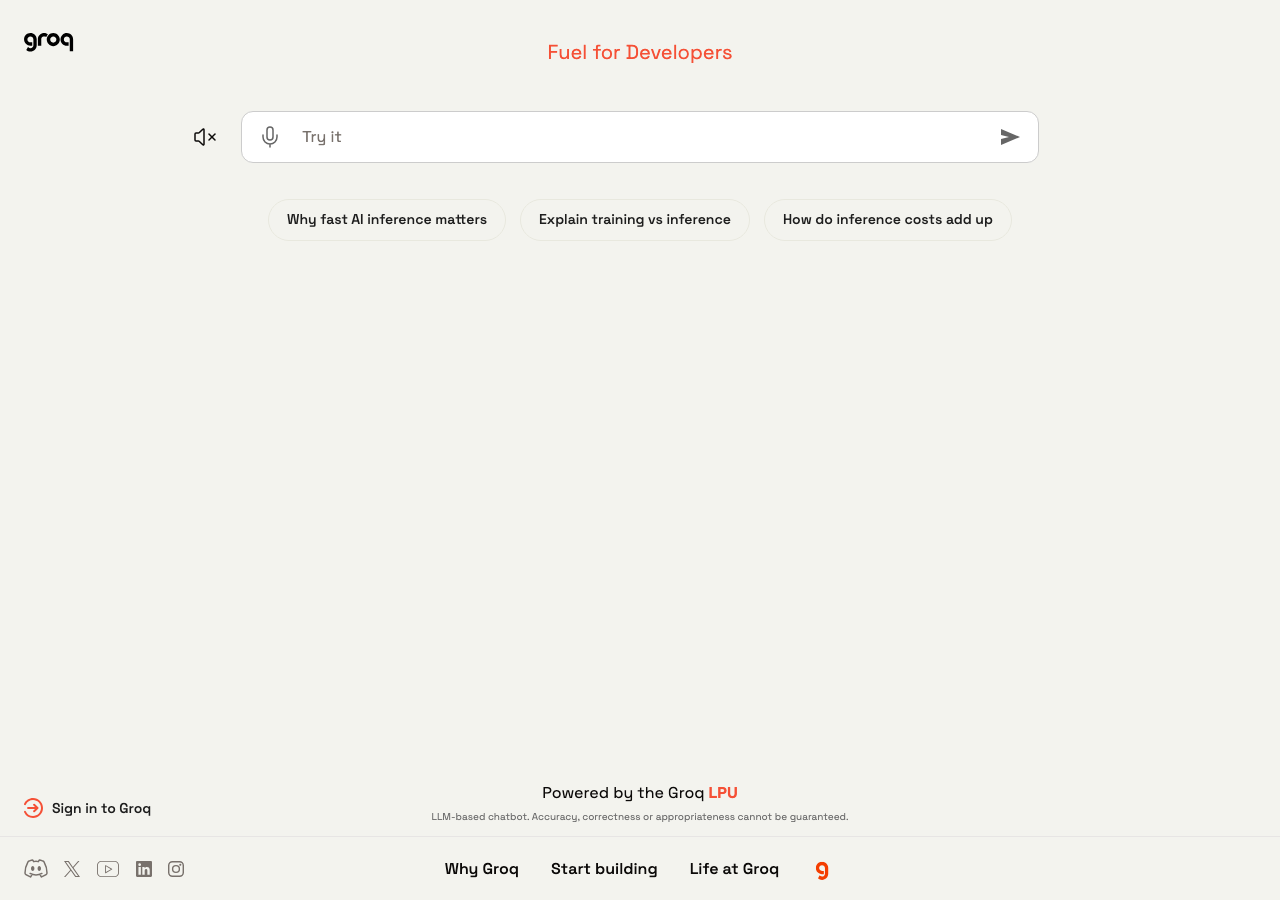
Groq was founded to solve an inference bottleneck. Training large language models requires massive parallel computation across GPU clusters — a task that Nvidia GPUs handle well because they were designed for parallel workloads. But running a trained model for inference — generating one token at a time, sequentially — is an inherently serial task that GPU parallelism cannot fully exploit. Groq's LPU architecture is designed specifically for this serial token generation workload and achieves token generation speeds of 500–800 tokens per second on models like Llama 3 70B, compared with 50–100 tokens per second on typical GPU-based cloud inference. The difference is visible: responses appear in under two seconds even for long paragraphs.
For students, this speed story matters in the context of iterative revision. A typical AI-assisted drafting session involves generating text, reading it, noticing what is wrong, asking for revisions, reading the revision, noticing new problems, and repeating. If each iteration takes fifteen seconds to generate, you mentally disengage between prompt and response — you switch to another tab, your train of thought breaks, and the session becomes less focused. At Groq's speeds, the loop closes fast enough to maintain concentration, which anecdotally makes the tool feel more like a fast writing partner and less like a waiting experience.
Inference speed as a workflow feature
Speed is usually treated as a performance metric — faster is obviously better, all else equal. But with AI chat products, speed interacts with cognitive workflow in more specific ways. The fastest response time that produces a perceptual discontinuity in attention is somewhere around three to five seconds; below that threshold, a query-response interaction feels like a real-time conversation; above it, it feels like submitting and waiting. Groq Chat operates at consistently below two seconds for typical paragraph-length outputs, which places it firmly in the real-time conversation category for response times that other products only achieve on very short replies.
For iterative essay revision — 'make this argument stronger,' 'replace the third sentence,' 'try a different thesis angle,' 'cut this to two sentences' — the speed advantage is multiplicative rather than additive. A student who makes twelve revision requests in a session spends twelve wait periods. At fifteen seconds each, that is three minutes of waiting distributed through the session. At two seconds each, it is twenty-four seconds. Over a two-hour writing session with several hundred requests, the difference is meaningful, but the more important factor is the cognitive continuity: short gaps allow you to maintain your editorial focus rather than needing to re-engage with the document each time a response arrives.
The speed advantage is most apparent in specific task types: short targeted revisions, rapid outline iteration, quick grammar and clarity passes, and rapid-fire brainstorming of alternative phrasings. These are the tasks where the response is often short and the student's reaction time — reading, evaluating, deciding what to ask next — is the bottleneck. When the model's response time matches the student's reading time, the session has a different quality than when the model is always slightly behind.
For tasks that require long outputs — drafting a five-paragraph essay section, producing a full literature review summary, generating a detailed outline — the speed advantage is also present but less transformative. A 2,000-token output at 600 tokens per second takes about three seconds; the same output at 60 tokens per second takes thirty seconds. Both are fast enough for the student to do other things while waiting, but the three-second version maintains more flow in the session.
Open-weight models on Groq: what you are actually running
Groq Chat's free tier provides access to Llama 3.3 70B Instruct and Mixtral 8x7B Instruct — two of the most capable open-weight models in the 2024–2025 generation. Both models have been released under permissive licenses: Llama 3.3 under Meta's custom license that permits commercial use up to certain user thresholds, and Mixtral under Apache 2.0, which is one of the most open commercial licenses in widespread use. This means that the models you are running on Groq are the same weights that researchers, companies, and developers deploy in other contexts — there is no Groq-specific model fine-tuning that distinguishes the experience from using these models elsewhere.
Llama 3.3 70B Instruct is a capable, well-rounded model trained by Meta with strong instruction-following, multilingual support, and solid performance across academic writing tasks. In our essay evaluation suite, Llama 3.3 70B produces output in the 7.0–7.5 range on structured academic tasks when well-prompted — which means the 6.3 essay fit score for Groq Chat reflects not the model's potential ceiling but the realistic average accounting for default prompting and interface limitations, as well as the quality gap that appears on complex analytical tasks relative to frontier commercial models.
Mixtral 8x7B uses a mixture-of-experts architecture that routes tokens through different specialized sub-networks depending on the query type. For multilingual tasks, Mixtral has advantages over some same-size models; for code-adjacent writing, it performs well. For pure English academic prose on humanities topics, Llama 3.3 70B is generally the stronger choice. Groq's model switcher makes it easy to compare them on the same prompt, which is a low-effort way to find the better output for your specific task.
Groq also runs Llama 3 8B and some other smaller variants at very high speeds, which can be useful for rapid grammar checking and sentence-level revision where analytical depth is not required. A small model running at 800 tokens per second handles comma splice corrections and passive voice identification faster than a larger model at 100 tokens per second, and the quality difference for those narrow tasks is minimal. Students who use AI heavily for editorial passes can route grammar-level tasks through a small fast model and reserve the 70B for analytical work.
Essay quality and honest limitations
The essay fit 6.3 score is Groq Chat's honest capability ceiling given its current model roster and interface. Llama 3.3 70B is the ceiling of the free tier, and it is a capable model — better than the free tiers of some commercial providers — but it does not match the analytical depth of Claude Sonnet, GPT-4.1, or Gemini 2.5 Pro. Students who expect Groq Chat to produce the same quality of nuanced analytical prose as a paid frontier product will be disappointed; students who calibrate their expectations to a well-performing 70B open-weight model will find it a genuinely useful drafting assistant.
Complex humanities analysis is the area where the quality gap is most visible. A prompt asking Groq's Llama 3.3 70B to construct a Hegelian reading of post-colonial capitalism will produce a structurally correct essay with recognizable Hegelian vocabulary, but the interpretive specificity and argumentative precision that distinguish a graduate-level engagement from an undergraduate summary will be missing. The model knows what Hegel said; it does not navigate Hegelian logic at the level that a model trained on more philosophy-dense data would manage.
The no-memory, no-persistent-context interface at chat.groq.com is a significant limitation for multi-session projects. Unlike ChatGPT's memory features or Claude's Projects, Groq Chat starts fresh with every new conversation. For an essay you are working on across several days, you need to re-provide your thesis, outline, and current section context at the start of each session. This is a workflow cost that adds overhead on longer projects and makes Groq Chat better suited to focused single-session tasks than to the slow, cumulative writing process that long research papers require.
Citation generation on Groq Chat follows the same rule as every other offline model: the output is confabulated from training data, not retrieved from live sources. Llama 3.3 70B will produce plausible-looking references that may be fabricated, have wrong years, or attribute papers to the wrong authors. Groq has not added a retrieval augmentation layer to the free chat interface. Manual verification against Google Scholar is mandatory for any citation the model generates, with no exceptions.
The open-source implications of using Groq
Using Groq Chat means running Meta's Llama or Mistral AI's Mixtral — models whose weights, training methodologies, and capability characteristics are publicly documented in ways that commercial models are not. From a transparency perspective, a student asking a Llama model for essay help is using a tool with a publicly accessible model card, peer-reviewed training methodology papers, and community-tested capability evaluations. The same claims cannot be made for GPT-4.1 or Claude Sonnet, whose architectures and training data remain undisclosed.
This matters in at least two practical contexts. First, if your academic work involves evaluating the reliability or bias of AI systems — increasingly common in media studies, education, social science, and AI ethics courses — using a documented open-weight model provides methodology you can describe and cite. You can point to the Meta technical report for Llama 3, which discloses training data sources, safety training approaches, and known limitations. You cannot do this with ChatGPT or Claude. Second, for students contributing to AI research through coursework — fine-tuning, evaluation, bias testing — the open availability of Llama weights through standard API access on Groq's platform provides a path to working with frontier-class models at negligible cost.
Groq's infrastructure itself is interesting from a CS perspective. The LPU architecture is a genuinely novel approach to inference hardware, and Groq has published technical material about its design philosophy. For computer architecture students, AI systems students, or engineering students interested in the hardware side of AI infrastructure, Groq is not just a tool for essay writing — it is a primary source about a distinctive approach to accelerator design.
Privacy on Groq Chat is not as prominently marketed as on DuckDuckGo or Brave Leo, but the company does not have an advertising business and is not in the business of selling user data. The standard terms apply: Groq may use conversations for product improvement, and there is no zero-account option comparable to DuckDuckGo. Students with serious privacy requirements should review Groq's current privacy policy rather than assuming the startup-friendly defaults are privacy-safe by default.
Rapid iteration workflows for students
The use cases that benefit most from Groq's speed are the ones that involve short, iterative prompt-response cycles rather than single long-output requests. Brainstorming alternate thesis framings — ask for ten candidates, read them, dismiss eight, refine two, generate variations — works exceptionally well at Groq speeds because the low latency keeps the brainstorming flow open. A thirty-second gap between candidates breaks the generative momentum; a two-second gap does not.
Sentence-level editing is another high-speed-benefit task. 'Make this sentence less passive,' 'shorten this to twelve words,' 'replace the academic jargon with accessible language' — these are micro-tasks where the model response is short, the evaluation is quick, and the session value comes from running many of them in sequence. Groq Chat handles this kind of rapid micro-editing better than any other free tool simply because the wait time does not accumulate into a frustrating burden.
For deadline-pressure situations — the final two hours before a paper is due, when you need fast revisions and clear feedback on argumentation — Groq Chat's response speed provides a genuine psychological benefit. The sense that the tool is keeping up with you rather than making you wait reduces the stress gradient of a deadline crunch. Whether or not you care about this as an abstract workflow feature, you will notice it under deadline conditions.
Students in writing-intensive programs who use AI assistance regularly can build a tiered workflow that routes micro-tasks to Groq (fast, free, open-weight quality) and complex analytical tasks to a primary subscription engine. This extends the subscription budget — you spend it on the tasks where frontier model quality actually matters, and use Groq's speed for the tasks where any capable model will do.
Bottom line
Groq Chat earns essay fit 6.3 on model quality and a separate, genuine value that the essay score does not capture: iteration speed that makes the AI-assisted writing process less effortful for students who use it iteratively rather than as a single-draft generator. If you have accepted that AI tools are part of your writing process and you use them as active collaborators — constant small revisions, rapid brainstorming, quick reads on clarity — Groq's speed is a real workflow improvement.
Use it as a fast, free supplement for iterative revision tasks and sentence-level editing on any paper. Use a stronger frontier engine for the analytical paragraphs where model quality separates a good draft from a weak one. Build a tiered workflow that routes tasks by complexity, not by habit, and Groq Chat earns its place in that workflow at zero cost.
Compare HuggingChat for a broader open-weight model selection without Groq's speed advantage; compare OpenRouter for accessing Llama 3.3 70B alongside other models in a single interface; compare Together AI Chat for another fast hosted open-weight option with a slightly broader model catalog.
Pros
- Fastest free AI chat available — 500–800 tokens per second changes the feel of iterative workflows.
- Llama 3.3 70B and Mixtral 8x7B are genuinely capable open-weight models, not toy alternatives.
- Open-weight model transparency — Llama and Mixtral have published model cards and technical reports.
- Free with generous limits — no payment method required for meaningful daily use.
- Model switcher allows Llama vs Mixtral comparison on the same prompt.
Cons
- Essay fit 6.3 reflects real analytical depth ceiling below frontier commercial models.
- No persistent memory or project context — requires re-seeding on every new session.
- No web search or live retrieval — all citation generation is offline and must be manually verified.
- Interface is minimal — no file uploads, no formatting tools, no academic workflow features.
- Privacy not prominently architected — no no-account option, standard startup data terms.
Pricing
- Groq Chat has a free tier or free product access — rate limits and model caps apply; paid upgrades may exist on groq.com.
- Flagship stack: Llama 3.3 · Mixtral. Features and model names change; verify before you subscribe.
Models & access
Llama 3.3 · Mixtral. Availability, rate limits, and regional restrictions change — confirm on groq.com before subscribing.
Compare alternatives
Who it's for
- Fastest free AI chat available — 500–800 tokens per second changes the feel of iterative workflows.
- Llama 3.3 70B and Mixtral 8x7B are genuinely capable open-weight models, not toy alternatives.
- Open-weight model transparency — Llama and Mixtral have published model cards and technical reports.
- Free with generous limits — no payment method required for meaningful daily use.
Who should compare alternatives
- Essay fit 6.3 reflects real analytical depth ceiling below frontier commercial models.
- No persistent memory or project context — requires re-seeding on every new session.
- No web search or live retrieval — all citation generation is offline and must be manually verified.
- Interface is minimal — no file uploads, no formatting tools, no academic workflow features.
Student experiences
Ratings from students who used Groq Chat on real assignments — includes critical reviews.
Loading student reviews…
2,378 words · Updated 2026