
Independent review · 2026
Google AI Pro Review
Google AI Pro is the subscription tier that most students actually buy when they type 'Google AI subscription' into a search bar, and it is different from Gemini Advanced in ways that matter for academic planning. At $20 per month on Google One AI Premium, the subscription delivers Gemini 2.5 Pro access, Deep Research, the NotebookLM Plus upgrade, and Google Workspace AI features — a bundle that justifies the price if you already live in Google Docs, Drive, and Gmail. The essay fit score of 8.2 reflects capable Gemini 2.5 Pro writing quality with the practical advantage of the deepest Google ecosystem integration available at this price point. Students who do not use Google Workspace day-to-day should compare the $20 here against $20 for Claude Pro or ChatGPT Plus, because Google AI Pro's premium value is largely in Workspace integration rather than raw model superiority over those alternatives.
google.com · #45 in TOP 50
Frontier subscription
Gemini 2.5 Pro · Deep Research
Our verdict
Google AI Pro is the subscription tier that most students actually buy when they type 'Google AI subscription' into a search bar, and it is different from Gemini Advanced in ways that matter for academic planning. At $20 per month on Google One AI Premium, the subscription delivers Gemini 2.5 Pro access, Deep Research, the NotebookLM Plus upgrade, and Google Workspace AI features — a bundle that justifies the price if you already live in Google Docs, Drive, and Gmail. The essay fit score of 8.2 reflects capable Gemini 2.5 Pro writing quality with the practical advantage of the deepest Google ecosystem integration available at this price point. Students who do not use Google Workspace day-to-day should compare the $20 here against $20 for Claude Pro or ChatGPT Plus, because Google AI Pro's premium value is largely in Workspace integration rather than raw model superiority over those alternatives.
Overview
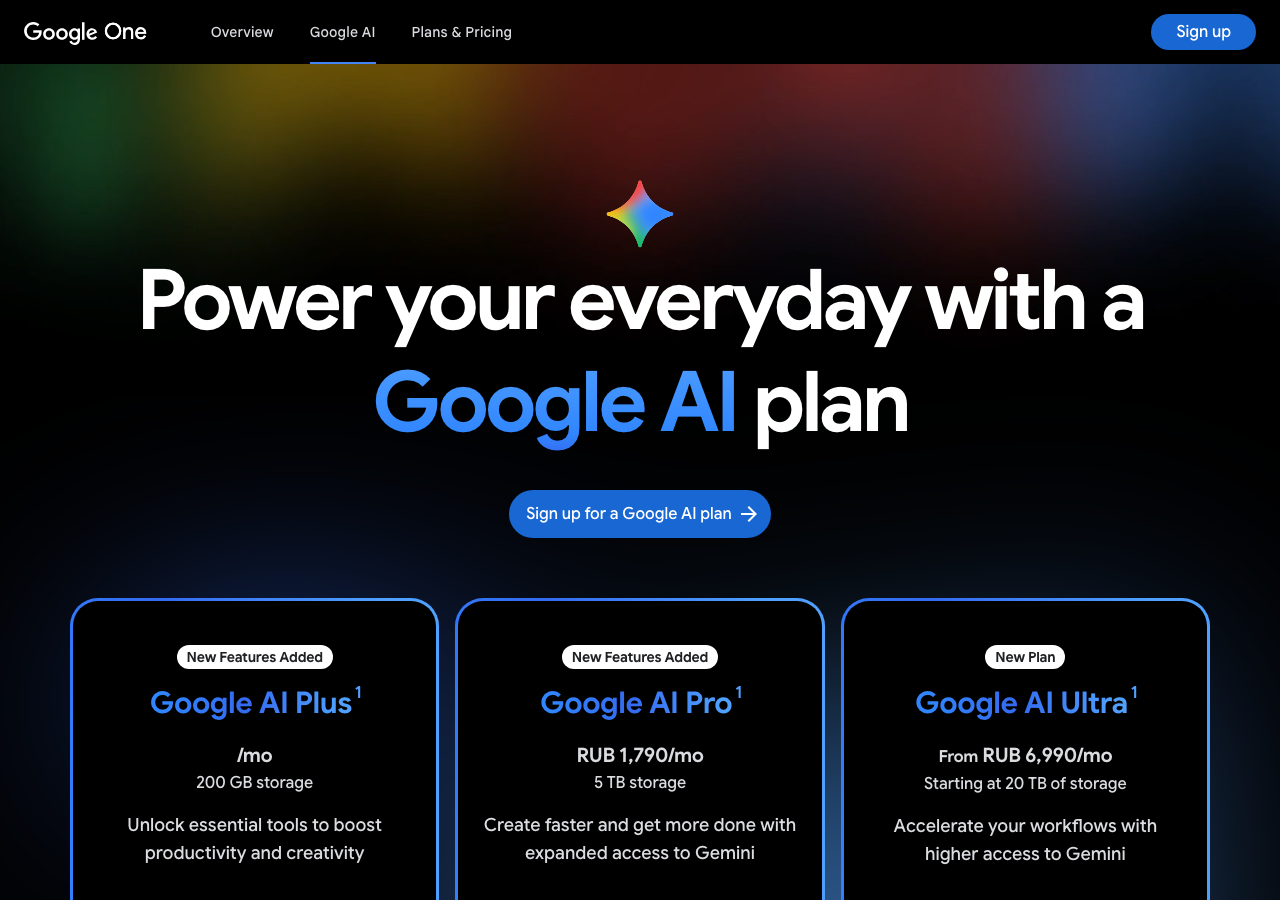
The Google AI product naming landscape in 2025–2026 is deliberately confusing, and this review addresses that confusion directly as its first task. Google offers AI subscriptions under multiple names that overlap in marketing but differ in actual product scope: Gemini Advanced, Google One AI Premium, and Google AI Pro are terms that appear in different parts of Google's website, pricing pages, and app interfaces and they often refer to the same underlying subscription while emphasizing different feature bundles. For the purposes of this review, Google AI Pro refers to the $20/month Google One AI Premium subscription that provides enhanced Gemini access with Workspace integration — the tier positioned between free Gemini and higher-tier enterprise plans.
Understanding what this tier buys versus the free Gemini tier and versus a hypothetical higher-tier Gemini offering is essential before purchase. The free Gemini tier uses Gemini 2.5 Flash — fast and capable for everyday questions but rate-limited for intensive work. Google AI Pro unlocks Gemini 2.5 Pro, which is a larger, more capable model particularly stronger at multi-step reasoning, long-document analysis, and nuanced essay argumentation. Deep Research, the agentic literature-survey feature, is a Pro-tier exclusive. NotebookLM Plus expands the number of notebooks and sources you can manage. Those are the concrete deliverables distinguishing the paid subscription from the free tier.
Google AI Pro sits at a specific position in the competitive landscape: it is Google's answer to the $20/month AI subscriptions offered by OpenAI (ChatGPT Plus) and Anthropic (Claude Pro). All three price at the same point, all three offer frontier-class model access with higher usage caps than free tiers, and all three target the same population of knowledge workers and students who need AI assistance beyond what free tiers provide. The differentiation between them is ecosystem integration and model-specific capability strengths, not price.
Google's specific advantage is Workspace. If you write academic essays in Google Docs, store research materials in Google Drive, organize notes in Google Keep, and communicate via Gmail, the AI Pro subscription threads through all of those applications in ways that ChatGPT Plus and Claude Pro do not match by default. Gemini in Docs assists with drafting and editing directly in the document interface. Gemini in Drive can answer questions about files stored in your Drive without manual copy-paste. Gemini in Gmail summarizes email threads and drafts replies. For students whose digital life already runs on Google's infrastructure, these integrations eliminate friction that competes with the model quality advantages of other platforms.
The essay quality from Gemini 2.5 Pro at this tier is genuinely strong — not quite ChatGPT Plus levels on some nuanced humanities tasks, but competitive on argumentative structure, synthesis across sources, and clear academic prose. Google has invested heavily in post-training alignment for the 2.5 Pro series, and the results show in essay benchmarks and in practical user experience for students writing analytical papers. The model's 1 million token context window — accessible within the chat interface and Docs integration — is the largest available at any $20/month price point as of 2026, which is a concrete advantage for students working with large amounts of source material simultaneously.
The naming confusion between Google AI Pro and Gemini Advanced is not accidental — Google's marketing has used both terms to refer to the same product in different periods and contexts. Gemini Advanced was the original branding for the premium Gemini experience; Google One AI Premium became the subscription label as Google bundled additional benefits into the package; Google AI Pro emerged as a cleaner consumer-facing name. In practice, if you are paying $20/month through Google One and getting Gemini 2.5 Pro access with Workspace integration, you have the tier this review covers regardless of which label Google's interface currently applies.
Google AI Pro versus Gemini Advanced: the real distinction
The most important clarification in this review is that Google AI Pro (as a concept) and Gemini Advanced (as a product label) have historically referred to the same $20/month subscription tier — not to separate products at different price points. Students who search for 'Gemini Advanced vs Google AI Pro' expecting to find two distinct offerings at different capability levels are typically looking at the same product under different names applied at different times in Google's product marketing evolution.
Where a meaningful distinction exists is between the standard Google One AI Premium subscription and any emerging higher-tier offerings Google may introduce. In 2025–2026, Google has tested and launched various premium AI plan structures, including AI Pro plans within Google Workspace for Education. If your institution provides Google Workspace for Education, access to AI features may differ from the consumer $20/month subscription — potentially better in some respects (free or subsidized), worse in others (institution-managed restrictions). Check your university's Google Workspace settings before paying for a consumer subscription.
The relevant consumer-tier comparison is not Google AI Pro versus Gemini Advanced but rather Google AI Pro versus ChatGPT Plus and Claude Pro. That comparison is covered honestly in the competitive positioning section of this review. Students who find Google AI Pro marketing confusing should simply navigate to one.google.com, find the AI Premium or AI Pro subscription, and read the listed features directly — Google's feature lists are more accurate than third-party summaries of the branding that may be outdated by the time you read this.
A future-facing note: Google has shown a pattern of tiered AI subscription expansion, moving from free Gemini to a single paid tier and likely toward multiple paid tiers at different capability and price levels. The 2026 AI subscription landscape for all major providers is in active flux, and the specific features bundled at specific price points will change after publication. Treat the feature list in this review as a snapshot as of early 2026 and verify current inclusions before purchase.
Deep Research and academic literature work
Deep Research is the feature that most meaningfully differentiates Google AI Pro from the free Gemini tier for academic purposes. It is an agentic research pipeline — when you enter a research question, Deep Research autonomously plans a multi-step investigation, runs searches across the web, synthesizes information from multiple sources, and produces a structured report with inline citations. For a student beginning research on an unfamiliar topic, Deep Research can compress hours of initial literature scoping into a fifteen-minute automated scan.
The quality of Deep Research output varies significantly by topic. For topics with substantial English-language web presence — major historical events, extensively documented scientific fields, widely covered policy debates — the feature produces genuinely useful scoping reports. For niche academic topics, specialized subfields, or very recent empirical findings, the feature may miss key literature that is behind journal paywalls or in databases that Google's crawler does not fully index. Always treat Deep Research output as a starting point that identifies search directions, not a comprehensive literature review you can submit.
Deep Research cites sources inline in its output, which is its practical advantage over asking Gemini a research question in the standard chat interface. You can click through to the cited sources directly. However, verify that those links resolve and that the cited material actually supports the claim made. AI-generated citation behavior, even in explicitly source-grounded systems like Deep Research, can produce mismatches between cited content and attributed claims. The volume of sources cited creates an illusion of thorough verification — systematic spot-checking is still required.
For students in quantitative research methods courses, Deep Research's synthesis of empirical literature is more useful than its handling of purely theoretical or philosophical debates. Empirical papers have clear conclusions Deep Research can extract; theoretical arguments that require nuanced interpretive reading are handled less reliably by automated synthesis. Calibrate your reliance on Deep Research accordingly based on your course's epistemological orientation.
Workspace integration workflow
The Google Docs integration is the strongest practical argument for Google AI Pro over competing subscriptions for students already in the Google ecosystem. With the subscription active, a Gemini panel appears in Docs that allows you to ask Gemini to revise selected paragraphs, rewrite sections in a different tone, summarize what you have written, or generate continuations from a prompt — all without leaving the document. The in-document context means Gemini can see your current draft when generating suggestions, which produces more consistent and contextually appropriate output than copy-pasting into a separate chat window.
Google Drive integration allows asking Gemini questions about your entire Drive library. For a student with lecture notes, course PDFs, and research materials scattered across Drive folders, being able to ask 'what do my notes from week three of organic chemistry say about reaction mechanisms' and get a grounded answer is genuinely useful for study purposes. The Drive integration does not replace careful note organization, but it partially compensates for disorganized archives when time is short.
The NotebookLM Plus upgrade included with AI Pro is significant for research-heavy students. Standard NotebookLM supports a limited number of notebooks with a restricted source count; Plus raises both limits significantly and adds priority processing. For a dissertation student who needs to maintain multiple source libraries — one per chapter, for instance — NotebookLM Plus provides the capacity that the free tier constrains. Given that NotebookLM is an essay researcher's extremely useful companion regardless of subscription status, getting the Plus version bundled into the AI subscription is a legitimate bundling value.
Gmail's AI features — summarization of long threads, smart reply drafting, email composition assistance — are less academically central but practically relevant for the student administrative workload: communicating with advisors, coordinating with academic departments, and managing application and scholarship correspondence. These features are available in the standard Google One AI Premium/AI Pro subscription and work in the standard Gmail interface without additional setup.
Bottom line
Google AI Pro is the right $20/month choice for students whose academic work already lives in Google Docs, Drive, and Gmail. The Workspace integrations, Deep Research feature, and NotebookLM Plus bundle make it a genuinely complete academic AI package for the Google-native student. The essay quality from Gemini 2.5 Pro is competitive — not the single best option for pure writing assistance, but strong enough that the workflow advantages of staying inside the Google ecosystem tip the decision for many students.
Students whose workflow centers on Microsoft 365, who primarily draft in Word and store notes in OneNote, should compare Microsoft Copilot's integration advantages at a similar price. Students who prioritize raw essay quality over ecosystem integration and have no strong platform preference should compare ChatGPT Plus and Claude Pro before committing to Google AI Pro.
Do not pay retail for this subscription if your university has a Google Workspace for Education agreement with AI features enabled — check institutional access first. And verify current feature inclusions at one.google.com before purchase; Google's AI subscription bundling changes frequently enough that any third-party review may lag behind the current offering.
Pros
- Gemini 2.5 Pro's 1-million token context window — largest available at the $20/month price point, useful for multi-source research synthesis.
- Deep Research automates initial literature scoping with inline citations — genuine time savings for unfamiliar topics.
- Strongest Google Workspace integration at this tier — Gemini in Docs, Drive, and Gmail without context switching.
- NotebookLM Plus included — meaningful upgrade for students managing large source libraries across multiple projects.
Cons
- Essay quality edge over ChatGPT Plus on humanities nuance and rhetorical calibration belongs to ChatGPT/Claude — Google AI Pro's writing is strong but not the category leader.
- Product naming confusion between Google AI Pro, Gemini Advanced, and Google One AI Premium requires homework before purchase.
- Deep Research quality degrades on niche topics and paywalled academic literature — verify citations systematically.
- Primary value is in Workspace integration — students outside the Google ecosystem gain less from this subscription than ChatGPT or Claude Pro.
Pricing
- Listed from $20/mo for Google AI Pro — student discounts and annual billing change the total.
- Flagship stack: Gemini 2.5 Pro · Deep Research. Features and model names change; verify before you subscribe.
Models & access
Gemini 2.5 Pro · Deep Research. Availability, rate limits, and regional restrictions change — confirm on google.com before subscribing.
Compare alternatives
Who it's for
- Gemini 2.5 Pro's 1-million token context window — largest available at the $20/month price point, useful for multi-source research synthesis.
- Deep Research automates initial literature scoping with inline citations — genuine time savings for unfamiliar topics.
- Strongest Google Workspace integration at this tier — Gemini in Docs, Drive, and Gmail without context switching.
- NotebookLM Plus included — meaningful upgrade for students managing large source libraries across multiple projects.
Who should compare alternatives
- Essay quality edge over ChatGPT Plus on humanities nuance and rhetorical calibration belongs to ChatGPT/Claude — Google AI Pro's writing is strong but not the category leader.
- Product naming confusion between Google AI Pro, Gemini Advanced, and Google One AI Premium requires homework before purchase.
- Deep Research quality degrades on niche topics and paywalled academic literature — verify citations systematically.
- Primary value is in Workspace integration — students outside the Google ecosystem gain less from this subscription than ChatGPT or Claude Pro.
Student experiences
Ratings from students who used Google AI Pro on real assignments — includes critical reviews.
Loading student reviews…
2,091 words · Updated 2026