
Independent review · 2026
Gemini Free Review
Gemini Free scores 7.4 for essay fit — the lowest of the major free-tier chatbots but not because the underlying model is weak; the Gemini 2.5 Flash architecture is fast and capable on short to medium tasks, but the prose defaults toward a corporate-smooth register that reads obviously AI-generated on academic essays, and the free tier's relationship to Google's wider ecosystem creates privacy and distraction dynamics that students should understand before committing to it.
google.com · #18 in TOP 50
Frontier subscription
Gemini 2.5 Flash
Our verdict
Gemini Free scores 7.4 for essay fit — the lowest of the major free-tier chatbots but not because the underlying model is weak; the Gemini 2.5 Flash architecture is fast and capable on short to medium tasks, but the prose defaults toward a corporate-smooth register that reads obviously AI-generated on academic essays, and the free tier's relationship to Google's wider ecosystem creates privacy and distraction dynamics that students should understand before committing to it.
Overview
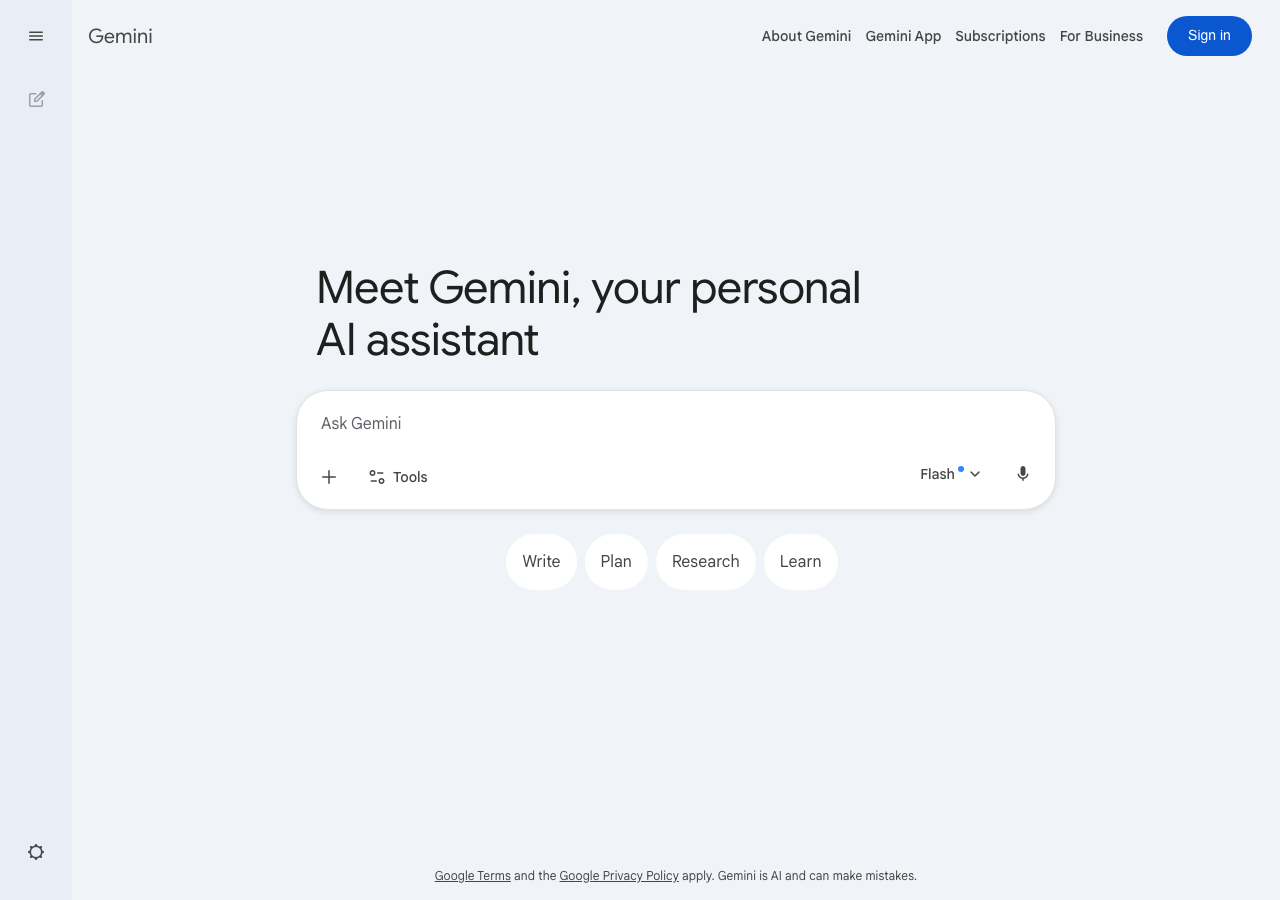
Gemini Free sits at the intersection of Google's strengths and Google's weaknesses for academic users. The strengths are real: Gemini 2.5 Flash is fast, the response latency is among the lowest in the free-tier category, and the model's integration with Google Search means it can cite specific, recent web sources more reliably than non-search-grounded tools. The weaknesses are equally real: the default prose style has a polished, corporate-communication cadence that stands out in academic essays, Google's data practices raise questions for students with privacy concerns, and the tool's placement inside the Google ecosystem — alongside Gmail, Google Docs, YouTube — creates an environment with more distraction potential than a standalone writing assistant.
For students who live inside Google's productivity suite, Gemini Free offers some workflow benefits that genuinely matter: ask Gemini to help revise a document you have open in Google Docs, cross-reference information from a Google Scholar search you are running, or draft an email to a professor about an extension request without switching applications. This integration advantage is real for students whose academic infrastructure is entirely Google-based. For students on Microsoft 365 or mixed ecosystems, the integration argument largely disappears.
The essay fit score of 7.4 reflects this mixed picture honestly. On speed and availability (Gemini Free has more generous daily limits than ChatGPT Free in many users' experience), it scores well. On prose quality and analytical depth for humanities and social science essays, it falls behind Claude Free and competitive-level with ChatGPT Free. On STEM coursework where factual precision and Google's training data breadth matter, it performs better than the overall score suggests.
Gemini 2.5 Flash is the model behind the free tier as of 2026, and it is a substantially faster and somewhat more capable model than Gemini 1.0 versions that older student reviews describe. The 2.5 Flash architecture trades some of the analytical depth of the 2.5 Pro tier for speed — response generation is noticeably faster than most competitors, which matters in high-iteration editing sessions where you are running multiple short prompts. For students who find slow AI responses a workflow friction, Gemini Free's speed is a genuine quality-of-life improvement.
Google's integration of search grounding in some Gemini responses provides source citations more reliably than non-search-grounded models. When this feature is active, Gemini will cite specific web pages alongside its responses, which helps with fact-checking and provides starting points for your own source search. The grounding is not as consistent or as academically rigorous as Perplexity's approach — the citations can include lower-quality web pages alongside reputable ones — but for getting oriented on a topic or finding sources to pursue further, it is useful.
The essay fit score of 7.4 positions Gemini Free below Claude Free (7.7) and ChatGPT Free (7.5) on the overall ranking, but above Copilot Free (7.2) and Grok Free (7.1). The ranking reflects general-purpose essay performance. For specific tasks — quick factual synthesis, Google Docs integration, STEM homework context — Gemini Free performs above this average position.
Daily usage limits on Gemini Free are more generous than official documentation implies, based on community usage reports. The free tier appears to allow sustained sessions of 30 or more exchanges before rate limiting activates, and the limits reset daily. During global peak hours, response quality can degrade slightly as the system optimizes for throughput, but hard message walls are less common on Gemini Free than on ChatGPT Free in users' typical experience.
Prose quality and the corporate-register problem
The most consistent criticism of Gemini-generated academic prose is its register: it sounds like a well-written corporate communication or a polished help article, not like an academic essay or a student's analytical voice. Phrases like 'it is widely recognized that,' 'this analysis seeks to explore,' and 'the implications of this finding are significant' appear in Gemini output at a rate that suggests specific training patterns. For instructors who read many papers, this register is recognizable quickly.
The corporate-smooth problem is not just an aesthetic issue — it indicates a shallow engagement with academic argument conventions. Strong academic prose makes specific, falsifiable claims and defends them with evidence and reasoning. Gemini's default output often makes broad observations and hedges them with universal statements rather than arguing a specific position. Prompting explicitly for a more argumentative structure — 'take and defend a clear position, use evidence to support it, address the strongest counterargument' — produces better results, but requires deliberate override of the default behavior.
For business writing, communication courses, and report formats that are intentionally closer to professional writing, Gemini's default register is actually an advantage. Students in MBA programs, professional development courses, or writing assignments that explicitly ask for a professional tone find Gemini's defaults more appropriate than they are for a literary criticism essay. Know your assignment's register expectations before deciding how much to fight Gemini's defaults versus work with them.
Paragraph-level editing requests produce better Gemini output than full-draft generation requests. When you provide text you have written and ask Gemini to improve clarity, tighten arguments, or smooth sentence flow, the corporate register is less obtrusive because it is operating on your syntax and vocabulary rather than generating from a blank premise. Editing assistance works better than cold generation for students who want to use Gemini while maintaining their own analytical voice.
Google ecosystem integration
The Google Docs integration through Gemini is genuinely useful for students whose entire academic workflow runs inside Google's suite. You can ask Gemini to summarize a document, suggest edits to a selected passage, generate an outline for an essay you are drafting in Docs, or draft specific sections — all without leaving the document window. For students who spend most of their academic writing time in Google Docs, this integration reduces the workflow friction of copying text between tabs.
Google Search integration means Gemini can reference recent information with source citations, which is useful for contemporary current events analysis, policy essays, and assignments requiring engagement with recent scholarship. The citations are not always well-curated — a well-known news site and an obscure blog may both appear alongside each other — but the capability to ground responses in recent web content is more developed here than in tools without search integration.
The distraction risk is worth naming explicitly. Gemini lives inside Google, and Google is one of the most attention-designed platforms on the internet. Students who open gemini.google.com in a browser where Gmail, YouTube, and social bookmarks are accessible may find the focused writing session they intended turns into a fragmented hour of interrupted work. Using Gemini in a dedicated browser window with other tabs closed, or using a browser profile specifically for academic work, manages this risk with minimal friction.
Privacy and data practices
Google's data practices are substantially different from Anthropic's. Google is fundamentally an advertising and data analytics company whose AI products sit within a broader data infrastructure that informs targeted advertising and product training. Conversations with Gemini may be reviewed by human contractors for quality and safety purposes, and data retention policies allow use in model improvement unless you explicitly manage your settings.
Students with Workspace accounts through their university may have different privacy terms than consumer Gmail users. University Google Workspace agreements sometimes include stronger data protection provisions for educational use. Check whether your institution's Google Workspace terms apply to Gemini access and whether your university's acceptable use policy has provisions about AI tools accessed through institutional accounts.
For essays that are entirely generic — a literature review on a non-sensitive topic, a history essay on publicly available events — the privacy question is less pressing. For essays that involve personal experience, sensitive research topics, case studies with named individuals, or proprietary course materials, reviewing Google's data terms before pasting content into Gemini is worthwhile due diligence.
Comparing Gemini Free to its peers
Against ChatGPT Free: Gemini Free often has more generous daily message availability, faster response times, and better search-grounded citations. ChatGPT Free has a more natural academic prose register and stronger instruction-following on complex editing tasks. The choice depends on whether you prioritize availability and speed or prose quality and instruction adherence.
Against Claude Free: Claude Free is substantially stronger for complex analytical essay work and instruction-following precision. Gemini Free wins on speed, Google Docs integration, and contemporary web-grounded information. For serious essay work, Claude Free is the stronger recommendation; for quick factual look-ups and Google ecosystem workflows, Gemini Free is more convenient.
Against Meta AI: Gemini Free has better search grounding and Google integration; Meta AI has a more natural non-corporate prose register and is accessible through mobile apps many students already have. For a student evaluating just these two free options, the deciding factor is usually whether Google ecosystem integration adds value for their specific workflow.
Gemini Free's best use case among the free options is as a search-grounded research assistant for building a bibliography of sources to pursue, checking recent factual context, and integrating into a Google Docs essay drafting workflow. It is not the strongest free choice for complex analytical essays in isolation, but it fills a distinct and useful role in a multi-tool free-tier strategy.
Bottom line
Gemini Free's 7.4 essay fit score reflects a tool that performs reliably on speed, availability, and Google integration while falling behind competitors on the prose quality and analytical depth that humanities and social science essays specifically require. The corporate register is a genuine limitation that requires deliberate editing prompts to mitigate.
For students who live in Google Docs and want a writing assistant that integrates with their existing workflow without adding a new application, Gemini Free is the most natural choice among free tools. For students who need the best analytical writing assistance within free-tier constraints, Claude Free is stronger; for students who need the most available and fastest free option with no prose quality concerns, Gemini Free competes well.
The honest recommendation is to use Gemini Free as part of a multi-tool free strategy rather than as a sole academic writing assistant. Its speed and Google integration make it a strong complement to Claude Free's analytical depth — use Gemini for quick research questions and Google Docs integration, Claude for the analytical editing passes that require instruction-following precision.
Pricing
- Gemini Free has a free tier or free product access — rate limits and model caps apply; paid upgrades may exist on google.com.
- Flagship stack: Gemini 2.5 Flash. Features and model names change; verify before you subscribe.
Models & access
Gemini 2.5 Flash. Availability, rate limits, and regional restrictions change — confirm on google.com before subscribing.
Compare alternatives
Who it's for
- Use Gemini Free for editing assistance on your own drafts rather than cold generation — the corporate prose register is less intrusive when it is polishing your existing text than generating from scratch
- Activate search-grounded mode when researching contemporary topics — the web citations provide starting points for source hunting even if they require curation before academic use
- Add explicit tone instructions upfront: 'write in a direct, argumentative academic style — make specific claims, avoid corporate hedging language' overrides the default smooth register
Student experiences
Ratings from students who used Gemini Free on real assignments — includes critical reviews.
Loading student reviews…
1,754 words · Updated 2026