
Independent review · 2026
Fireworks AI Review
Fireworks AI is an inference platform that happens to expose a chat playground, not a chat platform that happens to have an API — that ordering matters for students deciding whether it belongs in their essay toolkit. The 6.1 essay fit score reflects a product primarily designed for developers who want fast, cheap hosted open-weight model inference rather than a polished student writing interface. For the narrow subset of students who are comfortable with model selection, know what Llama 3.3 70B versus DeepSeek V3 means for their use case, and want to experiment with frontier-class open-weight outputs without self-hosting hardware, Fireworks's playground offers real value at zero subscription cost. For students who want a polished writing co-pilot out of the box, ChatGPT Plus, Claude Pro, or even the free tiers of those products are better starting points.
fireworks.ai · #43 in TOP 50
Open-weight chat
Llama · DeepSeek
Our verdict
Fireworks AI is an inference platform that happens to expose a chat playground, not a chat platform that happens to have an API — that ordering matters for students deciding whether it belongs in their essay toolkit. The 6.1 essay fit score reflects a product primarily designed for developers who want fast, cheap hosted open-weight model inference rather than a polished student writing interface. For the narrow subset of students who are comfortable with model selection, know what Llama 3.3 70B versus DeepSeek V3 means for their use case, and want to experiment with frontier-class open-weight outputs without self-hosting hardware, Fireworks's playground offers real value at zero subscription cost. For students who want a polished writing co-pilot out of the box, ChatGPT Plus, Claude Pro, or even the free tiers of those products are better starting points.
Overview
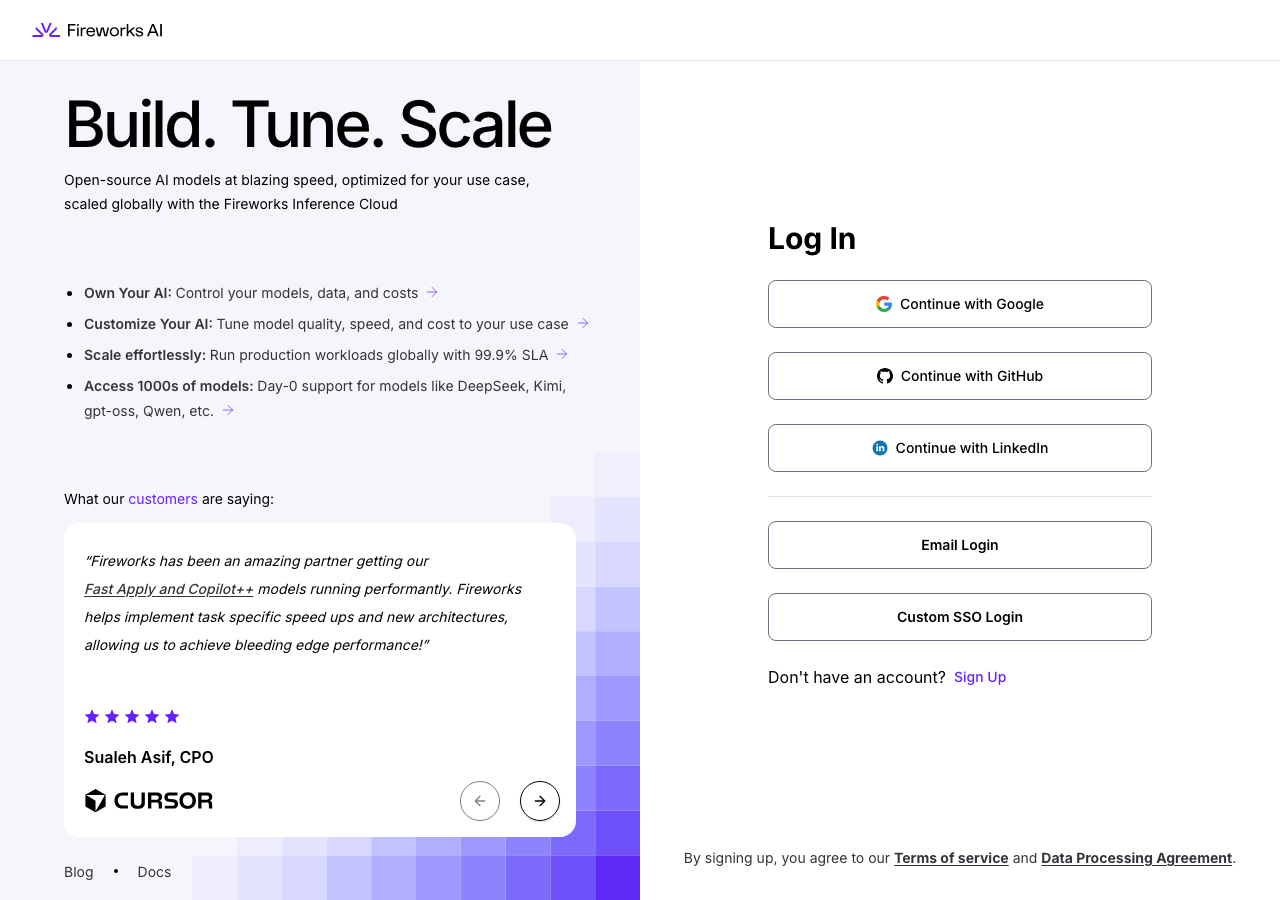
Fireworks AI's primary product is an inference API used by production applications to serve large language model outputs at low latency and competitive token pricing. The company's essay-oriented footprint is small — there is a chat interface accessible via fireworks.ai that allows direct interaction with hosted models including Llama 3.3 70B Instruct, DeepSeek V3, Qwen 2.5 series, and various fine-tuned variants. That interface is the surface students interact with, and it functions adequately as a writing assistant even if it was not designed for academic workflow convenience.
The free tier of the Fireworks playground has usage limits expressed in tokens per minute rather than a message count, which can be disorienting for students used to ChatGPT's 'you have 10 messages left' framing. Practically, casual essay drafting sessions stay well within free tier limits unless you are running very long context chains. API key registration is required to access the playground in some configurations — check current access requirements on the site, as these change periodically as Fireworks updates its onboarding flow.
Fireworks AI exists because serving large language models at scale is an infrastructure problem, and a class of startups including Fireworks, Together AI, Groq, and Replicate built inference platforms to solve it cheaper and faster than running your own GPU cluster. Students benefit from this infrastructure competition not because they need low-latency production API access, but because the competitive pressure makes frontier-adjacent model access free or nearly free in playground interfaces designed to show potential API customers what the platform can do.
The models available on Fireworks's playground as of 2025–2026 include several that match or approach frontier quality for text generation tasks. DeepSeek V3 on Fireworks is essentially the same model weights as on DeepSeek's own chat interface — the difference is inference speed and uptime reliability rather than output quality. When DeepSeek's own servers experience peak-hour slowdowns, Fireworks has historically been a stable alternative source for the same model. That reliability arbitrage is the most practical student use case for Fireworks as a platform.
For essay drafting specifically, the lack of a persistent conversation memory or custom instructions feature is the primary limitation compared to Plus or Claude Pro. Each session on Fireworks's playground starts fresh. There is no mechanism to define your preferred tone, academic discipline conventions, or citation style once and have it persist across sessions. Students who want that kind of personalization need to paste a system prompt at the start of every conversation or accept generic outputs. This is a genuine usability gap relative to ChatGPT's custom instructions or Claude's style memory.
The model selection interface is technically interesting but pedagogically demanding. Choosing between Llama 3.3 70B Instruct, Llama 3.1 405B, DeepSeek V3, and Qwen 2.5 72B requires some understanding of model capability tiers — a student who selects Llama 3.1 8B instead of the 70B variant because the name looks similar will get measurably weaker outputs without understanding why. ChatGPT and Claude abstract this selection entirely; Fireworks exposes it, which is educational if you have time to learn and frustrating if you just need an essay outline.
Which models to use for essay work
DeepSeek V3 is the strongest general-purpose essay model available on Fireworks as of early 2026. Its instruction following on complex rubric requirements, paragraph structuring quality, and prose coherence over multi-thousand word documents is competitive with GPT-4o class outputs. If you are using Fireworks because DeepSeek's own servers are overloaded, selecting DeepSeek V3 on Fireworks is the closest substitute for DeepSeek Chat. Response time can vary — Fireworks's server load at any given moment affects inference speed, and very long prompts on large models may take thirty to sixty seconds.
Llama 3.3 70B Instruct is Meta's strong open-weight performer and the model most commonly recommended as a free alternative to Plus-tier output quality in developer communities. For humanities essays, it produces coherent arguments, handles argumentative structure reasonably well, and avoids the worst citation hallucination patterns of earlier Llama generations. It is not as smooth as GPT-4.1 or Claude Sonnet on tonal nuance, but for factual expository writing on topics within its training data, 70B is a practical working model.
Qwen 2.5 72B, developed by Alibaba, is an underrated option for students in STEM fields and quantitative social sciences. Qwen's training data composition skews toward technical and scientific content, and the 72B parameter count gives it enough capacity for careful step-by-step reasoning on mixed qualitative and quantitative arguments. International students writing about East Asian economics, technology policy, or Chinese literature may find Qwen's training data coverage stronger than comparable Western models for those specific domains.
Avoid smaller model variants for academic writing unless you are experimenting or testing. Models below 13B parameters produce noticeably inconsistent argumentation in longer essays — the opening paragraphs often look fine but later sections drift in argument or introduce factual errors at higher rates. If Fireworks shows a 7B or 8B variant of a model you recognize, select the larger instruct-tuned version instead.
Practical workflow for essay drafting
Because Fireworks lacks persistent custom instructions, open every session with a system prompt block before your actual request. A minimal effective system prompt for essay work: specify your academic level, discipline, preferred citation style, approximate essay length, and any specific rubric requirements. Paste this block first, then your actual prompt. This adds ninety seconds of setup friction but meaningfully improves output consistency compared to prompt-less requests.
Long essays should be drafted in sections rather than requested wholesale. Asking any model for a 3,000-word essay in one prompt often produces structurally weak output that compresses the middle sections. Instead, generate the outline first, verify it against your rubric, then prompt each section individually using the full outline as context. This workflow is more manual than ChatGPT's file-upload-and-draft-everything approach but produces more defensible section-by-section output.
Citation handling on Fireworks's open-weight models is the same problem as on any frontier model — they produce plausible-looking references that may not be real. For factual claims that require sourcing, use Perplexity Pro or Semantic Scholar to identify actual papers, then bring those citations into Fireworks as context for the writing portion. Never trust a bibliographic reference from any LLM interface without opening the source.
Token context windows on the larger models available on Fireworks are generous — DeepSeek V3 and Llama 3.1 405B both accept large context payloads. For courses where you need to synthesize multiple lecture PDFs or reading chapters, you can paste substantial amounts of text into the conversation context before prompting. This is functionally similar to NotebookLM's source-grounded synthesis, though without NotebookLM's citation tracking and source attribution features.
Privacy and data handling
Fireworks AI's privacy position is more nuanced than a simple free-versus-paid story. The platform's primary customers are developers and enterprises, and it has incentives to maintain professional data handling standards because its reputation with those customers depends on it. However, the platform's privacy policy covers API usage and playground usage under the same general framework, and students should read it directly rather than assuming free playground access receives the same data protections as paid API contracts.
Unlike ChatGPT's free tier, which feeds user conversations into training data by default, Fireworks's inference platform is not in the business of using your essay drafts to train future model versions — the models are third-party open-weight releases, not Fireworks's proprietary models. That distinction is meaningful: Fireworks is a hosting layer rather than a model developer, so its incentive structure around training data collection is different from OpenAI's or Anthropic's. Still, playground sessions are logged for monitoring and debugging purposes, which means they are not private in the sense that a locally run LM Studio session would be.
For truly sensitive academic content — dissertation materials under institutional embargo, proprietary research data, personal statements with identifying information — Fireworks's cloud infrastructure is not the appropriate tool. Either use a locally run model via LM Studio or Jan AI, or a paid service with explicit data processing agreements. The free playground is appropriate for course essays, hypothetical analyses, and writing tasks that would not be damaging if observed by a third party.
Bottom line
Fireworks Chat belongs in the toolkit of students who are comfortable with model selection, understand token-based rate limits, and want access to frontier-adjacent open-weight models without paying subscription fees. As a DeepSeek V3 alternative when DeepSeek's own platform is slow, it is practically valuable. As a general-purpose essay co-pilot for students new to AI writing tools, it creates unnecessary friction compared to ChatGPT Free, Claude Free, or Gemini Free.
CS and data science students will find Fireworks's model selection and API orientation educational in itself — understanding that the same DeepSeek weights run on multiple inference providers, and that latency varies by hosting infrastructure, is genuinely useful AI literacy. Humanities students writing their first AI-assisted essay should not start here.
For privacy-concerned students, note that Fireworks is still cloud inference — your prompts pass through Fireworks's servers. If air-gapped local privacy is the requirement, see LM Studio or Jan AI instead.
Pros
- Access to strong open-weight models including DeepSeek V3 and Llama 3.3 70B at no cost — competitive with subscription tiers for pure text generation quality.
- Useful as a fallback when DeepSeek's own servers are overloaded — same model weights, different infrastructure.
- No subscription required — useful for students who need occasional AI writing assistance without a monthly commitment.
- Technical exposure to model selection builds meaningful AI literacy for CS and data science students.
Cons
- No persistent custom instructions or conversation memory — setup friction every session.
- No native file upload or PDF analysis interface — requires manual text pasting.
- Model selection interface is confusing for users unfamiliar with model naming conventions.
- Essay fit score of 6.1 reflects the platform's developer-first design priority — polished student writing UX is not the product.
Pricing
- Fireworks AI has a free tier or free product access — rate limits and model caps apply; paid upgrades may exist on fireworks.ai.
- Flagship stack: Llama · DeepSeek. Features and model names change; verify before you subscribe.
Models & access
Llama · DeepSeek. Availability, rate limits, and regional restrictions change — confirm on fireworks.ai before subscribing.
Compare alternatives
Who it's for
- Access to strong open-weight models including DeepSeek V3 and Llama 3.3 70B at no cost — competitive with subscription tiers for pure text generation quality.
- Useful as a fallback when DeepSeek's own servers are overloaded — same model weights, different infrastructure.
- No subscription required — useful for students who need occasional AI writing assistance without a monthly commitment.
- Technical exposure to model selection builds meaningful AI literacy for CS and data science students.
Who should compare alternatives
- No persistent custom instructions or conversation memory — setup friction every session.
- No native file upload or PDF analysis interface — requires manual text pasting.
- Model selection interface is confusing for users unfamiliar with model naming conventions.
- Essay fit score of 6.1 reflects the platform's developer-first design priority — polished student writing UX is not the product.
Student experiences
Ratings from students who used Fireworks AI on real assignments — includes critical reviews.
Loading student reviews…
1,760 words · Updated 2026