
Independent review · 2026
DuckDuckGo AI Chat Review
DuckDuckGo AI Chat is the most privacy-credible free AI assistant available to students in 2025–2026. You do not need an account. Your conversations are not stored beyond the session. DuckDuckGo contractually prevents its model providers — OpenAI, Anthropic, Meta, and Mistral — from using your chats to train future models. Essay fit 6.7 reflects the accessible mid-tier models that run behind the interface: capable enough for paragraph-level drafting, grammar review, and outline generation, but not the frontier analytical depth of ChatGPT Plus or Claude Pro. The reason to choose DuckDuckGo AI Chat is the privacy story, and that story is real, carefully documented, and genuinely unusual among free AI products.
duckduckgo.com · #26 in TOP 50
Multi-model hub
GPT-4o mini · Claude · Llama
Our verdict
DuckDuckGo AI Chat is the most privacy-credible free AI assistant available to students in 2025–2026. You do not need an account. Your conversations are not stored beyond the session. DuckDuckGo contractually prevents its model providers — OpenAI, Anthropic, Meta, and Mistral — from using your chats to train future models. Essay fit 6.7 reflects the accessible mid-tier models that run behind the interface: capable enough for paragraph-level drafting, grammar review, and outline generation, but not the frontier analytical depth of ChatGPT Plus or Claude Pro. The reason to choose DuckDuckGo AI Chat is the privacy story, and that story is real, carefully documented, and genuinely unusual among free AI products.
Overview
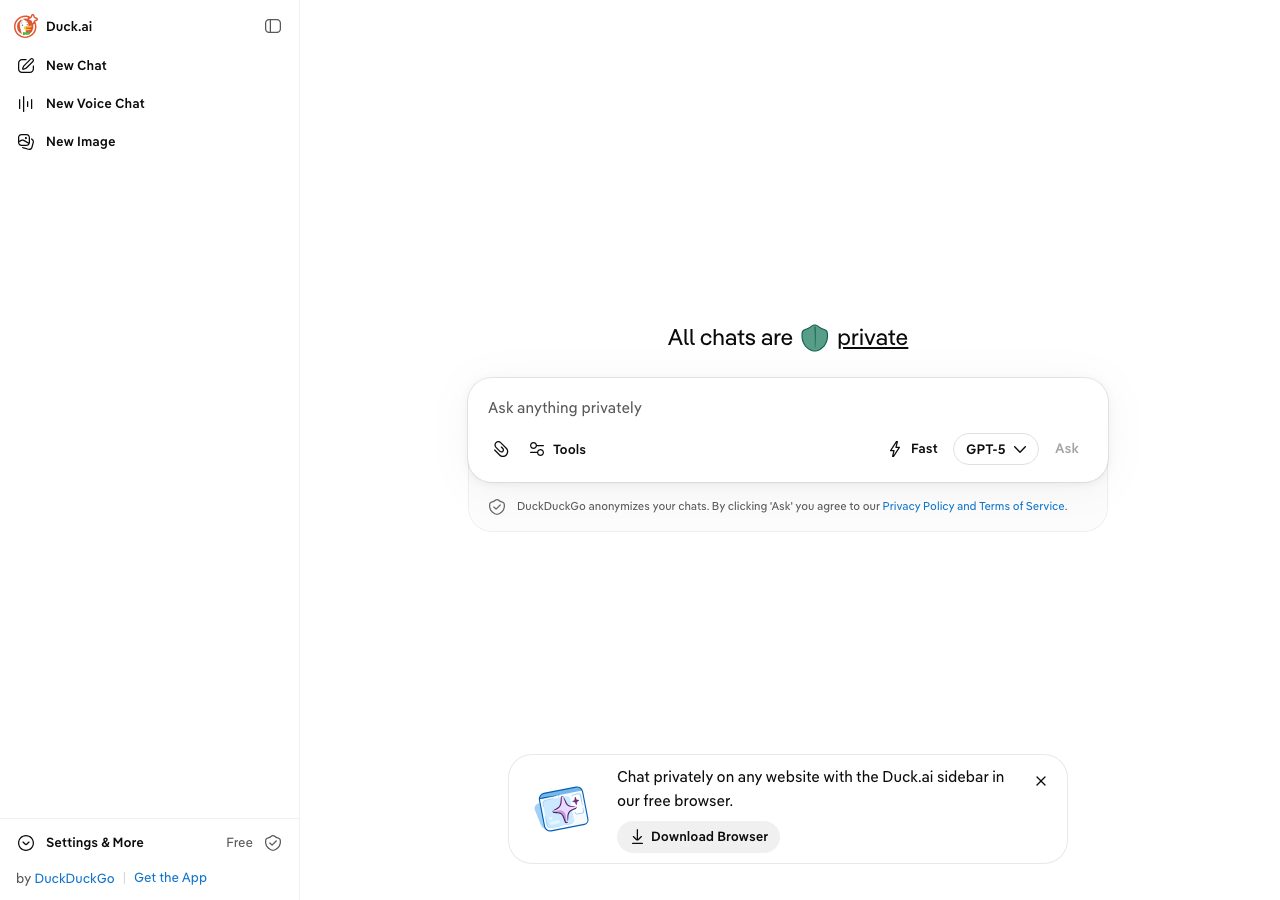
DuckDuckGo built its reputation on a simple, verifiable privacy promise for search: we do not store your search history or build advertising profiles. In 2024, the company extended that posture to AI with DuckDuckGo AI Chat — accessible at duckduckgo.com/aichat with no account required, no login prompt, no email collection. The available models cycle through GPT-4o mini, Claude Haiku, Meta Llama, and Mistral Small, with the specific lineup shifting as DuckDuckGo adds and rotates providers. Free usage is available with a daily limit; Fire TV and heavy users can access a paid expansion.
The student use case is specific but genuine. If you are writing about surveillance capitalism and you draft your essay in ChatGPT, there is a non-trivial irony in your methodology. If you are writing about data privacy and you want your drafting process to be consistent with your argument, DuckDuckGo AI Chat is one of the few tools where you can draft an essay critiquing corporate data practices without your drafting session itself becoming a data point in a corporate training pipeline. For students in privacy law, tech ethics, digital rights, and public policy programs, that coherence matters.
Privacy architecture: what DuckDuckGo actually does
DuckDuckGo AI Chat's privacy claims are specific and contract-backed, which distinguishes them from the vague 'we take your privacy seriously' language that most tech companies deploy. According to DuckDuckGo's published documentation, the service strips all metadata from your API calls to model providers before forwarding them, meaning OpenAI, Anthropic, Meta, and Mistral receive your prompt text but not your IP address, location, or any identifier that would link the query to you personally. DuckDuckGo holds the API agreements with providers and has contractual terms that prohibit those providers from using AI Chat conversations for model training.
This is meaningfully different from using OpenAI's ChatGPT directly. ChatGPT's training data opt-out requires navigating settings, applies per-account, and requires trusting that OpenAI's implementation of the opt-out works as described. DuckDuckGo's approach is architectural: there is no account to link your conversation to, so the opt-out problem is upstream of the usual failure mode.
DuckDuckGo itself stores conversation data temporarily for debugging and safety purposes — the session exists in memory while you are chatting, and the company may retain anonymized logs for short periods. The key distinction is that conversations are not stored with any identifier that connects them to you, and they are not used for advertising or profile building. The privacy policy is short, plainly written, and updated when the lineup changes — a welcome contrast with the dense legalese of frontier provider terms.
The practical privacy protection matters most in specific situations: students in countries with surveillance concerns, students drafting sensitive content (whistleblowing research, political analysis in authoritarian contexts, mental health-adjacent topics for social work coursework), and students at institutions where AI policy requires that academic work not be used for commercial training. In the latter case, DuckDuckGo AI Chat is one of the few free tools that satisfies that requirement without a paid privacy-enhanced tier.
Model quality and essay capability
The models available through DuckDuckGo AI Chat are mid-tier by design. GPT-4o mini, Claude Haiku, Meta Llama (typically the 70B instruct variant), and Mistral Small are all capable models for everyday writing tasks — grammar revision, paragraph-level drafting, argument-gap identification, and thesis statement refinement — but they are not the frontier analytical engines that their larger siblings represent. Essay fit 6.7 reflects this accurately: you can produce clean, structurally sound academic prose with DuckDuckGo AI Chat, but you will notice the ceiling on complex analytical synthesis that Claude Sonnet or GPT-4.1 handle with more specificity.
The model selector in DuckDuckGo AI Chat is simple: a small dropdown showing the available options, usually three or four at any time. Unlike OpenRouter's hundred-model overwhelm, this is actually a usability strength — pick GPT-4o mini for familiar behavior, Claude Haiku for careful prose, or Llama 70B for open-source alignment. The choice takes ten seconds and reflects a real difference in output style rather than an arbitrary feature parade.
For short and medium-length essay tasks — single paragraphs, thesis statement generation, outline creation, argument stress-testing — DuckDuckGo AI Chat performs at a level that makes it a legitimate primary tool for students who prioritize privacy over capability ceiling. A three-to-five page essay can be drafted, revised, and polished entirely within the platform if you are methodical about your prompting and attentive to its output. Longer, more analytically demanding papers will show the capability gap more clearly.
The absence of web search is a firm limitation. Unlike You.com or Perplexity, DuckDuckGo AI Chat does not retrieve live web content. Every factual claim, every apparent citation, and every reference to a recent event comes from the model's training data, which may be months or years stale. For time-sensitive topics, this is a serious constraint. For topics where training data is sufficient — classical literature, established historical events, foundational theory in philosophy or economics — the staleness matters less, and the privacy advantage becomes more dominant in the cost-benefit calculation.
No-account workflow and what it means practically
The absence of an account requirement is both DuckDuckGo AI Chat's most distinctive privacy feature and its most significant functional limitation. Sessions are ephemeral: when you close the browser tab, your conversation is gone. There is no conversation history, no cross-session memory, no project management, no persistent custom instructions. Each session starts fresh, with no knowledge of the essay you drafted yesterday or the writing style you specified last week.
For students working on a multi-session long paper, this is a genuine workflow challenge. Every new drafting session requires re-seeding the model with context: your thesis, your argument structure, your current draft section, and any stylistic preferences you want the model to respect. This re-seeding takes three to five minutes at the start of each session and produces a cognitive tax that makes sustained long-form projects harder than they would be in Claude, ChatGPT, or any account-linked tool.
The practical workaround is to maintain your own context file — a brief document summarizing your thesis, current argument structure, and any specific instructions for the AI — that you paste at the start of each DuckDuckGo AI Chat session. This is good practice regardless of which tool you use, since it forces you to articulate your argument concisely, but it is enforced necessity rather than optional discipline when using an account-free interface.
The no-account requirement also means no cross-device continuity. If you start drafting on your laptop and want to continue on your phone, there is no session to pick up. This makes DuckDuckGo AI Chat a single-device, single-session tool, which fits some student workflows (a focused two-hour writing block at a desktop) and does not fit others (scattered mobile drafting across a day).
Use cases where privacy-first wins
Several academic contexts make DuckDuckGo AI Chat the genuinely correct tool choice rather than just a privacy-principled alternative. The most compelling is research on sensitive topics: qualitative social research into extremist rhetoric, social work coursework involving case studies of vulnerable populations, journalism programs covering political corruption or organized crime, and public health research touching clinical scenarios. In all of these, the potential exposure of your drafting content to commercial training pipelines raises real ethical questions — not hypothetical ones. DuckDuckGo AI Chat's architecture reduces that exposure more credibly than any other free tool.
Students who are studying surveillance capitalism, data broker industries, or platform privacy as their academic subject are in a methodologically awkward position when using commercial AI assistants that represent the industry they critique. Using DuckDuckGo AI Chat does not fully resolve that tension — the underlying models are still commercial products from OpenAI, Meta, and Anthropic — but it reduces the direct irony from glaring to manageable.
For students in countries where AI use may be subject to government data requests, DuckDuckGo's US-based privacy architecture — with contractual protections against training data use and no account-linked identity — provides a thinner but real layer of protection compared with platforms that store full conversation histories linked to email accounts. This is not a security solution; it is a privacy improvement at the margins. Students operating in high-risk environments should consult with legal or security experts before relying on any commercial AI product for sensitive content.
For students at institutions with strict AI acceptable-use policies that require training data opt-out or that prohibit account creation for AI services, DuckDuckGo AI Chat's no-account, no-training structure may actually be one of the more policy-compliant free options. Check your specific institution's policy language — some AI policies are written around 'school data' rather than general essay drafting, which may or may not cover this use case.
Honest capability limitations
Essay fit 6.7 is an honest score that should not be glossed over by the privacy story. DuckDuckGo AI Chat's model roster was selected for cost efficiency and broad availability, not for maximum analytical capability. A philosophy student writing about Kantian deontology and trying to navigate the nuances of the categorical imperative will get a competent but slightly surface-level response from Claude Haiku that Claude Sonnet would handle with more precision. A political science student analyzing Machiavelli's use of historical examples will get a structurally sound paragraph that misses some of the scholarly debate about Machiavelli's irony that a better-prompted frontier model would include.
These limitations are real but not disqualifying for most undergraduate essay tasks. The majority of undergraduate writing assignments require correct structure, appropriate evidence use, clear argumentation, and correct grammar — all of which DuckDuckGo AI Chat handles adequately. The capability gap shows up most clearly at the A-grade margin, where specific analytical insight and original synthesis distinguish exceptional essays from competent ones.
The daily free usage limit is another real constraint. DuckDuckGo does not publish exact token counts, but heavy drafting sessions can exhaust the free allocation before a long essay is complete. The limit resets daily, so students who spread their AI use across sessions rather than doing marathon single-session drafts are less likely to hit it. If you need to draft and revise a long paper in a single sitting, DuckDuckGo AI Chat may run out before you do.
Finally, the lack of file upload means you cannot provide your assignment rubric, your reading materials, or a prior draft for the model to reference directly. Every piece of context must be typed or pasted into the chat window, which creates a practical ceiling on how much nuance you can convey to the model about your assignment requirements. For rubric-heavy assignments where point criteria map directly to specific paragraph requirements, this is a meaningful limitation.
Bottom line
DuckDuckGo AI Chat earns essay fit 6.7 on raw capability and a privacy-story score that no other free product in this review matches. The two numbers serve different students: the 6.7 is for students evaluating drafting capability, and the privacy distinction is for students for whom the data practices of their tools are ethically or academically significant.
Use it as your primary drafting tool if your topic involves sensitive content, if your institution's AI policy requires training data opt-out, or if the irony of using surveillance-capitalist infrastructure to critique surveillance capitalism bothers you enough to trade some capability for coherence. Use it as a secondary tool for quick paragraph-level tasks when you want a clean, private environment for exploratory thinking that you would rather not have attached to your OpenAI or Google account history.
Compare Claude Haiku directly if privacy is secondary and you want better analytical depth at a similar capability tier; compare Brave Leo if you want browser-integrated private AI; compare Le Chat Free if EU data residency matters more than training data opt-out.
Pros
- No account required — genuinely the lowest identity-exposure AI chat available for free.
- Contract-backed no-training-use terms with all model providers — the privacy promise is documented.
- Model switcher gives access to GPT-4o mini, Claude Haiku, Llama, and Mistral in one interface.
- Clean, fast interface with no marketing friction, upsell prompts, or feature lock-behind-paywall pressure.
- Principled tool choice for students studying surveillance, privacy, or digital rights.
Cons
- Ephemeral sessions — no conversation history, no cross-session memory, no project continuity.
- Mid-tier model roster — analytically weaker than frontier subscriptions for complex essays.
- No web search — citation generation is offline, stale, and requires full manual verification.
- Daily free limit can be exhausted during marathon drafting sessions.
- No file uploads — rubric and source material must be manually pasted.
- Single-device, single-session workflow — no mobile continuity.
Pricing
- DuckDuckGo AI Chat has a free tier or free product access — rate limits and model caps apply; paid upgrades may exist on duckduckgo.com.
- Flagship stack: GPT-4o mini · Claude · Llama. Features and model names change; verify before you subscribe.
Models & access
GPT-4o mini · Claude · Llama. Availability, rate limits, and regional restrictions change — confirm on duckduckgo.com before subscribing.
Compare alternatives
Who it's for
- No account required — genuinely the lowest identity-exposure AI chat available for free.
- Contract-backed no-training-use terms with all model providers — the privacy promise is documented.
- Model switcher gives access to GPT-4o mini, Claude Haiku, Llama, and Mistral in one interface.
- Clean, fast interface with no marketing friction, upsell prompts, or feature lock-behind-paywall pressure.
Who should compare alternatives
- Ephemeral sessions — no conversation history, no cross-session memory, no project continuity.
- Mid-tier model roster — analytically weaker than frontier subscriptions for complex essays.
- No web search — citation generation is offline, stale, and requires full manual verification.
- Daily free limit can be exhausted during marathon drafting sessions.
Student experiences
Ratings from students who used DuckDuckGo AI Chat on real assignments — includes critical reviews.
Loading student reviews…
2,176 words · Updated 2026