
Independent review · 2026
Character.AI Review
Character.AI scores 4.5/10 for essay use — the lowest among the platforms in our main catalog — and that score is generous if you narrow the use case to graded academic submission. The platform was built from the ground up as a roleplay and persona simulation tool: its characters break into historical figures mid-argument, refuse to sustain dry analytical prose, and are filtered in ways that make rigorous academic dissent difficult to express cleanly. It is enormously popular — tens of millions of monthly active users, a dominant position with Gen Z — but popularity in one context does not transfer to fitness in another. Students who use Character.AI for academic essays risk character voice contamination, missing citations, tonally inconsistent paragraphs, and outputs that detectors flag heavily. The honest recommendation: enjoy Character.AI for what it is designed for, and open a different tab when the assignment is due.
character.ai · #33 in TOP 50
Multi-model hub
Character models
Our verdict
Character.AI scores 4.5/10 for essay use — the lowest among the platforms in our main catalog — and that score is generous if you narrow the use case to graded academic submission. The platform was built from the ground up as a roleplay and persona simulation tool: its characters break into historical figures mid-argument, refuse to sustain dry analytical prose, and are filtered in ways that make rigorous academic dissent difficult to express cleanly. It is enormously popular — tens of millions of monthly active users, a dominant position with Gen Z — but popularity in one context does not transfer to fitness in another. Students who use Character.AI for academic essays risk character voice contamination, missing citations, tonally inconsistent paragraphs, and outputs that detectors flag heavily. The honest recommendation: enjoy Character.AI for what it is designed for, and open a different tab when the assignment is due.
Overview
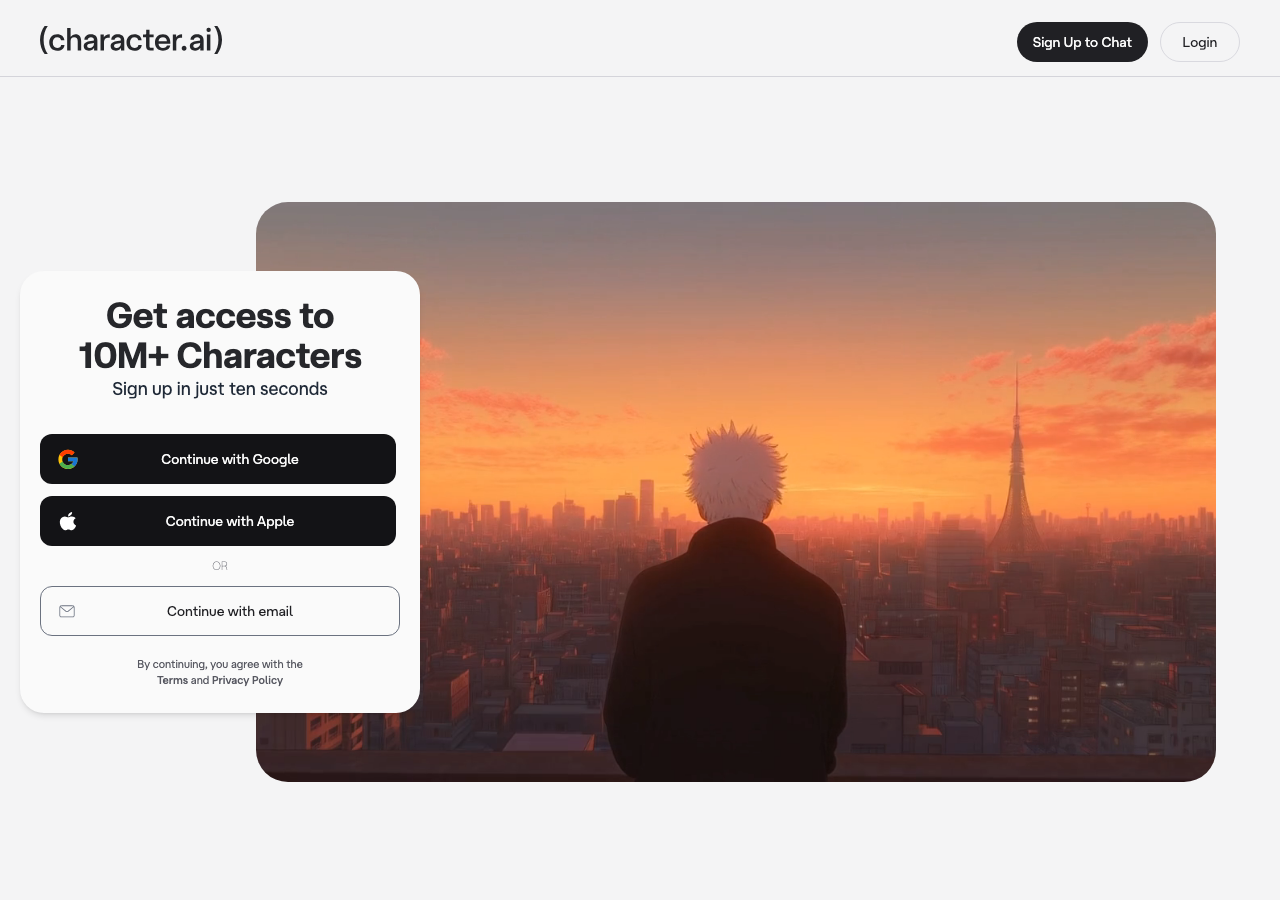
Character.AI occupies a genuinely unusual position in the AI landscape. Founded by former Google Brain researchers Noam Shazeer and Daniel De Freitas, it launched with a thesis that conversational AI was most compelling when embodied in characters — historical figures, fictional personas, original creations. That thesis proved commercially powerful: the platform attracted hundreds of millions of interactions per day, dominated teen demographics, and built a loyalty that frontier chatbots with better benchmarks struggle to match. The essay use case was never the design brief.
Understanding that design context is important before criticizing Character.AI for failing at academic writing, because the failure is categorical rather than marginal. This is not a case where the model occasionally misses a citation or produces a slightly informal paragraph. The architecture of the product — the character framing, the persona adherence, the entertainment optimization — is actively at odds with what academic writing requires. Sober, impersonal, source-grounded analytical prose is almost the opposite of what Character.AI is trained to reward.
Character.AI is not suitable for academic submission, and we are not aware of credible writing workflows that require it. We include it because students encounter it, and an honest negative review is more useful than silence.
Character.AI's product model is fundamentally different from every other platform in this catalog. When you open ChatGPT Plus, Claude Pro, or Gemini Advanced, you interact with a general-purpose assistant that you can prompt toward essay-writing tasks. When you open Character.AI, you enter a persona — either one you create, one a community member built, or one the platform offers. The AI plays that character throughout the conversation. Switching from 'Socrates teaches you philosophy' to 'write me a coherent academic argument about Plato's forms in my own voice' is not a natural product flow.
The popularity of the platform with student-aged users creates a use-path problem: students familiar with Character.AI from entertainment naturally reach for it when they need academic help, because it is already open. The transition from roleplay to academic assistance is smoother than it should be — Character.AI will generate text that looks like an essay response — but the quality, consistency, and citation integrity of that text are significantly below what even free alternatives like Claude Free or Gemini Free produce.
Content filtering adds a second layer of academic friction. Character.AI's moderation is tuned for a mixed-age general audience and adjusts outputs toward safer, simpler expression. Academic writing sometimes requires engagement with disturbing historical events, morally complex arguments, contested political science claims, or explicit critical theory. Character.AI's filters compress exactly those edges — the places where nuanced academic engagement lives — into blander, safer formulations that would lose marks in most humanities courses.
The platform has expanded aggressively, adding voice modes, character creator tools, and group chat features. None of these expansions have oriented the product toward academic writing capability. The development roadmap prioritizes engagement metrics that correlate with entertainment use, not essay quality metrics that would require very different model training and evaluation pipelines.
The roleplay contamination problem
When you ask a Character.AI persona to write an academic essay, the character framing contaminates the output in subtle and obvious ways. Obvious contamination: the response is written in first person from the character's perspective, uses the character's speech patterns, and includes character-specific vocabulary or anachronism. If you asked 'Albert Einstein' to explain quantum mechanics for your physics essay, you might get theatrical nineteenth-century German academic prose that reads like a historical novel rather than a contemporary analytical paper.
Subtle contamination is harder to catch and more academically dangerous. When Character.AI generates essay-shaped text — paragraphs, thesis-like sentences, structured arguments — the character's personality still inflects the word choice, the emotional register, and the argumentative stance. A character designed to be encouraging will soften your argument's critical edge. A character designed to be provocative will overstate claims. A character designed to be Shakespearean will produce prose that reads like a creative writing exercise regardless of the prompt.
The contamination problem extends to tonal inconsistency within a single essay. If you generate section one through one character and section two through a different prompt or character, the prose register shifts visibly. Instructors who read fifty papers recognize tonal discontinuities as integrity signals. An essay where the introduction sounds like a Romantic-era intellectual and the methodology section sounds like a corporate explainer is easier to flag than a uniform weak paper.
This is not a problem that careful prompting fully solves. You can tell a Character.AI persona to adopt an 'academic neutral voice' and it will try — but the underlying character training pulls against that instruction in ways that frontier models without character preconditioning do not exhibit. The effort required to force Character.AI into a stable academic register is greater than the effort of using a better-suited tool from the start.
Citation and factual integrity
Academic essay writing at most post-secondary institutions requires documented sources. Character.AI cannot retrieve, verify, or consistently format citations. When characters generate references, those references are frequently fabricated — plausible-sounding author names, journal titles that do not exist, page numbers from books the model has not accessed. The fabrication problem is not unique to Character.AI; ChatGPT Plus and other frontier models also hallucinate citations. But frontier models have browsing capabilities, library integrations, and explicit citation-check modes that reduce the problem. Character.AI has none of those tools.
Fact integrity within the body of an essay is also lower than on platforms optimized for accuracy. Characters are tuned to maintain persona consistency and entertainment engagement — both optimization targets that are orthogonal to factual precision. A character modeled on a scientist may confidently state outdated findings because the character persona was trained on older data that made the character feel authentic. An academic essay reproducing those findings without independent verification will contain claims that a grading instructor can disprove in a thirty-second search.
For history papers, the risk is especially acute. Historical character personas often blend documented speech patterns with model-invented details that fill gaps in the training data. Students who extract factual claims from those personas without primary-source verification will find anachronisms, conflated events, and invented quotations that are plausible enough to submit and wrong enough to cost marks — or worse, to trigger academic misconduct review if the fabrication is systematic.
AI detection risk
Character.AI outputs score poorly on academic AI detection tools, and the pattern of failure is different from what frontier models produce. Frontier model outputs can at least be strategically revised to reduce detection signatures. Character.AI outputs carry character-specific stylistic signatures — unusual for the student who presumably submitted them — that create additional flags beyond the standard AI-detection probability score.
Detection tools like Turnitin's AI indicator, GPTZero, and Originality.ai have been trained on diverse AI output corpora. Character.AI's distinctive sentence structures, emotional phrasing, and roleplay-adjacent prose patterns are likely represented in those training datasets given the platform's scale. An essay generated through Character.AI faces both the general AI-detection risk that all AI-generated essays carry and the specific stylistic signature risk that platform-specific training creates.
The revision path to reduce detection exposure is also longer with Character.AI than with frontier models. Because the baseline prose is already contaminated by character voice and tonally inconsistent, heavy rewriting is required to produce something that reads like the student's own voice at an academic register. At that point, the student has done most of the actual writing work anyway — which raises the question of why Character.AI was the starting tool.
Where Character.AI does have genuine value
The honest account requires acknowledging where Character.AI genuinely works. For creative writing students exploring dialogue, character development, and narrative voice, the platform offers a uniquely interactive workshop partner — you can conversation-test how a historical figure might argue a position, or develop the voice of a fictional character through extended roleplay. These are legitimate creative exercises, and Character.AI's depth in persona simulation is unmatched.
For students studying communication, media, or psychology, the platform itself is a legitimate object of academic analysis. Understanding how conversational AI builds parasocial relationships, how millions of users interact with non-human entities they anthropomorphize, and how product design creates emotional dependency — these are real research topics, and Character.AI is the primary case study.
Language learning is another valid use for non-academic purposes. Practicing conversational exchanges with character personas in a target language can build fluency in a lower-stakes, more engaging environment than grammar drill software. This does not produce academic essays; it produces vocabulary and conversational confidence that might later help a student write better.
Mental health and peer support communities around Character.AI are also genuinely active, and the platform's effect on adolescent loneliness is a live research question. We note this not as an endorsement of the therapeutic claims but as context for why the platform attracts the users it does: it meets a real emotional need that the essay-writing framing completely obscures.
Bottom line
Character.AI is a remarkable platform for what it was designed to do, and a genuinely poor choice for academic essay writing. The 4.5/10 essay fit score reflects a product that is not trying to compete on academic output quality and is not architected to do so. Comparing it to ChatGPT Plus for essays is like comparing a theater rehearsal app to a library database: both involve language, but the fitness for academic work is categorically different.
If you use Character.AI and enjoy it — millions of students do — keep it for the creative and social experiences where it excels. When an assignment is due, close Character.AI and open a purpose-built tool: Claude Free and Gemini Free both offer better academic output than Character.AI's best effort at no cost, with citation awareness and consistent analytical prose that Character.AI's character architecture cannot replicate.
Our recommendation for students is simple: Character.AI is not in your academic writing toolkit. It is in your entertainment toolkit, your creative writing toolkit, and possibly your emotional support toolkit. Those are legitimate categories. They are not the essay category.
Pros
- deeply engaging persona simulation with enormous character variety — unrivaled for creative writing dialogue practice.
- free access with broad mobile reach — extremely low barrier for casual use.
- uniquely suited as an object of academic study for communication, media, and psychology papers.
Cons
- essay fit 4.5/10 — lowest in our main catalog and the score is accurate.
- character voice contamination consistently undermines academic register regardless of prompt specificity.
- no citation tools, no source verification, high hallucination rate on factual claims.
- content filtering compresses academic nuance into safer formulations that lose marks in rigorous courses.
- AI detection risk is elevated and difficult to mitigate through revision alone.
- not suitable for any graded academic work — the gap between this platform's design intent and academic essay requirements is categorical, not marginal.
Pricing
- Character.AI has a free tier or free product access — rate limits and model caps apply; paid upgrades may exist on character.ai.
- Flagship stack: Character models. Features and model names change; verify before you subscribe.
Models & access
Character models. Availability, rate limits, and regional restrictions change — confirm on character.ai before subscribing.
Compare alternatives
Who it's for
- deeply engaging persona simulation with enormous character variety — unrivaled for creative writing dialogue practice.
- free access with broad mobile reach — extremely low barrier for casual use.
- uniquely suited as an object of academic study for communication, media, and psychology papers.
Who should compare alternatives
- essay fit 4.5/10 — lowest in our main catalog and the score is accurate.
- character voice contamination consistently undermines academic register regardless of prompt specificity.
- no citation tools, no source verification, high hallucination rate on factual claims.
- content filtering compresses academic nuance into safer formulations that lose marks in rigorous courses.
Student experiences
Ratings from students who used Character.AI on real assignments — includes critical reviews.
Loading student reviews…
1,932 words · Updated 2026