
Independent review · 2026
Apple Intelligence Review
Apple Intelligence scores 6.0/10 for essay use — a score shaped almost entirely by device and operating system requirements that determine whether you can access it at all. The writing tools within Apple Intelligence are genuinely capable for their scope: sentence rewrites, tone adjustments, proofreading, concision passes, and summary generation are all functional and well-integrated into Notes, Pages, and Mail. The platform ceiling, however, is hard and architectural: Apple Intelligence does not draft long-form academic essays from scratch, cannot ingest rubrics from document uploads in the same workflow as ChatGPT Plus, does not retrieve or verify academic citations, and runs at limited capability on older devices that do not meet the hardware requirements. For students on compatible iPhones, iPads, or Macs, Apple Intelligence is a genuinely useful prose-polishing layer that sits adjacent to the actual essay-writing work. For students on Android, Windows, or older Apple hardware, it does not exist. That access inequality is the defining fact of this product from a student perspective.
apple.com · #39 in TOP 50
Device / built-in AI
Apple on-device + cloud
Our verdict
Apple Intelligence scores 6.0/10 for essay use — a score shaped almost entirely by device and operating system requirements that determine whether you can access it at all. The writing tools within Apple Intelligence are genuinely capable for their scope: sentence rewrites, tone adjustments, proofreading, concision passes, and summary generation are all functional and well-integrated into Notes, Pages, and Mail. The platform ceiling, however, is hard and architectural: Apple Intelligence does not draft long-form academic essays from scratch, cannot ingest rubrics from document uploads in the same workflow as ChatGPT Plus, does not retrieve or verify academic citations, and runs at limited capability on older devices that do not meet the hardware requirements. For students on compatible iPhones, iPads, or Macs, Apple Intelligence is a genuinely useful prose-polishing layer that sits adjacent to the actual essay-writing work. For students on Android, Windows, or older Apple hardware, it does not exist. That access inequality is the defining fact of this product from a student perspective.
Overview
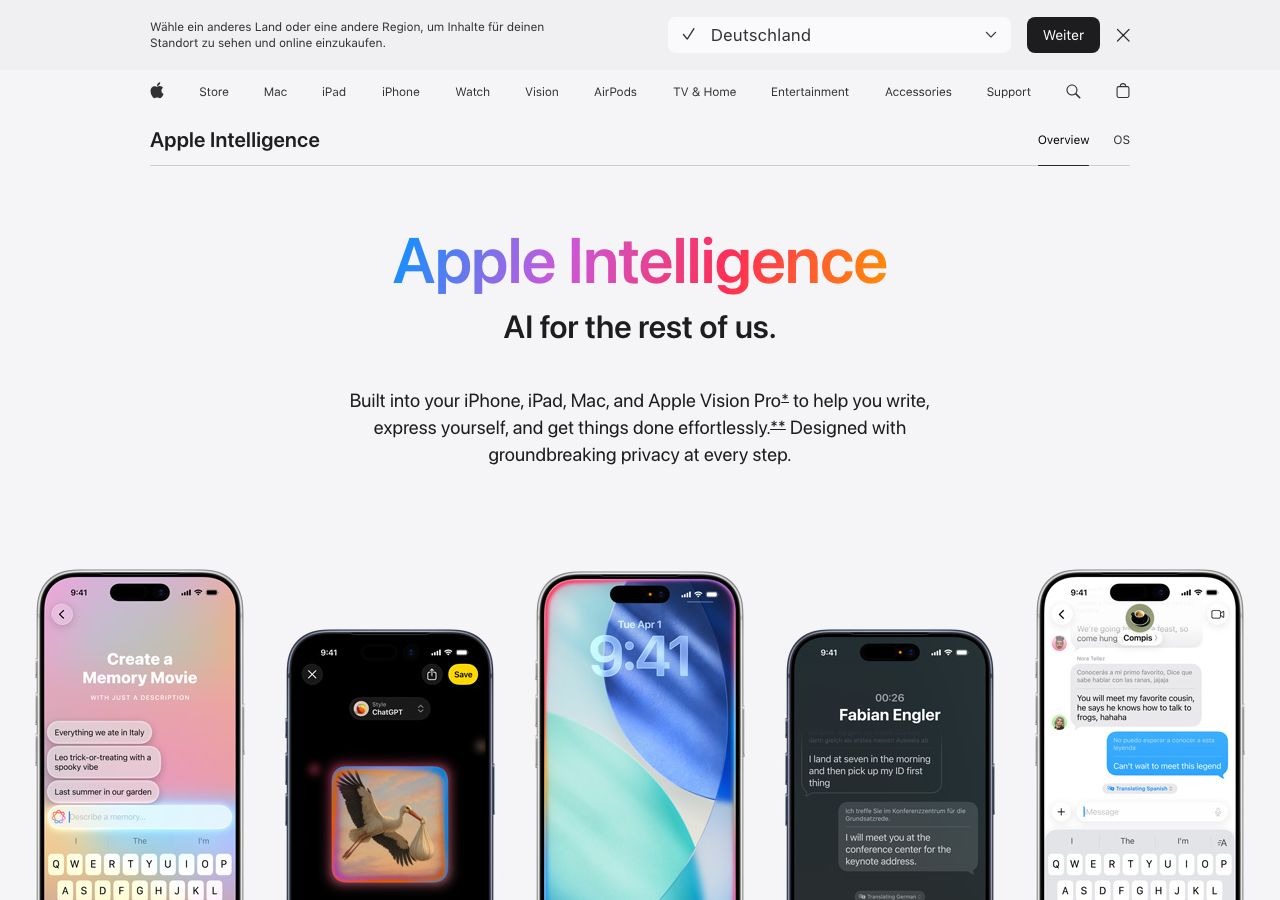
Apple Intelligence launched with iOS 18, iPadOS 18, and macOS Sequoia in 2024, with a phased feature rollout that continued into 2025. The product represents Apple's strategic answer to the ChatGPT-driven AI assistant race — an on-device-first, privacy-oriented set of writing and personal intelligence features integrated into Apple's operating system rather than delivered as a standalone application. The philosophy is meaningfully different from ChatGPT Plus or Claude Pro: Apple Intelligence is not trying to be a general-purpose chatbot that students open to generate essays. It is trying to be a writing layer within the apps students already use.
That philosophy is worth understanding before evaluating the tool. Apple Intelligence's essay-adjacent features — the Writing Tools accessible through the text selection menu in Notes, Pages, Mail, and Safari — operate on selected text. You write a paragraph, select it, choose Writing Tools, and access options: Proofread, Rewrite, Make Longer, Make Shorter, Change Tone (Friendly, Professional, Concise). These are editing operations applied to existing text, not generation operations that create text from a prompt. The underlying model quality for these operations is good. But the operational mode means Apple Intelligence is a revision tool, not a drafting tool.
Privacy architecture is Apple Intelligence's most distinctive feature relative to competitors. The on-device processing model means that text you feed to Writing Tools in Notes does not routinely leave your device. For requests that exceed on-device model capability, Apple's Private Cloud Compute routes processing to Apple's servers with technical commitments about data isolation and non-logging that Apple has described in its published framework. For students at institutions with strict data governance policies — medical schools, law schools, intelligence studies programs — the privacy architecture may make Apple Intelligence more institutionally acceptable than cloud-first alternatives.
Apple Intelligence at rank forty-two in our catalog occupies the device category alongside Samsung Galaxy AI. The essay fit score of 6.0 reflects the tool's genuine capability within a narrow scope combined with the access inequality that device requirements create. A student with an iPhone 16 Pro running iOS 18.4 has access to a meaningfully capable text editing and polishing tool built into every app they use. A student with an iPhone 12 — a three-year-old device at Apple Intelligence's launch — has access to nothing, because the on-device neural engine requirements exclude older hardware.
The hardware floor for Apple Intelligence is not an arbitrary marketing choice — the on-device neural engine processing that enables private AI writing assistance requires the A17 Pro chip (iPhone 15 Pro and later) or the M-series chips in recent iPad and Mac. Apple has been clear that older devices will not receive Apple Intelligence features, which is consistent with the product's architecture but creates a hard access divide for students who cannot afford recent Apple hardware.
The feature set that matters for students has expanded through software updates. Early Apple Intelligence writing tools were limited; subsequent updates added Compose from prompt in some contexts, longer text handling, and improved Writing Tools across additional applications. The product is in active development, and the capabilities available at review time may underestimate where the platform will be by the time this is read — a caveat that applies more to Apple Intelligence than to more stable product offerings, because Apple's phased rollout means new features arrive through routine software updates rather than subscription tier changes.
International availability is a further access constraint. Apple Intelligence launched in English-first and expanded to additional languages — French, German, Japanese, Korean, Portuguese, Spanish, Chinese — through phased updates in 2025. Students whose primary academic language is not in Apple's supported list either work in English through Apple Intelligence or cannot use it for language-specific writing tasks. The expansion pace has been faster than initially announced, but the launch gap created real inequality for non-English-speaking students at Western universities with Apple devices.
What Apple Intelligence writing tools actually do
Writing Tools in Apple Intelligence are best understood as a sophisticated revision layer rather than a generation engine. Accessing them through text selection in Notes or Pages presents a menu: Proofread checks grammar and spelling with suggestions integrated directly into the document; Rewrite produces an alternative version of selected text maintaining meaning while varying phrasing and structure; Make Longer expands the selected text by developing existing points; Make Shorter distills the selection to its core claim; Change Tone applies register adjustments from a small set of options.
For the specific task of polishing a draft essay — fixing grammatical errors, tightening loose sentences, identifying unclear passages — Writing Tools are effective and frictionless in a way that no external AI chatbot can match. The tool is already inside the document; you select a problematic paragraph, hit Proofread, accept corrections inline, and continue. That workflow integration is genuinely superior to copying text to a chatbot, receiving a revised version, and manually integrating changes. The convenience gap is real and matters in the final hour before a submission deadline.
The Rewrite function is the most academically significant of the Writing Tools. For a student who has written a paragraph that conveys the right argument but in clumsy language, Rewrite produces a cleaner version that maintains the argument's substance. The function does not add claims, add sources, or change the argumentative position — it improves the expression of what is already there. This is a genuinely helpful academic writing tool that carries minimal academic integrity risk compared with generation-mode AI use, because the ideas remain the student's original contribution.
Compose from prompt, available in Notes and some other surfaces, is the closest Apple Intelligence gets to AI-assisted drafting from scratch. The context window is smaller than ChatGPT Plus, the prompt interface is less flexible, and rubric ingestion through file upload is not part of the native workflow. Students who want to generate a complete essay from a topic description will find Compose mode less capable than purpose-built chatbots. Students who want to expand a bullet-point outline into prose — using Compose on each bullet point in sequence — will find it functional for that narrower use.
Summaries are available for Notes, Mail, and documents in compatible apps. For students reviewing lengthy assigned readings and needing a quick summary before writing — a legitimate academic workflow — the on-device summary in Notes is convenient and private. The summary quality is adequate for identifying key points and themes; it is not a substitute for reading when detailed argument comprehension is required.
Device requirements and access inequality
The hardware requirements for Apple Intelligence create a clear access divide within the Apple device ecosystem. iPhone 15 Pro and iPhone 15 Pro Max were the minimum iPhone requirement at launch; iPhone 16 series extended the feature set further. iPad devices with M1 chip or later qualify. Mac computers with Apple silicon (M1 and later) qualify. All Intel-based Macs, regardless of their recency or cost, do not qualify for Apple Intelligence.
This creates an economically correlated access gap that is unusual among the AI tools in our catalog. Most AI tools are access-limited by subscription price — a student who can spend $20 per month gets ChatGPT Plus or Claude Pro; a student who cannot uses free alternatives. Apple Intelligence is access-limited by hardware cost — a student who upgraded to an iPhone 15 Pro or later gets a writing assistant embedded in their phone; a student who cannot afford to upgrade gets nothing. The economic threshold for a new iPhone Pro is $999 USD in the United States — significantly higher than any subscription AI service in our catalog.
Within the subset of students who do have compatible hardware, Apple Intelligence eliminates the subscription cost barrier entirely. The writing tools are part of the operating system, included with the device, with no additional payment required. For those students, Apple Intelligence represents genuinely free AI writing assistance — a more honest free tier than AI services that offer free access with usage limits or throttled model versions.
Storage and network requirements add a secondary constraint. On-device model files require several gigabytes of device storage, and initial setup requires an active internet connection. Students with limited device storage or unreliable internet access may encounter setup friction even on compatible devices. Once configured, on-device features work offline — a genuine advantage over cloud-only AI tools in contexts with unreliable connectivity.
Integration and workflow advantages
The deepest advantage Apple Intelligence offers is native integration with the applications where academic writing actually happens. Notes integration means a student drafting a paper in Apple Notes — a genuinely common workflow — has Writing Tools available without a second application, second account, or context switch. Pages integration means that final formatting and Writing Tools polishing happen in the same interface. The reduction in workflow fragmentation is real productivity value.
Siri enhancements from Apple Intelligence improve the ability to voice-compose short text in Messages and Notes contexts, and to receive intelligent summaries of communications. For students using accessibility features, the voice composition improvements and text intelligence features represent meaningful quality-of-life improvements. Siri's new ability to take actions across applications — looking up calendar events, reading emails, setting reminders — reduces cognitive load during essay-writing sessions where task management and research coordination require context switching.
The ChatGPT integration Apple announced and implemented from iOS 18.2 deserves mention as a capability extension point. When Apple Intelligence encounters a request that exceeds its on-device capability and a user has opted into the ChatGPT connection, Siri can route the request to ChatGPT — with explicit user consent at each handoff. This is not Apple Intelligence becoming ChatGPT; it is Apple acknowledging where its on-device model falls short and offering a bridging solution. For students who want the privacy of on-device processing for routine editing and the power of GPT-4o for complex drafting, the hybrid path is available within the same device.
Academic integrity considerations
Apple Intelligence's revision-focused mode of operation carries a different academic integrity profile than generation-focused AI. Writing Tools that proofread, rewrite, and polish existing student text occupy a similar space to human editing services — they improve expression without substituting for original intellectual contribution. This distinction matters: many faculty members who restrict AI generation still allow editing assistance, and Apple Intelligence's writing tools are closer to the editing end of the spectrum than to the generation end.
The Compose from prompt feature, however, does generate new text from scratch and carries the same integrity questions as any generation-mode AI tool. Students should understand their institution's policies and not assume that Apple Intelligence's on-device privacy automatically resolves questions about AI generation — the integrity concern is about authorship, not about which server processed the text.
AI detection tools have limited visibility into on-device AI usage. Text processed by Apple Intelligence's on-device model does not carry the server-side fingerprints that cloud AI processing sometimes creates, and the output of the Rewrite and Proofread tools is sufficiently grounded in the student's original text that it does not reliably produce the stylistic uniformity that detectors flag. This is not a recommendation to use Apple Intelligence to evade detection — it is an honest characterization of the detection landscape for tools that operate primarily on student-written text.
Bottom line
Apple Intelligence earns its 6.0 essay fit score as an honest reflection of a product that does a small set of things very well within a narrow access window. The Writing Tools in Notes and Pages are genuinely good editing assistance — better integrated into writing workflows than any external AI chatbot and lower in integrity risk than generation-mode tools. The product ceiling for academic essay drafting is real and architectural: Apple Intelligence does not replace ChatGPT Plus or Claude Pro for students who need to generate substantial original text from a topic and rubric.
The access inequality is the most important fact to communicate clearly: Apple Intelligence is a hardware-gated feature that reaches students on recent Apple devices and does not reach everyone else. The experience is excellent for those inside the gate and nonexistent for those outside it. Budgeting for a Claude Free or ChatGPT Free account alongside Apple Intelligence — even if you have compatible hardware — ensures you have generation-capable drafting assistance that Apple Intelligence alone cannot provide.
For students with compatible Apple devices, the practical recommendation is to use Apple Intelligence for final-draft polishing (Proofread, Rewrite, Make Shorter) and a purpose-built chatbot for initial drafting and research assistance. The two-tool approach exploits Apple Intelligence's integration strengths without asking it to perform tasks outside its design scope.
Pros
- native integration in Notes, Pages, Mail, and Safari — Writing Tools are already inside the document, eliminating workflow switching.
- revision-mode operation (Proofread, Rewrite, Make Shorter/Longer) is low-integrity-risk and genuinely effective for polishing student-written prose.
- on-device privacy architecture — text does not routinely leave the device for Writing Tools operations.
- no additional subscription cost on compatible devices — free for students who already have qualifying Apple hardware.
- offline capability for on-device features — useful in low-connectivity academic environments.
Cons
- hardware gate — requires iPhone 15 Pro/16, M1+ iPad, or Apple silicon Mac; excludes older Apple devices and all non-Apple platforms.
- essay fit 6.0 reflects the ceiling of revision-mode tools; does not replace generation-capable chatbots for drafting from scratch.
- no academic citation tools, no bibliography verification, no research sourcing — missing core academic workflow features.
- limited supported languages at launch, with phased expansion — non-English-primary students face variable availability.
- economic access inequality — hardware cost threshold ($999+) is higher than any subscription AI service in catalog.
Pricing
- Apple Intelligence has a free tier or free product access — rate limits and model caps apply; paid upgrades may exist on apple.com.
- Flagship stack: Apple on-device + cloud. Features and model names change; verify before you subscribe.
Models & access
Apple on-device + cloud. Availability, rate limits, and regional restrictions change — confirm on apple.com before subscribing.
Compare alternatives
Who it's for
- native integration in Notes, Pages, Mail, and Safari — Writing Tools are already inside the document, eliminating workflow switching.
- revision-mode operation (Proofread, Rewrite, Make Shorter/Longer) is low-integrity-risk and genuinely effective for polishing student-written prose.
- on-device privacy architecture — text does not routinely leave the device for Writing Tools operations.
- no additional subscription cost on compatible devices — free for students who already have qualifying Apple hardware.
Who should compare alternatives
- hardware gate — requires iPhone 15 Pro/16, M1+ iPad, or Apple silicon Mac; excludes older Apple devices and all non-Apple platforms.
- essay fit 6.0 reflects the ceiling of revision-mode tools; does not replace generation-capable chatbots for drafting from scratch.
- no academic citation tools, no bibliography verification, no research sourcing — missing core academic workflow features.
- limited supported languages at launch, with phased expansion — non-English-primary students face variable availability.
Student experiences
Ratings from students who used Apple Intelligence on real assignments — includes critical reviews.
Loading student reviews…
2,401 words · Updated 2026